Home
Class 11
PHYSICS
Let there are three equal masses situate...

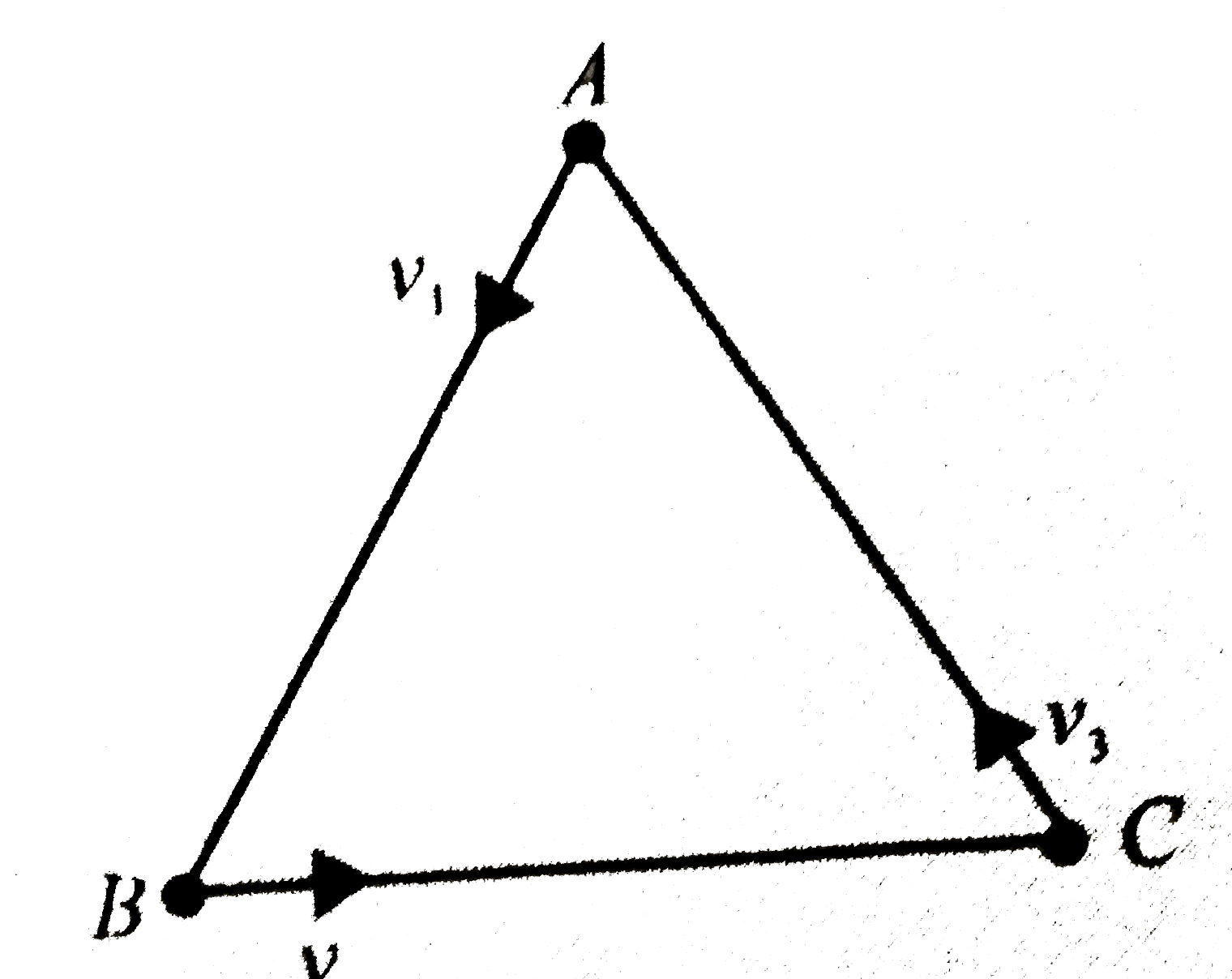
Let there are three equal masses situated at the vertices of an equilateral triangle, as shown in Fig. Now particle `A` starts with a velocity `v_(1)` towards line `AB`, particle `B` starts with the velocity `v_(2)`, towards line `BC` and particle `C` starts with velocity `v_(3)` towards line `CA`. Find the displacement of the centre of mass of the three particles `A, B` and `C` after time `t`. What would it be if `v_(1)=v_(2)=v_(3)`?

A

zero

B

`(v_(1)+v_(2)+v_(3))/3t`

C

`(v_(1)+(sqrt(3))/2v_(2)+v_(3)/2)/3 t`

D

`(v_(1)+v_(2)+v_(3))/4 t`

Text Solution

Verified by Experts

The correct Answer is:

A

Using `vecv_(CM)=hativ_(x)+hatjv_(y)`
where `v_(x)=(mv_((x)_(1))+mv_((x)_(2))+mv_((x)_(2)))/(3m)=0`
`v_(y)=(mv_(y_1)+mv_(y_2)=mv_(x_3))/(3m)=0`
net velocity of zero (using vector theory) i.e. `CM` is at rest. So, displcement of `CM` of zero. So choices `b, c` and `d` are wrong.
Promotional Banner

Topper's Solved these Questions

  • CENTRE OF MASS

    CENGAGE PHYSICS ENGLISH|Exercise Multiple Correct|25 Videos
  • CENTRE OF MASS

    CENGAGE PHYSICS ENGLISH|Exercise Assertion - Reasoning|2 Videos
  • CENTRE OF MASS

    CENGAGE PHYSICS ENGLISH|Exercise Subjective|23 Videos
  • CALORIMETRY

    CENGAGE PHYSICS ENGLISH|Exercise Solved Example|13 Videos
  • DIMENSIONS & MEASUREMENT

    CENGAGE PHYSICS ENGLISH|Exercise Integer|2 Videos

Similar Questions

Explore conceptually related problems

Three particles A, B, Care located at the comers of an equilateral triangle as shown in figure. Each of the particle is moving with velocity v. Then at the instant shown, the relative angular velocity of

Two identical particles move towards each other with velocity 2v and v, respectively. The velocity of the centre of mass is:

A car is moving with velocity vec v_(c) towards north and a train is moving towards east with velocity vec v_(t) . Find the direction of relative velocity of car with respect to train.

Thre identical masses are kept at the corners of an equilateral triangle ABC. A moves towards B with a velocity V, B moves towards C with velocity V, and C moves towards A with same velocity V. Then the velocity of centre of mass of the system of particles is

The velocity-time graph of a particle moving in a staight line is shown in the . Find the displacement and the distance trav elled by the particle in 6 s . .

Three particles A, B and C are situated at the vertices of an equilateral triangle ABC of side d at time t=0. Each of the particles moves with constant speed v. A always has its velocity along AB, B along BC and C along CA. At what time will the particles meet each other?

Three particles A, B and C are situated at the vertices of an equilateral triangle ABC of side d at time t=0. Each of the particles moves with constant speed v. A always has its velocity along AB, B along BC and C along CA. At what time will the particles meet each other?

A particle moves with initial velocity v_(0) and retardation alphav , where v is velocity at any instant t. Then the particle

The acceleration-time graph of a particle moving along x-axis is shown in the figure. If the particle starts with velocity 3 m/s at t = 0, find the velocity of particle at t = 4 s.

The acceleration-time (a-t) graph of a particle moving along straight line is as shown in figure. The time at which velocity of particle becomes equal to its initial velocity is

CENGAGE PHYSICS ENGLISH-CENTRE OF MASS-Single Correct
  1. A particle of mass m is moving along the x-axis with speed v when It c...

    Text Solution

    |

  2. A particle of mass m is acted on by two forces of equal magnitude F ma...

    Text Solution

    |

  3. Let there are three equal masses situated at the vertices of an equila...

    Text Solution

    |

  4. A ball is projected in a direction inclined to the vertical and bounce...

    Text Solution

    |

  5. In the figure shown, the heavy ball of mass 2m, rests on the horizonta...

    Text Solution

    |

  6. In the figure shown, the cart of mass 6m is initially at rest. A parti...

    Text Solution

    |

  7. Two identical particles collide in air inelastically. One moves horizo...

    Text Solution

    |

  8. A particle at rest is constrained to move on a smooth horizontal surfa...

    Text Solution

    |

  9. A stationary body explodes in to four identical fragments such that th...

    Text Solution

    |

  10. Shown in the figure is a system of three particles of mass 1 kg, 2 kg ...

    Text Solution

    |

  11. A ping-pong ball of mass m is floating in air by a jet of water emergi...

    Text Solution

    |

  12. A body of mass 1 kg, initially at rest, explodes and breaks into three...

    Text Solution

    |

  13. A block m(1) strikes a stationary block m(3) inelastically. Another bl...

    Text Solution

    |

  14. A ball collides with an inclined plane of inclination theta after fall...

    Text Solution

    |

  15. A particle loses 25% of its energy during collision with another ident...

    Text Solution

    |

  16. A body of mass 3 kg collides elastically with another body at rest and...

    Text Solution

    |

  17. A glass ball collides with a smooth horizontal surface (xz plane) with...

    Text Solution

    |

  18. A mass m(1) moves with a great velocity. It strikes another mass m(2) ...

    Text Solution

    |

  19. A body is hanging from a rigid support. by an inextensible string of l...

    Text Solution

    |

  20. A steel ball of mass 0.5 kg is fastened to a cord 20 cm long and fixed...

    Text Solution

    |
