
Home
Class 11
PHYSICS
A rod of length l is moving in a vertica...

A rod of length `l` is moving in a vertical plane (`x-y`) when the lowest point `A` of the rod is moved with a velocity `v`. find the a angular velocity of the rod and `b` velocity of the end `B`.

Text Solution

Verified by Experts
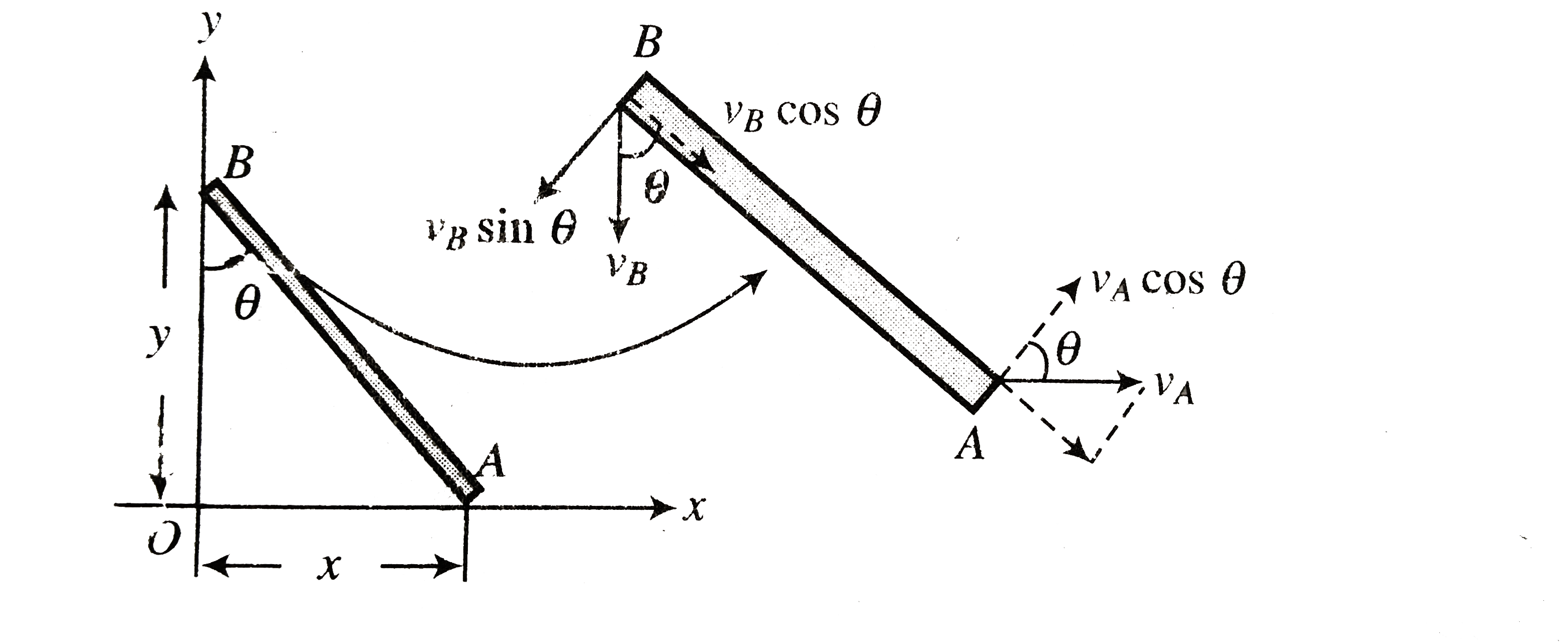
Since the rod is rigid, thecomponents of `v_(A)` and `v_(B)` along the rod are equal. Thus,

`v_(B)costheta=v_(A)sintheta=vsintheta`
`implies v_(B)=vtantheta`…………i
Then `omega_(BA)=v_(BA)/l=(v_(BA_(_|_)))/l`
`=(|v_(A)costheta-(-v_(B)sintheta)|)/l`
`(v_(A)costheta+v_(B)sintheta)/l`............ii
Using eqn i and ii `omega_(BA)=v/(lcostheta)`
Promotional Banner

Topper's Solved these Questions

  • RIGID BODY DYNAMICS 1

    CENGAGE PHYSICS ENGLISH|Exercise Solved Examples|9 Videos
  • RIGID BODY DYNAMICS 1

    CENGAGE PHYSICS ENGLISH|Exercise Exercise 2.1|6 Videos
  • PROPERTIES OF SOLIDS AND FLUIDS

    CENGAGE PHYSICS ENGLISH|Exercise INTEGER_TYPE|2 Videos
  • RIGID BODY DYNAMICS 2

    CENGAGE PHYSICS ENGLISH|Exercise Interger|2 Videos

Similar Questions

Explore conceptually related problems

A uniform rod of length l is spinning with an angular velocity omega=2v/l while its centre of mass moves with a velocity v . Find the velocity of the end of the rod.

In the figure shown, the instantaneous speed of end A of the rod is v to the left. The angular velocity of the rod of length L must be

Figure shows a rod of length l resting on a wall and the floor. Its lower end A is pulled towards left with a constant velocity v. Find the velocity of the other end B downward when the rod makes an angle theta with the horizontal.

A uniform rod of mass m=2 kg and length l is kept on a smooth horizontal plane. If the ends A and B of the rod move with speeds v and 2v respectively perpendicular to the rod, find the: a. angulr velocity of CM of the rod. b. Kinetic energy of the rod (in Joule).

A rod of length l is placed perpendicular to a long wire carrying current i . The rod is moved parallel to the wire with a velocity v . Find the emf induced in the rod, if its nearest end is at a distance a from the wire.

A rod of length l is placed perpendicular to a long wire carrying current i . The rod is moved parallel to the wire with a velocity v . Find the emf induced in the rod, if its nearest end is at a distance a from the wire.

The instaneous velocity of point B of the given rod of length 0.5 is 3m/s in the represented direction. The angualr velocity of the rod for minimum velocity of end A is

A rod of mass M and length L is falling vertically with speed v . Suddenly its one end gets stuck in a friciitonless hook. Find the angular velocity of the rod just after its end gets struck.

A rod AB length 5 m which remains in vertical plane has its ends A and B constrained to remain contact with a horizontal floor and a vertical wall respectively. Determine the velocity of the end B and angular velocity at the position shown in Fig. , if the point A has a velocity of 3ms^(1) rightward.

The magnetic field in a region is given by vec B = (B_0)/(L)y hatk where L is a fixed length. A conducting rod of length L lies along the Y - axis between the origin and the point (0,L, 0). If the rod moves with a velocity v= v_0 hati , find the EMF induced between the ends of the rod.

