
Home
Class 11
PHYSICS
Find the instantneous axis of rotation o...

Find the instantneous axis of rotation of a rod length `l` when its end `A` moves with a velocity `vecv_(A)=Vi` and the rod rotates with an angular velocity `vecomega=-v/(2l)hatk`.

Text Solution

Verified by Experts
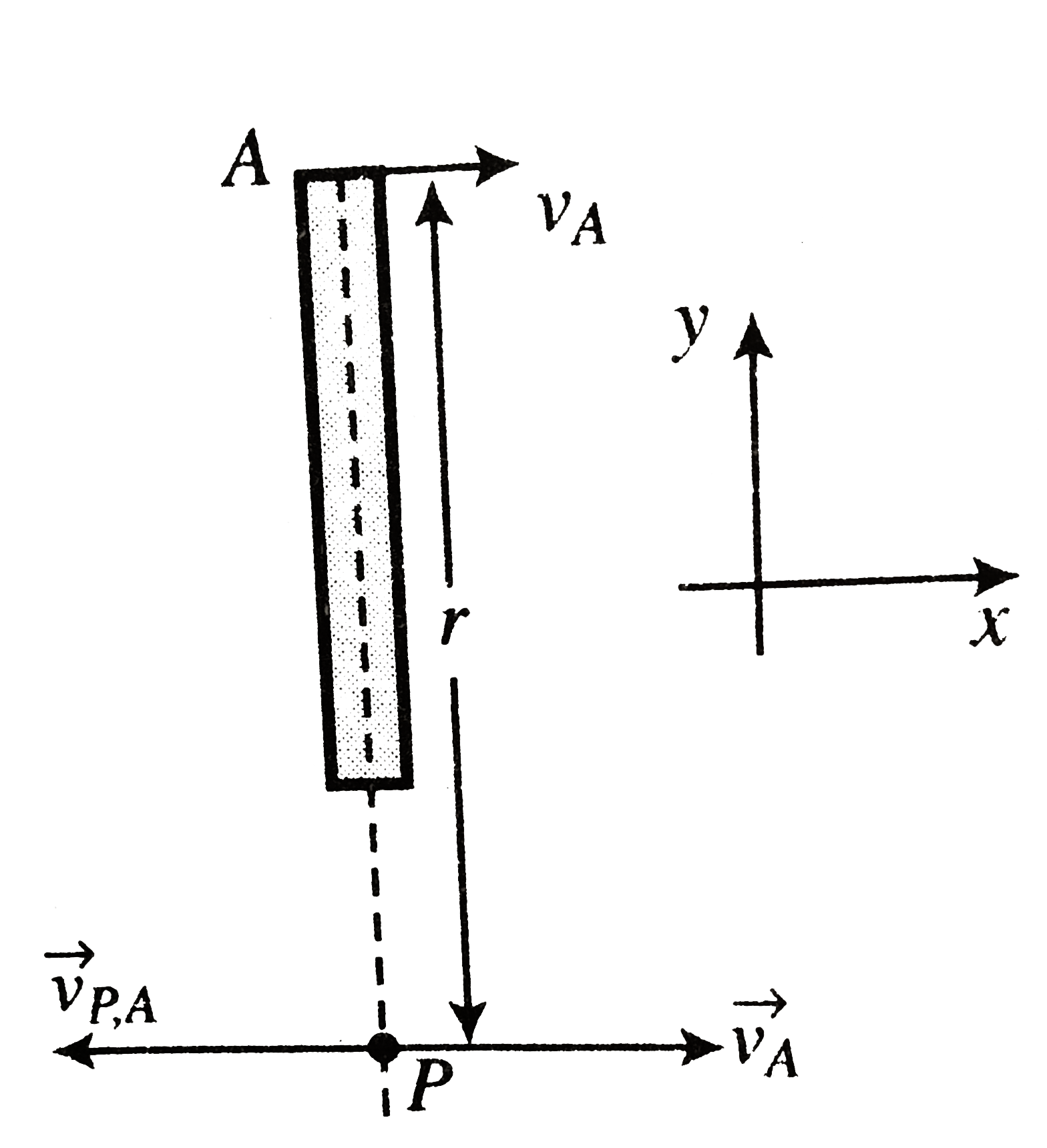
Let us choose the point `P` as `ICR` in the extended rod. We can say `ICR` is a point of zero velocity. So we can write
`vecv_(P)=vecv_(P,A)+vecv_(A)`
we have `vecv_(P)=0`
Hence `vecv_(P,A)=vecv_(A)=0`

Here `vec_(A)=vhati` and `vecv_(P,A)=-omegahati`
Hence `-omegarhati+vhati=0`
`implies v=omegar`
or `r=v/omega=v/((v/2l))=2l`
Hence `ICR` will be located at a distance `2l` from `A`.
Method 2
The instantaneous centre of rotation will be lie on the perpendicular line at point `A` with `vecv_(A)`.
The `ICR` will lie at distance `AP+(|vecv_(A)|)/omega=v/(v/2l)=2l`
or at a distance `2l` from point `A`.
Promotional Banner

Topper's Solved these Questions

  • RIGID BODY DYNAMICS 1

    CENGAGE PHYSICS ENGLISH|Exercise Solved Examples|9 Videos
  • RIGID BODY DYNAMICS 1

    CENGAGE PHYSICS ENGLISH|Exercise Exercise 2.1|6 Videos
  • PROPERTIES OF SOLIDS AND FLUIDS

    CENGAGE PHYSICS ENGLISH|Exercise INTEGER_TYPE|2 Videos
  • RIGID BODY DYNAMICS 2

    CENGAGE PHYSICS ENGLISH|Exercise Interger|2 Videos

Similar Questions

Explore conceptually related problems

If the rod were translating as well as rotating, what will be its emf? Assume that the centre of mass has a velocity v and the rod is rotating with an angular velocity omega atout its centre of mass.

A rod is rotating with angular velocity omega about axis AB. Find costheta .

A homogeneous rod AB of length L = 1.8 m and mass M is pivoted at the center O in such a way that it can rotate it can rotate freely position. An insect S of the same mass M falls vertically with speed V on the point C, midway between the points O and B. Immediately after falling, the insect moves towards the end B such that the rod rotates with a constant angular velocity omega. (a) Determine the angular velocity omega in terms of V and L. (b) If the insect reaches the end B when the rod has turned through an angle of 90^@ , determine V.

The linear velocity of rotating body is given by vecv = vecomega xx vecr where vecomega is the angular velocity and vecr is the radius vector. The angular velocity of body vecomega = hati - 2hatj + 2hatk and this radius vector vecr = 4hatj - 3hatk , then |vecv| is

A conducting rod of length 1 is moving on a horizontal smooth surface. Magnetic field in the region is vertically downward and magnitude B_(0) . If centre of mass (COM) of the rod is translating with velocity v_(0) and rod rotates about COM with angular velocity v_(0)//l , then potential difference between points O and A will be

A rod of length l is pivoted smoothly at O is resting on a block of height h . If the block moves with a constant velocity V , pick the correct alternatives about angular velocity of rod :

A rod AB of length 2m moves in horizontal x-y plane. At any instant end a of the rod is at origin and has velocity vecv_(A)=2hati+v_(y)hatj . The other end B at the same instant is moving with velocity vecv_(B)=3hati+6hatj . The rod makes an angle of 30^(@) with the x- axis at this instant (see figure) The magnitude of angular velocity of the rod is

A rod of length l is moving in a vertical plane ( x-y ) when the lowest point A of the rod is moved with a velocity v . find the a angular velocity of the rod and b velocity of the end B .

In the figure shown, the instantaneous speed of end A of the rod is v to the left. The angular velocity of the rod of length L must be

A uniform rod AB of mass m and length L rotates about a fixed vertical axis making a constant angle theta with it as shown in figure. The rod is rotated about this axis, so that point B the free end of the rod moves with a uniform speed V in the horizontal plane then the angular momentum of the rod about the axis is:

