Home
Class 11
PHYSICS
Two small kids weighing 10 kg and 15 kg ...

Two small kids weighing 10 kg and 15 kg respectively are trying to balance a seesaw of total length 5.0 with the fulcrum at the centre. If one of the kids is sitting at an end where should the other sit?

Text Solution

Verified by Experts
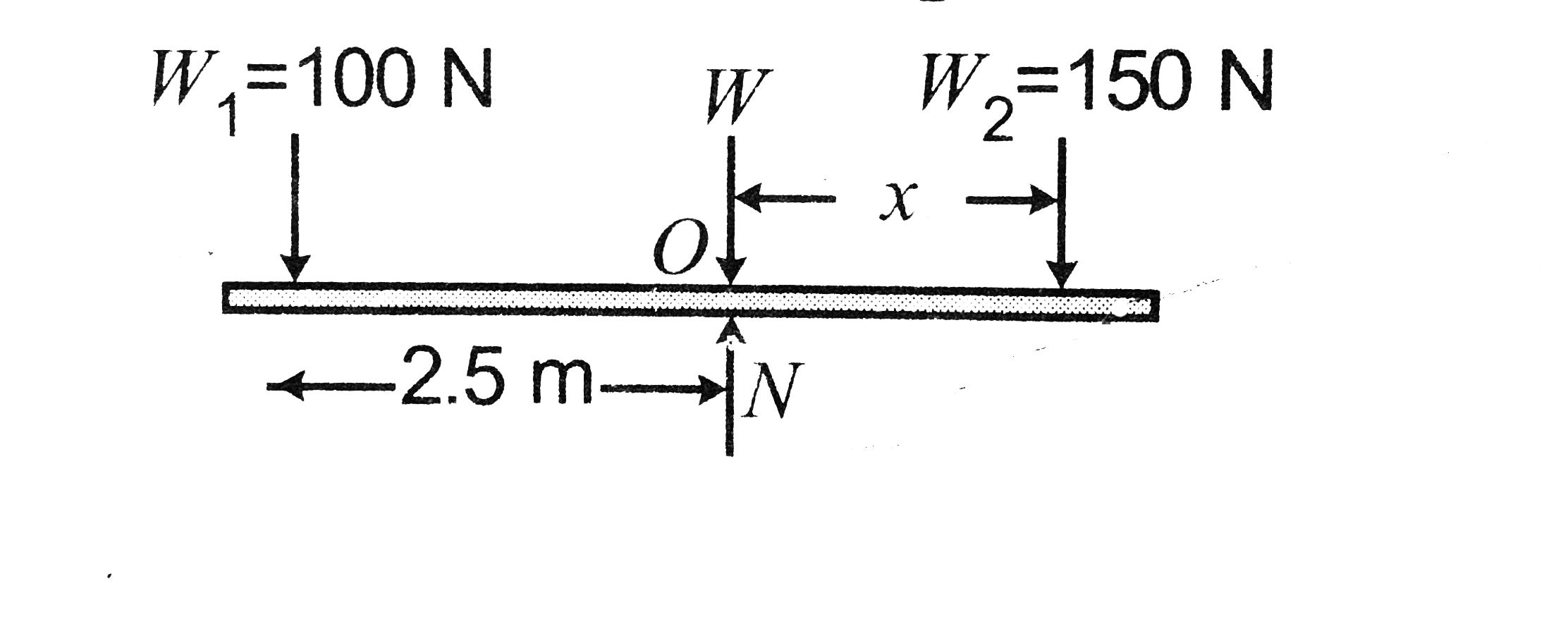
If the kid of mass `15 kg` sit at the end, he will produce maximum torque about fulcrum.

The seesaw will not be balance for any position of kid of mass `10 kg`. It is clear that the `10 kg` kid should sit at the end the `15 kg` kid should sit closer to the centre. suppose his distance from the centre is `x`. As the kids are in equilibrium,the normal force between a kid and the see saw equals the weight of that kid. consider the rotational equilibrium add to zero. the forces are as follows:
a. `(15 kg)g=150N` downwards by the `15 kg` kid,
b. `(10 kg)=g=100 N` downwards by the `10 kg` kid,
c. weight of the seesaw, and
d. the normal force by the fulcrum
Taking torques about the fulcrum.
`150xxx=100xx2.5` or `x=1.7m`
Promotional Banner

Topper's Solved these Questions

  • RIGID BODY DYNAMICS 1

    CENGAGE PHYSICS ENGLISH|Exercise Solved Examples|9 Videos
  • RIGID BODY DYNAMICS 1

    CENGAGE PHYSICS ENGLISH|Exercise Exercise 2.1|6 Videos
  • PROPERTIES OF SOLIDS AND FLUIDS

    CENGAGE PHYSICS ENGLISH|Exercise INTEGER_TYPE|2 Videos
  • RIGID BODY DYNAMICS 2

    CENGAGE PHYSICS ENGLISH|Exercise Interger|2 Videos

Similar Questions

Explore conceptually related problems

Two persons A and B of weight 80 kg and 50 kg respectively are standing at opposite ends of a boat of mass 70 kg and length 2 m at rest. When they interchange their positions then displacement of the centre of mass of the boat will be :-

Two particles of mass 5 kg and 10 kg respectively are attached to the twoends of a rigid rod of length 1 m with negligible mass. the centre of mass of the system from the 5 kg particle is nearly at a distance of :

Two persons of masses 55 kg and 65 kg respectively are at the opposite ends of a boat. The length of the boat is 3.0 m and weights 100 kg . The 55 kg man walks up to the 65 kg man and sits with him. If the boat is in still water the centre of mass of the system shifts by.

Two persons of masses 55 kg and 65 kg respectively are at the opposite ends of a boat. The length of the boat is 3.0 m and weights 100 kg . The 55 kg man walks up to the 65 kg man and sits with him. If the boat is in still water the centre of mass of the system shifts by.

Two blocks of masses 2 kg and 1 kg respectively are tied to the ends of a string which passes over a light frictionless pulley . The masses are held at rest at the same horizontal level and then released . The distance traversed by centre of mass in 2 s is ( g = 10 m//s^(2) )

Two bodies of masses 0.5 kg and 1 kg are lying in the X-Y plane at points (-1, 2) and (3, 4) respectively. Locate the centre of mass of the system.

Two masses A and B of 10 kg and 5 kg , respectively , are connected with a string passing over a frictionless pulley fixed at the corner of a table as shown. The coefficient of static friction between A and the table is 0.2 . The minimum mass C that should be placed on A to prevent it from moving is equal to

Two masses A and B of 10 kg and 5 kg , respectively , are connected with a string passing over a frictionless pulley fixed at the corner of a table as shown. The coefficient of static friction between A and the table is 0.2 . The minimum mass C that should be placed on A to prevent it from moving is equal to

Two masses A and B of 10 kg and 5 kg respectively are connected with a string passing over a frictionless pulley fixed at the corner of a table as shown in Fig. 15.4.1. The co-efficient of friction of A with the table is 0.2 The minimum mass of C that may by placed on A to prevent it from moving is equal to

Two uniform thin rods A and B of length 0.6 m each and of masses 0.01 kg and 0.02kg respectively are rigidly joined end to end. The combination is pivoted at the lighter end, P as shown in fig. Such that it can freely rotate about point P in a vertical plane. A small object of mass 0.05kg, moving horizontally, hits the lower end of the combination and sticks to it what should be the velocity of the object so that the system could just be reised to the horizontal position.

