Home
Class 11
PHYSICS
A rod AB rests with the end A on rough h...

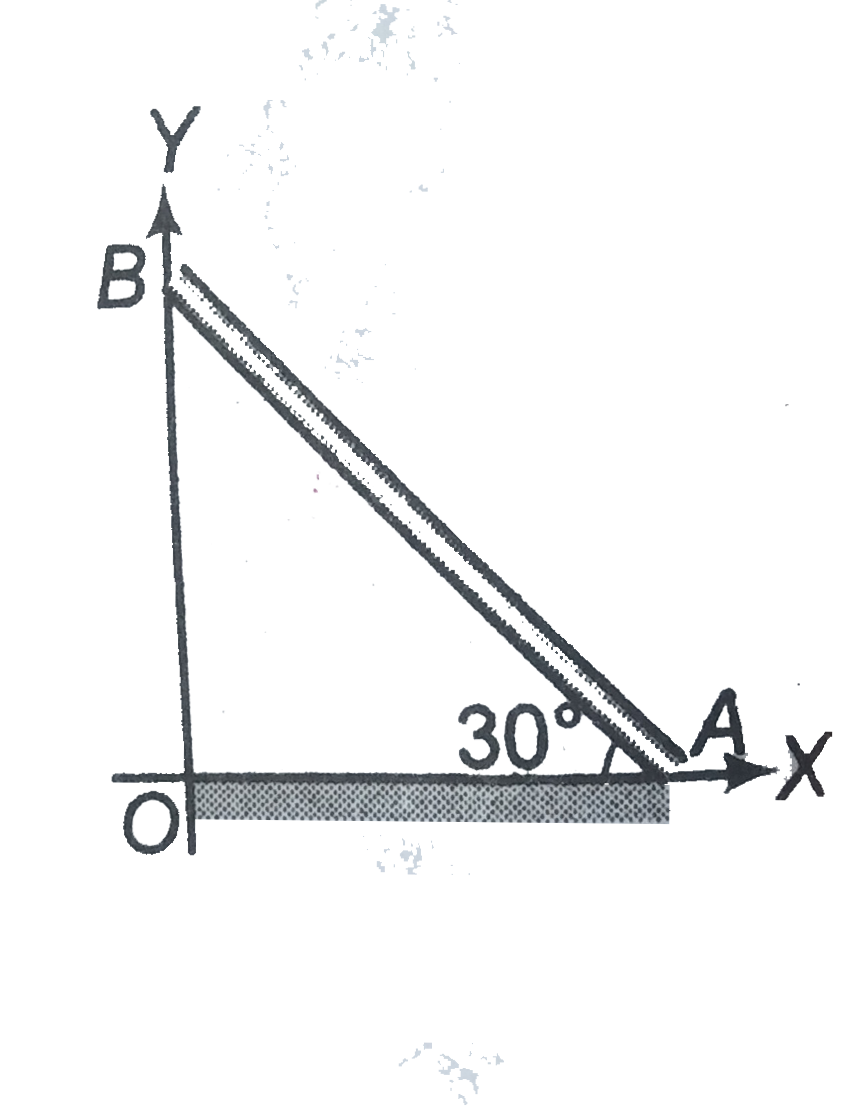
`A` rod `AB` rests with the end `A` on rough horizontal ground and the end `B` against a smooth vertical wall. The rod is uniform and of weight w. If the rod is in equilibrium in the position shown in figure.Find
(a)frictional force shown at `A`
(b) normal reaction at `A`
(c) normal reaction at `B`.

Text Solution

Verified by Experts
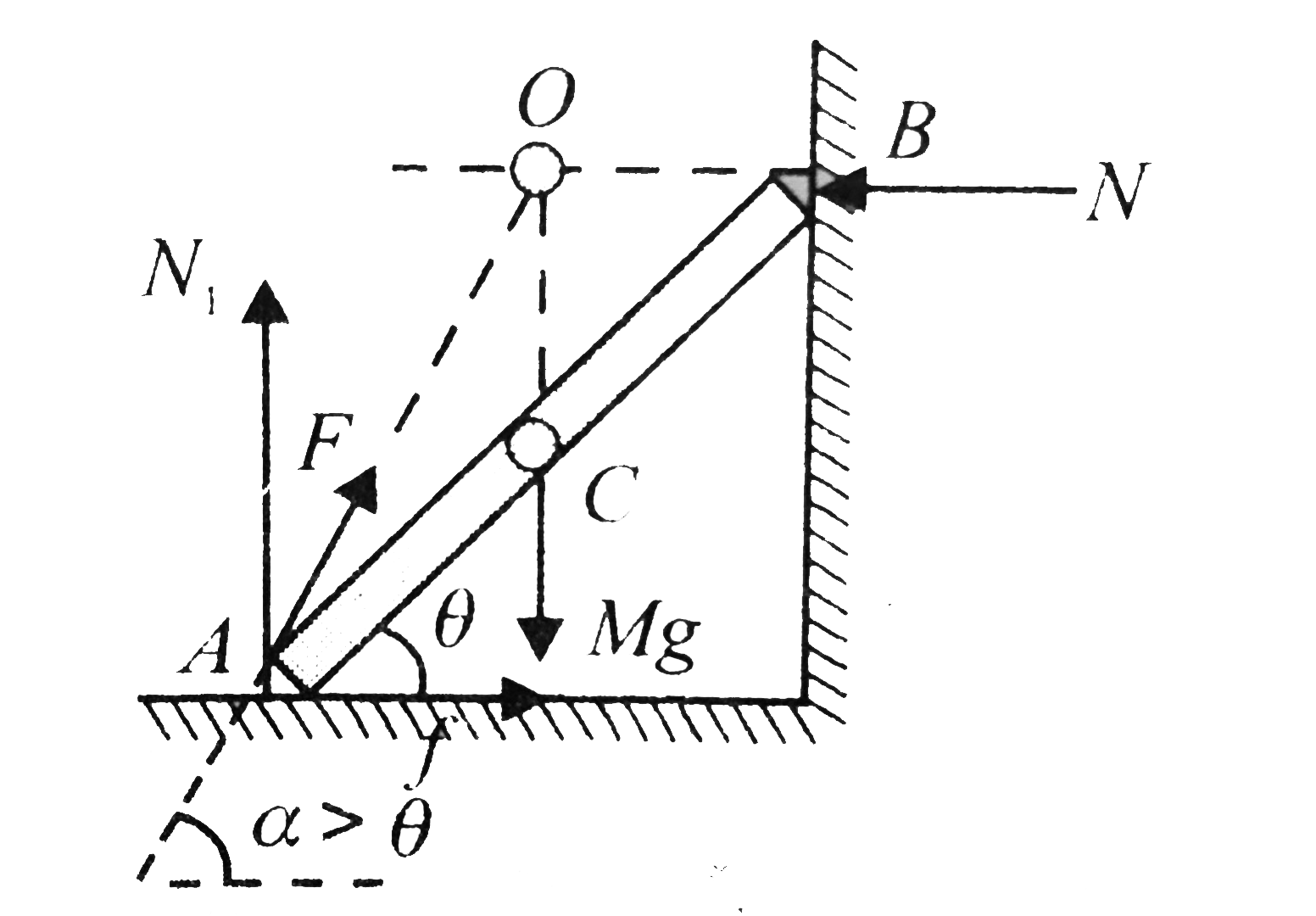
a. The free body digram of the ladder is shown in figure.
Note that all the three forces acting on the ladder have to pas through a common point `O`, otherwise it cannot be in equilibrium.

The total reactiion force `F` from the horizontal surface is inclined at an angle `alpha(gttheta)` to the horizontal. The horizontal component of this force is friction force and its vertical component is the normal reaction applied by the ground on the ladder.
b. Applying the conditions of equilibrium, we get
`SigmaF_(x)=0implies-N=0`
`implies f=N` ............i
`Sigma F_(y)=0impliesN_(1)-Mg=0`
`implies N_(1)=Mg`...........ii
Taking torque about centre of the rod `C, Sigmatau_(C)=0`
`(N_(1))L/2costheta-(f)L/2sintheta-NL/2sintheta=0`.......iii
Substituting the value of `N_(1)` and from eqs i and ii in eqn iii we get
`MgL/2costheta-NLsintheta=0`
`N=(Mg)/(2tantheta)=1/2mgcottheta=f`........iv
Thus, the net force applied by ground on the ladder is
`F=sqrt(N_(1)^(2)+f^(2))`
`F=1/2Mgsqrt(4+cot^(2)theta)`
Alternative method:
As ladder is in equilibrium, the net torques about `A` will be zero. `sum tau_(A)=0` taking torque about end `A` of the rod.
`Mg(L/2costheta)-N(Lsintheta)=0`
`N=(Mg)/(2tantheta)=f`
It is the same result as we get by taking torque about `C`.
Promotional Banner

Topper's Solved these Questions

  • RIGID BODY DYNAMICS 1

    CENGAGE PHYSICS ENGLISH|Exercise Solved Examples|9 Videos
  • RIGID BODY DYNAMICS 1

    CENGAGE PHYSICS ENGLISH|Exercise Exercise 2.1|6 Videos
  • PROPERTIES OF SOLIDS AND FLUIDS

    CENGAGE PHYSICS ENGLISH|Exercise INTEGER_TYPE|2 Videos
  • RIGID BODY DYNAMICS 2

    CENGAGE PHYSICS ENGLISH|Exercise Interger|2 Videos

Similar Questions

Explore conceptually related problems

A rod AB rests with the end A on rough horizontal ground and the end B against a smooth vertical wall. The rod is uniform and of weight w. If the rod is in equilibrium in the position shown in figure.Find (a)frictional shown at A (b) normal reaction at A (c) normal reaction at B .

A uniform ladder of mass 10 kg leans against a smooth vertical wall making an angle of 53^0 with it. The other end rests on a rough horizontal floor. Find the normal force and the frictional force that the floor exerts on the ladder

A rod bent at right angle along its centre line is placed on a rough horizontal fixed cylinder of radius R as shown in the figure. Mass of the rod is 2m and the rod is in equilibrimu. Assume that the friction force on rod at A and B is equal in magnitude.

A uniform rod AB hinged about a fixed point P is initially vertical. A rod is released from vertical position. When rod is in horizontal position: The acceleration of end B of the rod is

A rod of length I leans by its upper end against a smooth vertical wall, while its other end leans against the floor. The end that leans against the wall moves uniformly downward. Then:

A wire is bent an an angle theta . A rod of mass m can slide along the bended wire without friction as shown in Fig. A soap film is maintained in the frame kept in a vertical position and the rod is in equilibrium as shown in the figure. If rod is displaced slightly in vertical direction, then the time period of small oscillation of the rod is

A rod AB of mass M and length L is shown in figure. End A of rod is hinged and end B is lying on the ground. Find the Normal reaction by ground on the rod

A thin, uniform rod with negligible mass and length 0.200m is attached to the floor by a frictionless hinge at point P (as shown in fig) A horizontal spring with force constant k=4.80Nm^-1 connects the other end of the rod to a vertical wall. The rod to a vertical wall. The rod is in a uniform magnetic field B=0.340T directed into the plane of the figure. There is current I=6.50 A in the rod, in the direction shown. Calculate the torque due to the magnetic force on the rod, for an axis at P.

A uniform rod of length L pivoted at the bottom of a pond of depth L//2 stays in stable equilibrium as shown in the figure. Find the force acting at the pivoted end of the rod in terms of mass m of the rod.

A rod of mass m and length L is hinged at its top end. If the rod is in equilibrium making an angle of 30^(@) with the vertical when a horizontal force F is applied as shown in figure, then the value of F is:

