Home
Class 11
PHYSICS
A horizontal force F is applied to a hom...

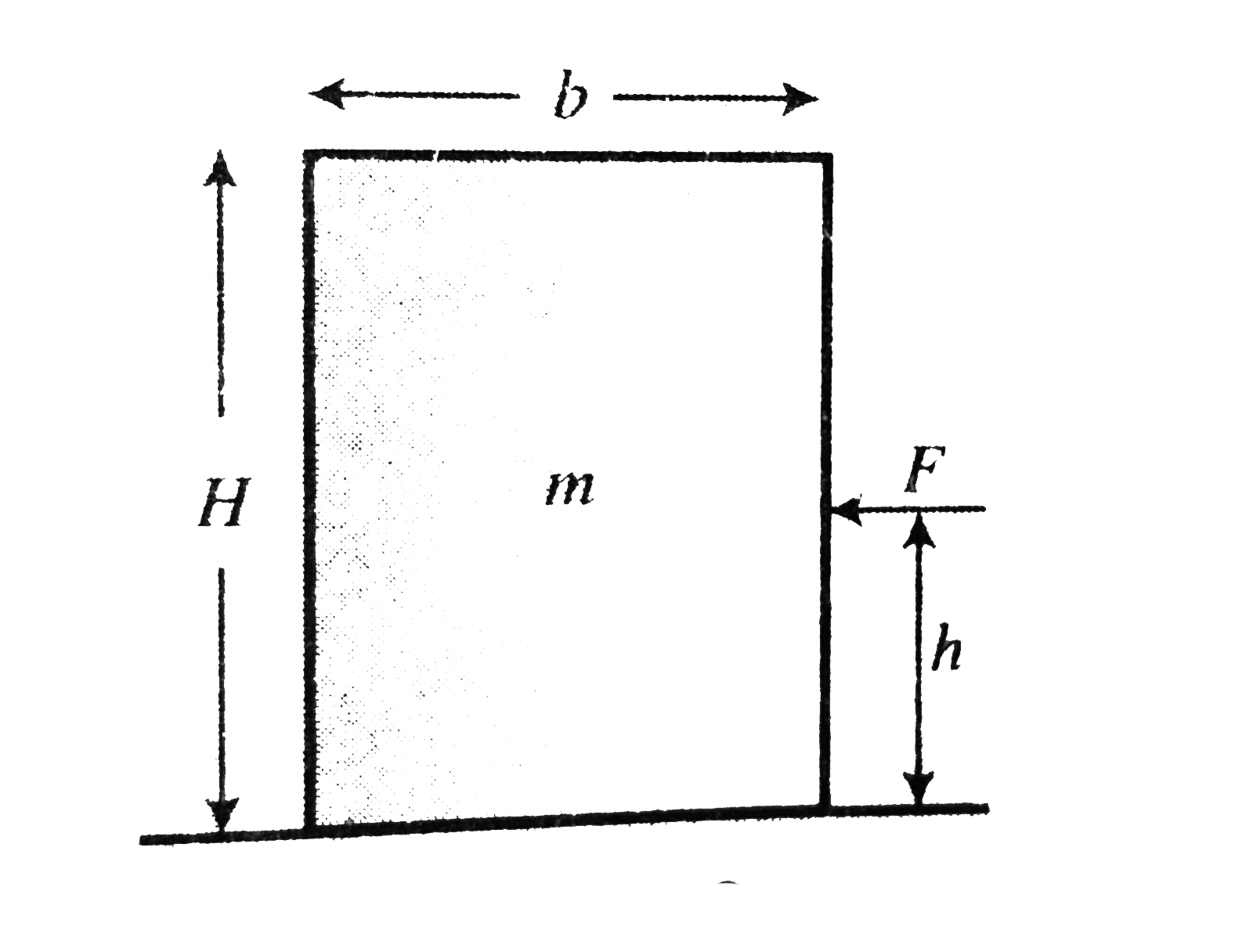
A horizontal force `F` is applied to a homogeneous rectangular block of mass `m`, width `b` and height `H`. The block moves with constant velocity, the coefficient of friction is `mu_(k)`.
a. What is the greater height `h` at which the force `F` can be applied so that the block will slide without tipping over ?

b. Through which point on the bottom face of the block will the resultant of the friction and normal forces act if `h=H//2?`
c. If the block is at rest and coefficient of static friction is `mu_(s)` what are the various criteria for which sliding or tipping occurs?

Text Solution

Verified by Experts
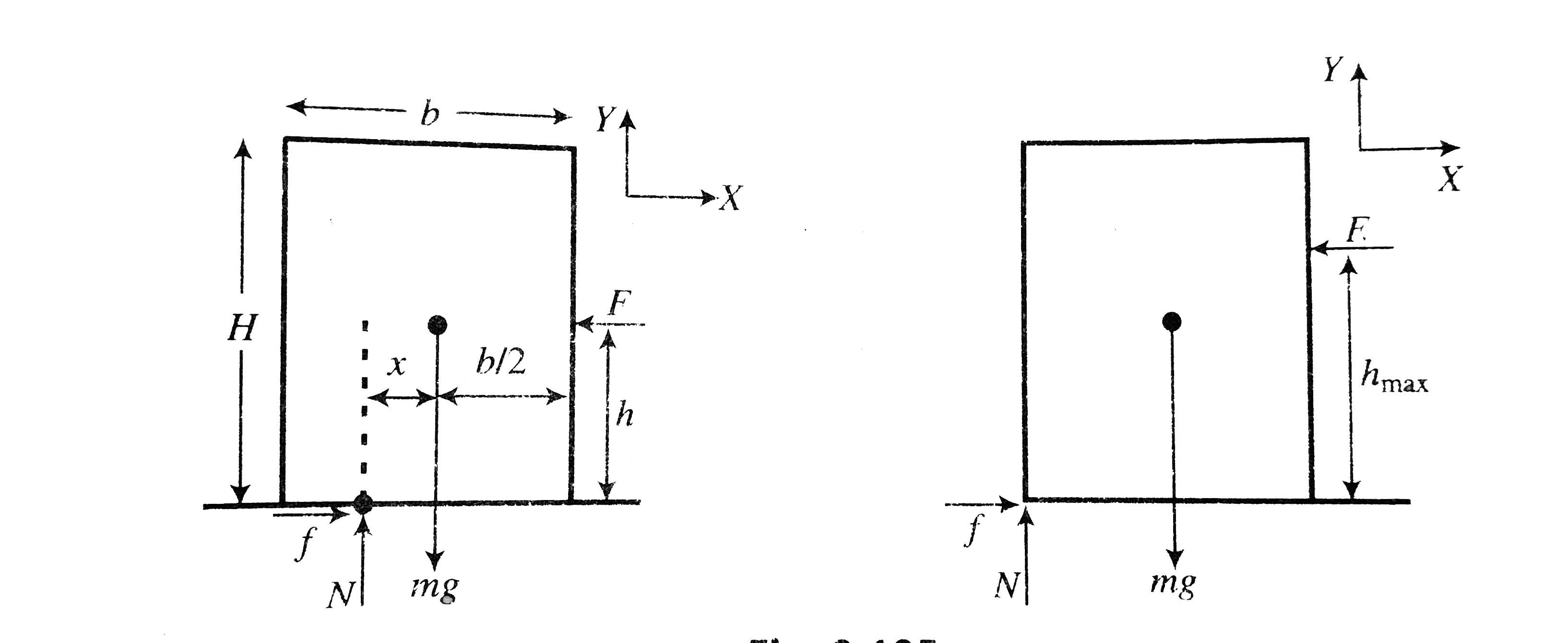
a. In the absence of any external force in horizontal direction the normal reaction `N` passes through the centre of mass of the block, when force `F` is applied, normal reaction shifts in the direction of applied force `F`.

Since right part of body is having tendency to lift from surface, at the instant of tipping over about the edge the normal reaction passes through edge. from the conditionns of equilibrium.
In horizontal directionn `f=F=mu_(k)mg`
In vertical direction `N=mg`
Balancing torque about edge `Fh-mgb/2`
or `h=(mgb)/(2F)=(mgb)/(2mu_(k)mg)=b/(2mu_(k))`
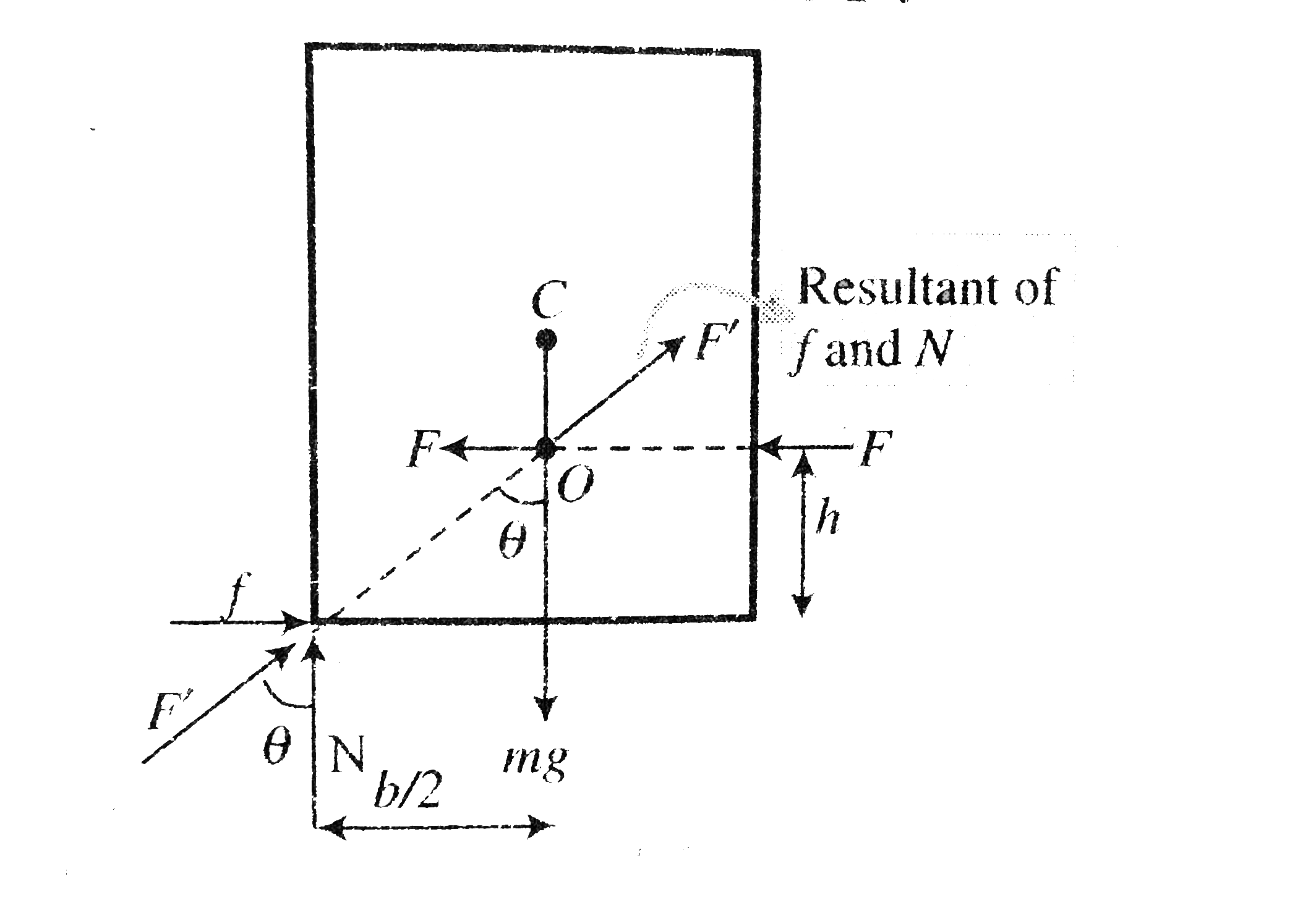
We can solve the problems by another approach also as the resultant of friction force `(mu_(k)N)` and the normal reactiong must pass through the same point through which `F` passes, since three coplanar forces keeping a body inequilibrium pass through a common point i.e. they should be concurrent.
From Lami's theorem.
`F'/(sin90^@)=F/(sin(180^@+theta))=(mg)/(sin(90^@+theta))`
`implies F/(sintheta)=(mg)/(costheta)` or `tan theta=F/(mg)=(mu_(k)mg)/(mg)=mu_(k)`
From figure it is clear `tan theta=(mu_(k)N)/N=(b/2)/h`
or `(b/2)/h=mu_(k)impliesh=b/(2mu_(k))`
b. In this case we cannot take normal reaction at the edge.

Let normal reaction acts at a distance `x` from the line of action of `mg`.
Torque of all the forces about `C` must be zero.
`(mu_(k)NxxH/2)=N_(x)`
`x=(mu_(k)H)/2`
Alternately we can proceed as in part a. Resultant of `mu_(k)N,N` passes through `C` the interaction of `F` and `mg`.
Therefore from geometry of the figure.
`x/(H/2)=tantheta=mu_(k),x=(mu_(k)H)/2`
c. As the point of application of force is raised higher, the location of the line of action of the normal reaction `N` moves to the let. In the limiting case (when the block is about to tip over ), `x=b//2`. the normal reaction passes through edge as shown in figure.

Initial toppling torque about edge:
`Fh_(max)=mgb/2` or `h_(max)=(mgb)/(2F)`........i
For initial sliding in horizontal direction `F=muN` In vertical direction `N=mg`
Hence, `F=mumg`......ii
If sliding and tipping are equally likely to occur, we can elimiate `F` from eqn i and ii to get `h_(max)=b/(2mu)`
which is independent of weight `mg` height `H` of the body and applied force `F`.
Promotional Banner

Topper's Solved these Questions

  • RIGID BODY DYNAMICS 1

    CENGAGE PHYSICS ENGLISH|Exercise Solved Examples|9 Videos
  • RIGID BODY DYNAMICS 1

    CENGAGE PHYSICS ENGLISH|Exercise Exercise 2.1|6 Videos
  • PROPERTIES OF SOLIDS AND FLUIDS

    CENGAGE PHYSICS ENGLISH|Exercise INTEGER_TYPE|2 Videos
  • RIGID BODY DYNAMICS 2

    CENGAGE PHYSICS ENGLISH|Exercise Interger|2 Videos

Similar Questions

Explore conceptually related problems

A tall block of mass M=50kg and base width b=1 m and height h=3 m is kept on rough inclined surface with coefficient of friction mu=0.8 as shown in figure. The angle of inclination with the horizontal is 37^@ . Determine whether the block slides down or topples over.

A block is sliding on a rough horizontal surface. If the contact force on the block is sqrt2 times the frictional force, the coefficient of friction is

A horizontal force F is applied at the top of an equilateral triangular block having mass m . The minimum coefficient of friction required to topple the block before translation will be

In given diagram what is the minimum value of a horizontal external force F on block A so that block B will slide on ground is .

In given diagram what is the minimum value of a horizontal external force F on block A so that block B will slide on ground is .

A varying horizontal force F = at act on a block of mass m kept on a smooth horizontal surface An identical block is kept on the first block. The coefficient of friction between the blocks is mu . The time after which the relative sliding between the blocks prevails is

force F is applied at the topmost point of block of mass M. The force required to topple the block before sliding is (µ = coefficient of friction)

Determine the maximum ratio h//b for which the homogenous block will side without tipping under the actionof force P . The coefficient of static friction between the block and the incline is mu_(s) .

A horizontal force of 20 N is applied to a block of mass 4 kg resting on a rough horizontal table. If the block does not move on the table, how much frictional force the table is applying on the block. What can be said about the coefficient of static friction between the block and the table? Take g=10m/s^2 .

A block of mass 2 kg is kept on a rough horizontal floor an pulled with a force F. If the coefficient of friction is 0.5. then the minimum force required to move the block is :-