Home
Class 11
PHYSICS
In figure calculate the linear accelerat...

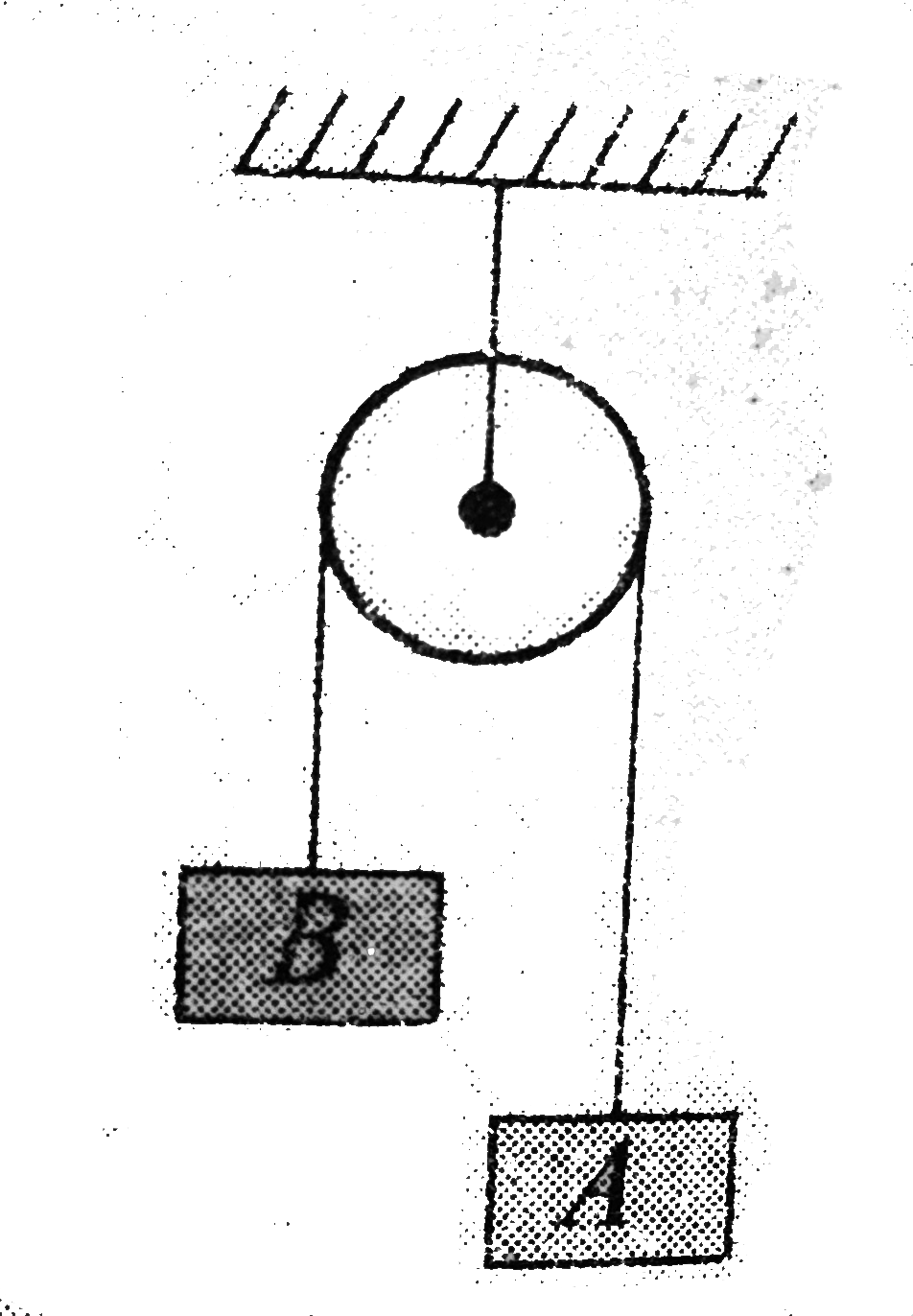
In figure calculate the linear acceleration of the blocks.
Mass of block `B= 8kg`
mass of disc shaped pulley `=2kg` (take `g=10m//s^(2)`)

Text Solution

Verified by Experts
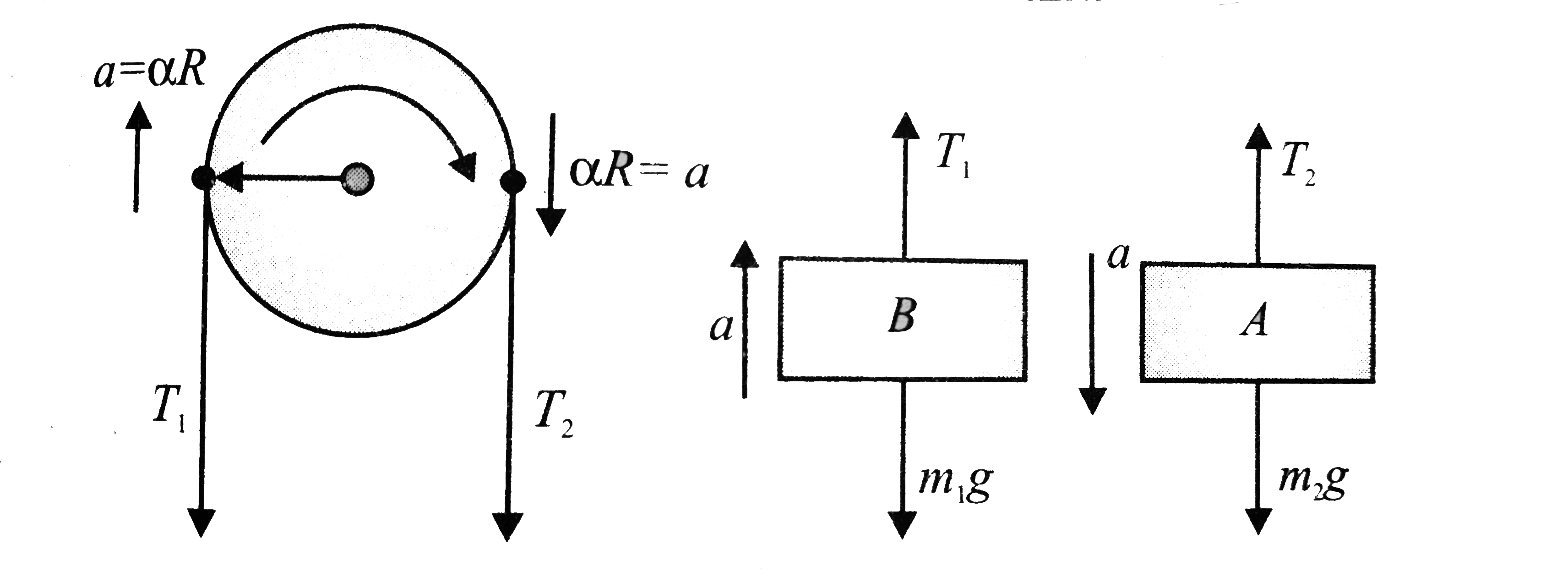
Let `R` on the radius of the pulley and `T_(1)` and `T_(2)` be the tension in the left and right portions of the string Unlike laws of motion where tension in striln is the same on both the sides of the pulley. In this case, the string does not slide and the pulley rotates. the tensions on both the sides of the pulley will be different. this This different tensions will provide angular acceleration to pulley.

Let `m_(1)=8kg, m_(2)=10 kg, M=2kg`
Let `a` be the acceleration of blocks.
for the blocks (linear motion)
`T_(1)-m_(1)g=m_(1)a`.......i
`m_(2)g-T_(2)=m_(2)a`...........ii
For the pulley (rotation)
Net torque `tau_(net)=Ialpha`
`T_(1)R-T_(1)R=1/2MR^(2)alpha`
The linear acceleration of the blocks is the same as the tangetial acceleration of any point on the circumference of the pulley which is `Ralpha`.
`a=Ralpha`
Dividing eqn iii by `R` and addinng to eqn i and ii we get
`m_(2)g-m_(1)g=m_(2)a+m_(1)a+M/2Ralphaimplies m_(2)g-m_(1)g`
`=(m_(2)=m_(1)+M/2)a`
`a=(m_(2)-m_(1))/(m_(2)+m_(1)+M/2g) =((10-8)g)/(10+8+2/2)=20/19m//s^(2)`
Promotional Banner

Topper's Solved these Questions

  • RIGID BODY DYNAMICS 1

    CENGAGE PHYSICS ENGLISH|Exercise Solved Examples|9 Videos
  • RIGID BODY DYNAMICS 1

    CENGAGE PHYSICS ENGLISH|Exercise Exercise 2.1|6 Videos
  • PROPERTIES OF SOLIDS AND FLUIDS

    CENGAGE PHYSICS ENGLISH|Exercise INTEGER_TYPE|2 Videos
  • RIGID BODY DYNAMICS 2

    CENGAGE PHYSICS ENGLISH|Exercise Interger|2 Videos

Similar Questions

Explore conceptually related problems

The acceleration of the 10 kg mass block shown in the figure is : -

A block of mass 8 kg is sliding on a surface inclined at an angle of 45^(@) with the horizontal. Calculate the acceleration of the block. The coefficient of friction between the block and surface is 0.6. (Take g=10m//s^(2) )

A block of mass 8 kg is sliding on a surface inclined at an angle of 45^(@) with the horizontal . Calculate the acceleration of the block . The coefficient of friction between the block and surface is 0*6 ( Take g = 10 m//s^(2) )

Two blocks 'A' and 'B' having masses m_(A) and m_(a) , respectively are connectd by an arrangement shown in the figure. Calculate the downward acceleration of the block B. Assume the pulleys to be massless. Under what condition will block A have downward acceleration?

The magnitudes of accelerations of blocks of mass 2 kg and 4 kg are respectively . ( Pulleys and threads are massless) ( g = 10 m//s^(2 )

A block B is pulled by a force of 18 N applied to a light pulley as shown in the figure. If the coefficient of friction is 0.4 and the acceleration of the block is 0.5 ms^(-2) , the mass of the block is (g = 10 m//s^2)

Find the acceleration of the two blocks shown in figure-2.101.Take g=10m/s2

A 2 kg block A is attached to one end of a light string that passes over an an ideal pulley and a 1 kg sleeve B slides down the other part of the string with an acceleration of 5m//s^(2) with respect to the string. Find the acceleration of the block, acceleration of sleeve and tension in the steing. [g=10m//s^(2)]

The elevator shown in figure is descending with an acceleration of 2m/s^2 . The mass of the block A is 0.5 kg. What force is exerted by the block A on the block B?

A wooden block of mass 1kg and density 800 Kg m^(-3) is held stationery, with the help of a string, in a container filled with water of density 1000 kg m^(-3) as shown in the figure. If the container is moved upwards with an acceleration of 2 m s^(-2) , then the tension in the string will be ( take g=10ms^(-2) )

