Home
Class 11
PHYSICS
In figure mass m(1) slides without frict...

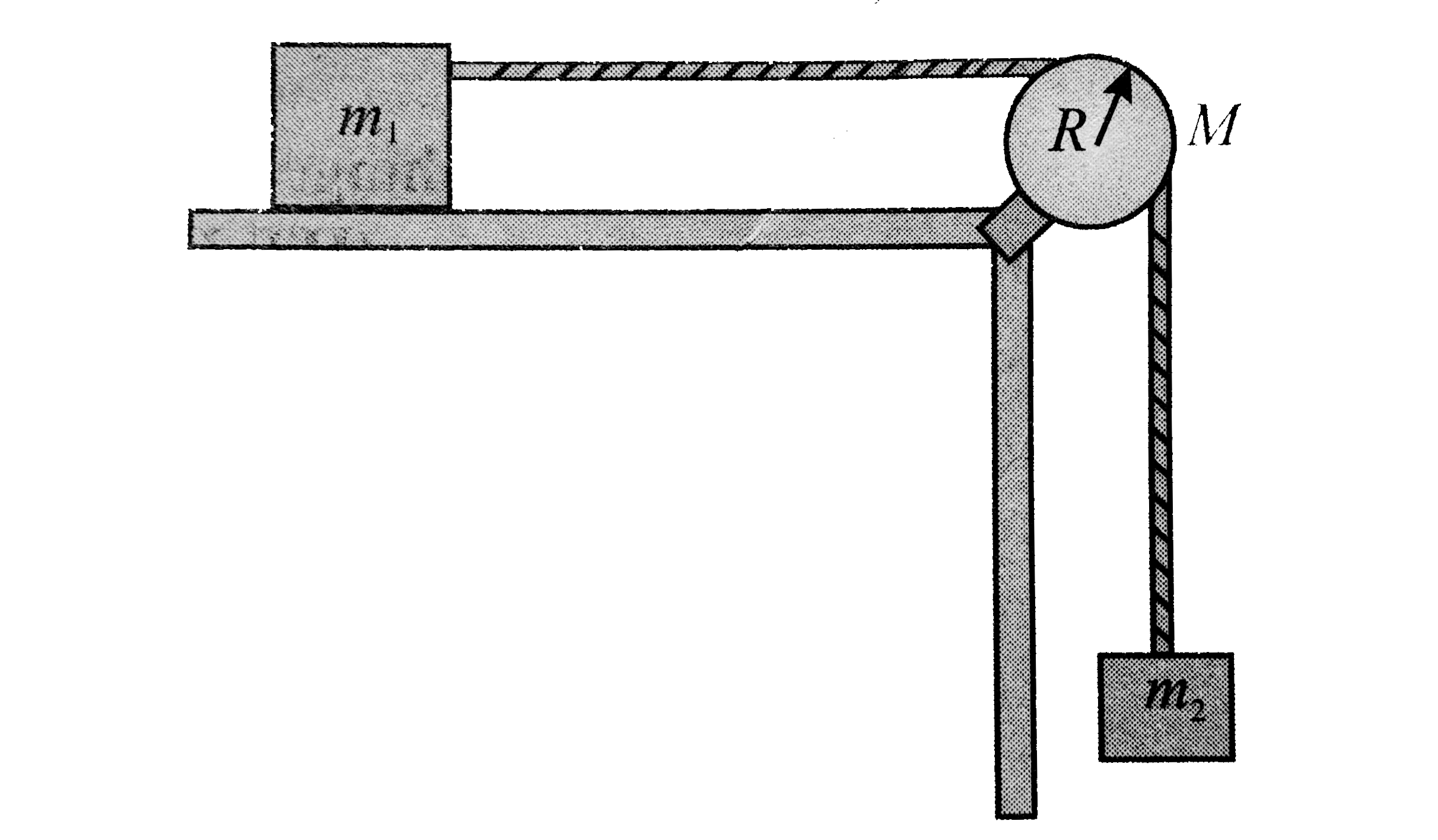
In figure mass `m_(1)` slides without friction on the horizontal surface, the frictionless pulley is in the form of a cylinder of mass `M` and radius `R`, and a string turns the pulley without slipping. Find the acceleration of each mass, and tension in each part of the string.

Text Solution

Verified by Experts

Through this illustration we will learn the application of torque equation and constraint relation in more complex case here. We have change the block with cylinder `M_(2)` Pulley `M_(1)` will have oly pure rotation while cylinder `M_(2)` will have rotatioin and translation combined. Let us analyse step by step in the same way as the previous illustration.
Step I: Analyse the motion of the pulley and the cyinder. Pulley: One rotational acceleration `alpha_(1)` (clockwise)
Cylinder: One rotational acceleration `alpha_(2)` (clockwise) andn a linear acceleration `a_(2)` (downward)
Step II: Equation of motion for `M_(2)`
`M_(2)g-T=M_(2)a_(2)` ..........i
Step III: Torque equation for pulley `tau_(c)=I_(c)alpha`
`TR=((M_(1)R^(2))/2)alpha_(1)implies(2T)/(M_(1)R)`.......ii
Torquue equation for the cylinder (about centre of mass of cylinder `tau_(c)=I_(c)alpha`
`implies TR=((M_(2)R^(2))/2)alpha_(2)`
`alpha_(2)=(2T)/(M_(2)R)`.........iii
Step IV: The acceleration of `P` and `Q` should be equal as both are connected with the same inextensible string ltbr. Accceleration of `P, a_(M)=alpha_(1)R` (downward) .........iv
Acceleration of `Q, a_(N)=a_(2)-alpha_(2)R` (downwards) .............. v
Hence, constraint relation `alpha_(1)R=a_(2)-alpha_(2)R` .............vi
Step V: Solving equations
After solving eqn i, ii, iii and iv, we get
` a_(2)=[((2M_(1)+M_(2)))/(3M_(1)+2M_(2))]g`
Promotional Banner

Topper's Solved these Questions

  • RIGID BODY DYNAMICS 1

    CENGAGE PHYSICS ENGLISH|Exercise Solved Examples|9 Videos
  • RIGID BODY DYNAMICS 1

    CENGAGE PHYSICS ENGLISH|Exercise Exercise 2.1|6 Videos
  • PROPERTIES OF SOLIDS AND FLUIDS

    CENGAGE PHYSICS ENGLISH|Exercise INTEGER_TYPE|2 Videos
  • RIGID BODY DYNAMICS 2

    CENGAGE PHYSICS ENGLISH|Exercise Interger|2 Videos

Similar Questions

Explore conceptually related problems

Consider the situation shown in the figure. The surface is smooth and the string and the pulley are light. Find the acceleration of each block and tension in the string.

A solid cylinder of mass M and radius R rolls without slipping on a flat horizontal surface. Its moment of inertia about the line of contact is

If the string & all the pulleys are ideal, acceleration of mass m is :-

A string is wrapped around a cylinder of mass M and radius R . The string is pulled vertically upwards to prevent the centre of mass from falling as the cylinder unwinds the string. The tension in the string is

A mass M is hung with a light inextensible string as shown in Find the tension in the horizontal part of the string .

A load of mass m is attached to the end of a string wound on a cylinder of mass M and radius R . The string passes round a pulley. a. Find the acceleration of the cylinder M when it rolls. b. If the coefficient of friction is mu . Find the accelerative of the cylinder when it slips and rolls. c. Find the minimum value of coefficient of friction for which the cylinder rolls always

A block of mass m is attached at the end of an inextensible string which is wound over a rough pulley of mass M and radius R figure a. Assume the string does not slide over the pulley. Find the acceleration of the block when released.

A mas m hangs with help of a string wraped around a pulley on a frictionless bearling. The pulley has mass m and radius R. Assuming pulley to be a perfect uniform circular disc, the acceleration of the mass m, if the string does not slip on the pulley, is:

The pulley A and C are fixed while the pulley B is movable. A mass M_2 is attached to pulley B , while the string has masses M_1 and M_3 at the two ends. Find the acceleration of each mass .

A block of mass m_(1) rests on a horizontal table. A string tied to the block is passed on a frictionless pulley fixed at the end of the table and to the other end of string is hung another block of mass m_(2) . The acceleration of the system is
