Home
Class 11
PHYSICS
Find the position of instantaneous centr...

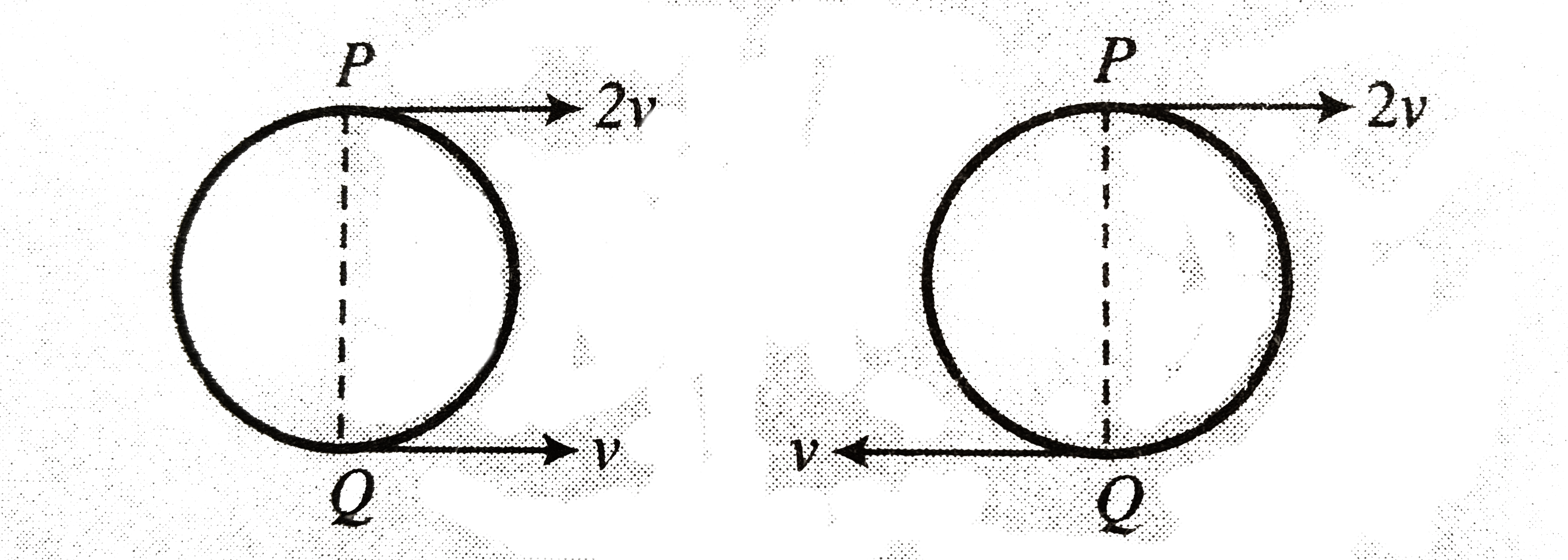
Find the position of instantaneous centre of rotation and angular velocity of the disc in the following cases as shown. Radius of disc is `R` in each case.

Text Solution

Verified by Experts
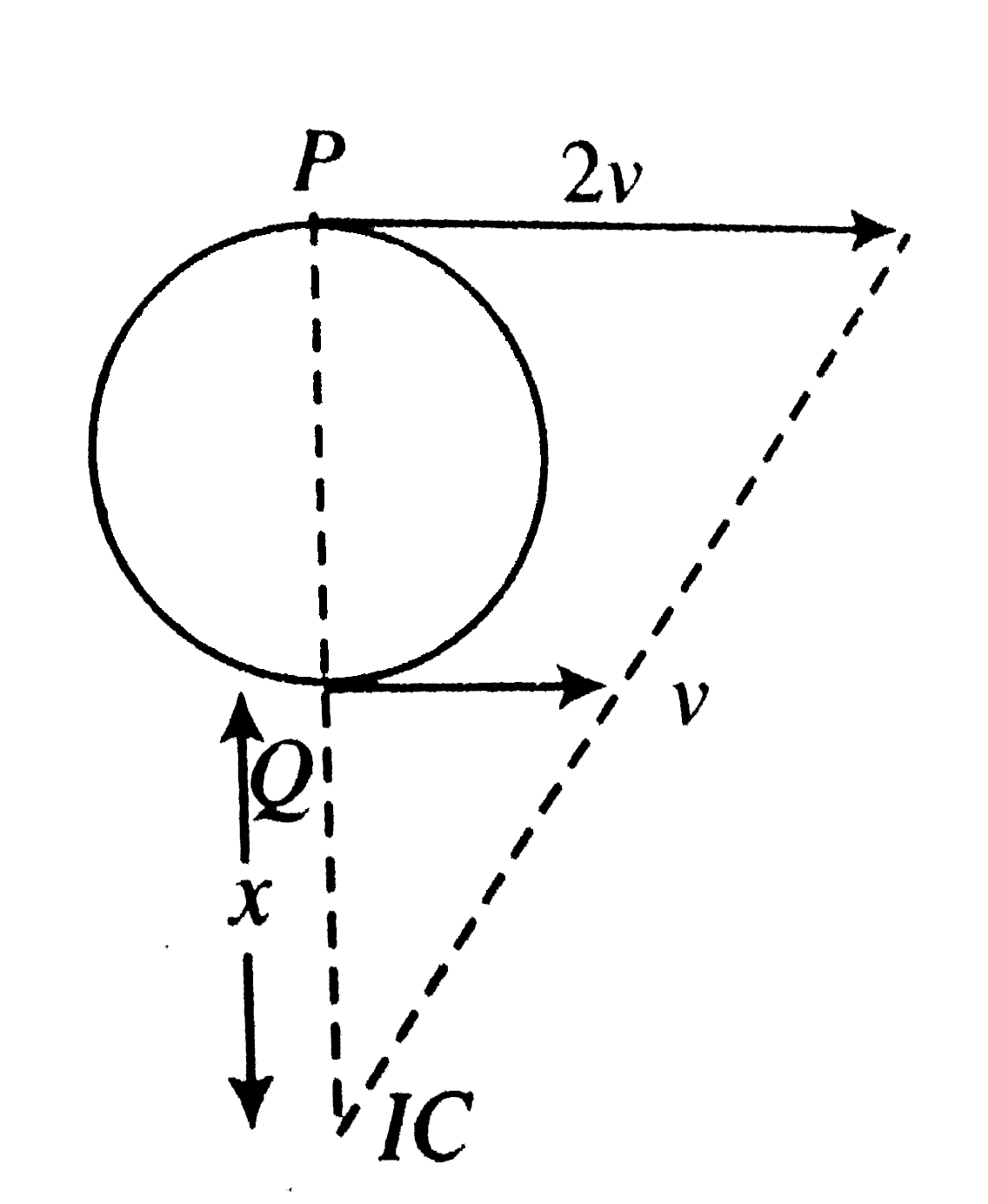
a. `(v_(P))/(v_(Q))=(2R+x)/x`
`=(2v)/v=(2R+x)/x x x`
`implies2x=2R+x:. x=2R`
`:. Omega=v_Q/x=v/(2R)`
`b. v_P/v_Q=(2R-x)/x`
`(2v)/v=(2R-x)/x`
`:. x=2R//3` and `omega=(v_(Q))/x=(3v)/(2R)`

Promotional Banner

Topper's Solved these Questions

  • RIGID BODY DYNAMICS 1

    CENGAGE PHYSICS ENGLISH|Exercise Exercise 2.2|17 Videos
  • RIGID BODY DYNAMICS 1

    CENGAGE PHYSICS ENGLISH|Exercise Exercise 2.3|15 Videos
  • RIGID BODY DYNAMICS 1

    CENGAGE PHYSICS ENGLISH|Exercise Solved Examples|9 Videos
  • PROPERTIES OF SOLIDS AND FLUIDS

    CENGAGE PHYSICS ENGLISH|Exercise INTEGER_TYPE|2 Videos
  • RIGID BODY DYNAMICS 2

    CENGAGE PHYSICS ENGLISH|Exercise Interger|2 Videos

Similar Questions

Explore conceptually related problems

When a disc rotates with uniform angular velocity, which of the following is not true ?

When a disc rotates with uniform angular velocity, which of the following is not true ?

A rotating disc moves in the positive direction of the x-axis. Find the equation y(x) describing the position of the instantaneous axis of rotation if at the initial moment of the centre c of the disc was located at the point O after which it moved with constant velocity v while the disc started rotating counterclockwise with a constant angular acceleration alpha . the initial angular velocity is equal to zero.

A disc is rotating with angular velocity omega . If a child sits on it, what is conserved?

Find the ratio of magnetic dipole moment and magnetic field at the centre of a disc. Radius of disc is R and it is rotating at constant angular speed o about its axis. The disc is insulating and uniformly charged

Find the position of center of mass of the uniform lamina shown in figure, if small disc of radius alpha/2 is cut from disc of radius a.

A disc shaped body (having a hole shown in the figure) of mass m=10kg and radius R=10/9m is performing pure rolling motion on a rough horizontal surface. In the figure point O is geometrical center of the disc and at this instant the centre of mass C of the disc is at same horizontal level with O . The radius of gyration of the disc about an axis pasing through C and perpendicular to the plane of the disc is R/2 and at the insant shown the angular velocity of the disc is omega=sqrt(g/R) rad/sec in clockwise sence. g is gravitation acceleration =10m//s^(2) . Find angular acceleation alpha ( in rad//s^(2) ) of the disc at this instant.

Two discs of radii R and 2R are pressed against each other. Initially, disc with radius R is rotating with angular velocity omega and other disc is stationary. Both discs are hinged at their respective centres and are free to rotate about them. Moment of inertia of smaller disc is I and of bigger disc is 2I about their respective axis of rotation. Find the angular velocity of bigger disc after long time.

A thin uniform circular disc of mass M and radius R is rotating in a horizontal plane about an axis passing through its centre and perpendicular to its plane with an angular velocity omega . Another disc of same dimensions but of mass (1)/(4) M is placed gently on the first disc co-axially. The angular velocity of the system is

A charge Q is uniformly distributed over the surface of non - conducting disc of radius R . The disc rotates about an axis perpendicular to its plane and passing through its centre with an angular to its plane and passing through its centre of the disc. If we keep both the amount of charge placed on the disc and its angular velocity to be constant and vary the radius of the disc then the variation of the magnetic induction at the centre of the disc will br represented by the figure: