Home
Class 11
PHYSICS
A rotating disc moves in the positive di...


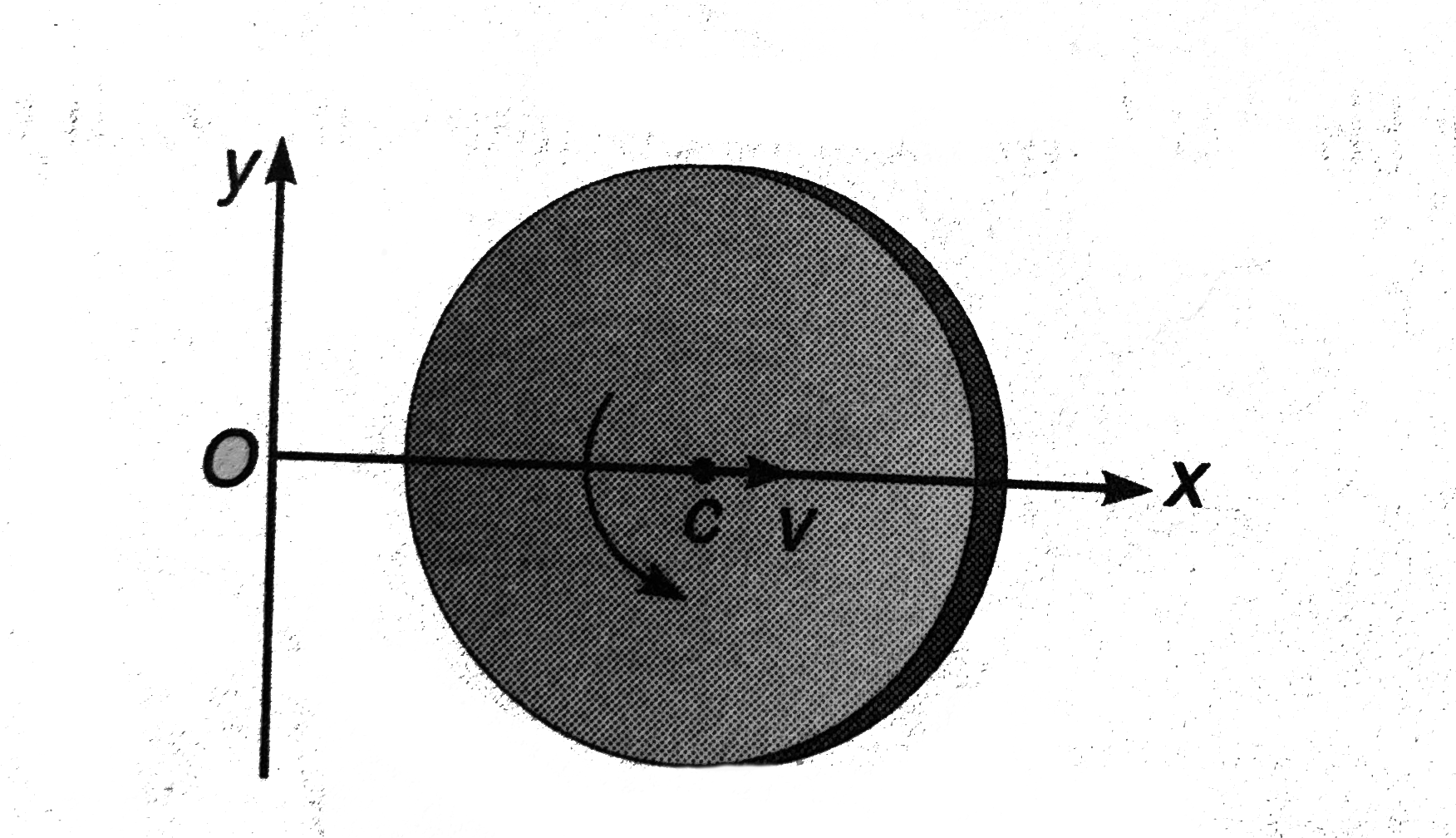
A rotating disc moves in the positive direction of the x-axis. Find the equation `y(x)` describing the position of the instantaneous axis of rotation if at the initial moment of the centre `c` of the disc was located at the point O after which it moved with constant velocity v while the disc started rotating counterclockwise with a constant angular acceleration `alpha`. the initial angular velocity is equal to zero.

Text Solution

Verified by Experts
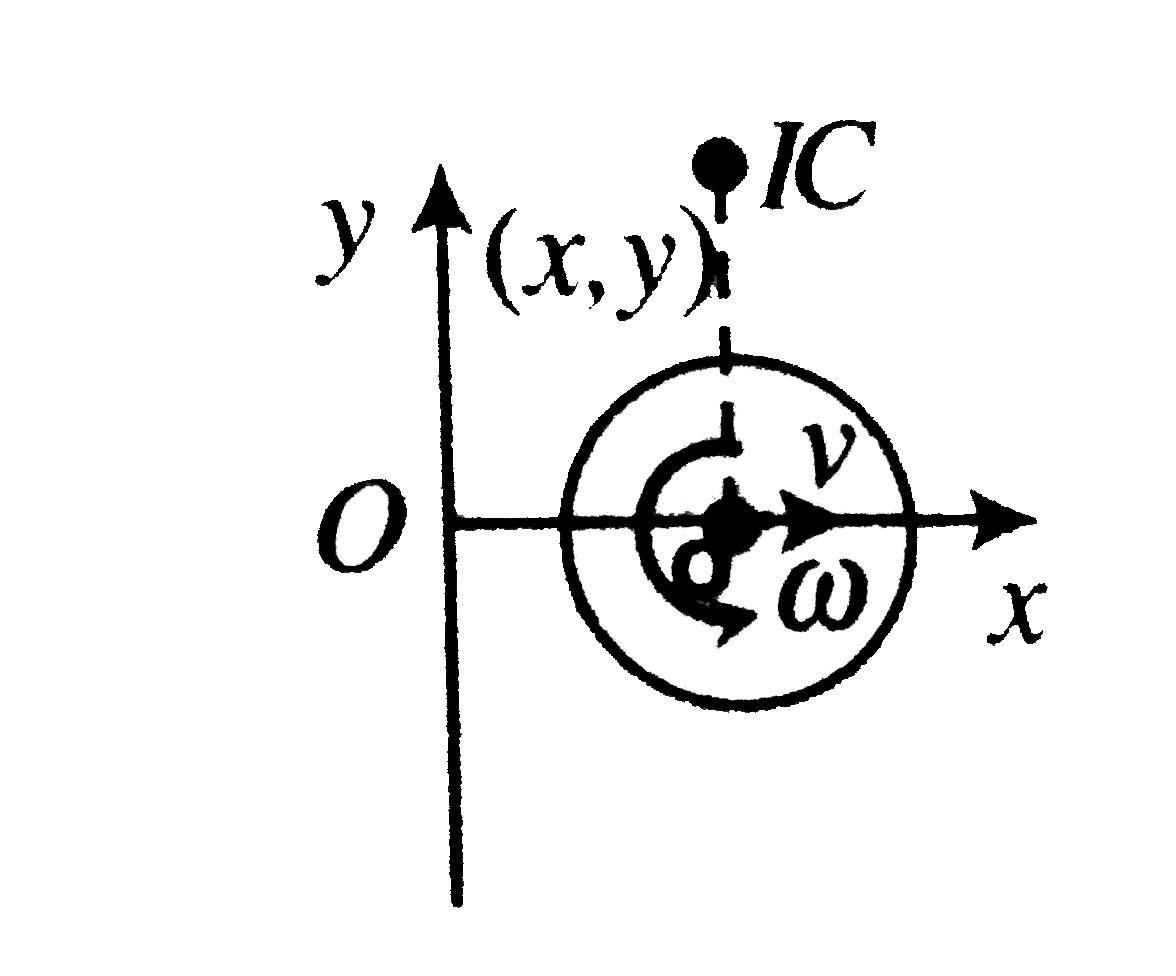
Let the coordinate of instantaneous centre of rotation at any time `t` be (x,y).
Now, `v=omegay`
`sqrt(2ax)=omegay`
`:. y^2=((2a)/omega^(2))x(parabola)`
b. `v=omegay`
`v=(ax y)/v`
`:. xy=(v^(2))/alpha=` constant (rectangular hyperbola)
Promotional Banner

Topper's Solved these Questions

  • RIGID BODY DYNAMICS 1

    CENGAGE PHYSICS ENGLISH|Exercise Exercise 2.2|17 Videos
  • RIGID BODY DYNAMICS 1

    CENGAGE PHYSICS ENGLISH|Exercise Exercise 2.3|15 Videos
  • RIGID BODY DYNAMICS 1

    CENGAGE PHYSICS ENGLISH|Exercise Solved Examples|9 Videos
  • PROPERTIES OF SOLIDS AND FLUIDS

    CENGAGE PHYSICS ENGLISH|Exercise INTEGER_TYPE|2 Videos
  • RIGID BODY DYNAMICS 2

    CENGAGE PHYSICS ENGLISH|Exercise Interger|2 Videos

Similar Questions

Explore conceptually related problems

Find the position of instantaneous centre of rotation and angular velocity of the disc in the following cases as shown. Radius of disc is R in each case.

If angular velocity of a disc depends an angle rotated theta as omega=theta^(2)+2theta , then its angular acceleration alpha at theta=1 rad is :

A disc is rotating in the anticlockwise direction in the xy plane with decreasing angular velocity: What is direction of the angular acceleration ?

An ant is sitting at the edge of a rotating disc. If the ant reaches the other end, after moving along the diameter, the angular velocity of the disc will:-

A disc is rolling without slipping with linear velocity v as shown in figure. With the concept of instantaneous axis of rotation, find velocities of point A, B, C and D.

A frame of reference that is accelerated with respect to an inertial frame of reference is called a non-inertial frame of reference. A coordinate system fixed on a circular disc rotating about a fixed axis with a constant angular velocity omega is an example of non=inertial frame of reference. The relationship between the force vecF_(rot) experienced by a particle of mass m moving on the rotating disc and the force vecF_(in) experienced by the particle in an inertial frame of reference is vecF_(rot)=vecF_(i n)+2m(vecv_(rot)xxvec omega)+m(vec omegaxx vec r)xxvec omega . where vecv_(rot) is the velocity of the particle in the rotating frame of reference and vecr is the position vector of the particle with respect to the centre of the disc. Now consider a smooth slot along a diameter fo a disc of radius R rotating counter-clockwise with a constant angular speed omega about its vertical axis through its center. We assign a coordinate system with the origin at the center of the disc, the x-axis along the slot, the y-axis perpendicular to the slot and the z-axis along the rotation axis (vecomega=omegahatk) . A small block of mass m is gently placed in the slot at vecr(R//2)hati at t=0 and is constrained to move only along the slot. The net reaction of the disc on the block is

A thin disc of radius R has charge Q distributed uniformly on its surface. The disc is rotated about one of its diametric axis with angular velocity omega . The magnetic moment of the arrangement is

A disc is free to rotate about a smooth horizontal axis passing through its centre of mass. A particle is fixed at the top of the disc. A slight push is given to the disc and it starts rotating. During the process.

A non-conducting disc having unifrom positive charge Q , is rotating about its axis with unifrom angular velocity omega .The magnetic field at the centre of the disc is.

A cockroach is moving with velocity v in anticlockwise direction on the rim of a disc of radius R of mass m . The moment of inertia of the disc about the axis is I and it is rotating in clockwise direction with an angular velocity omega . If the cockroach stops, the angular velocity of the disc will be

