Home
Class 11
PHYSICS
A uniform rod of weight F(g) and length ...

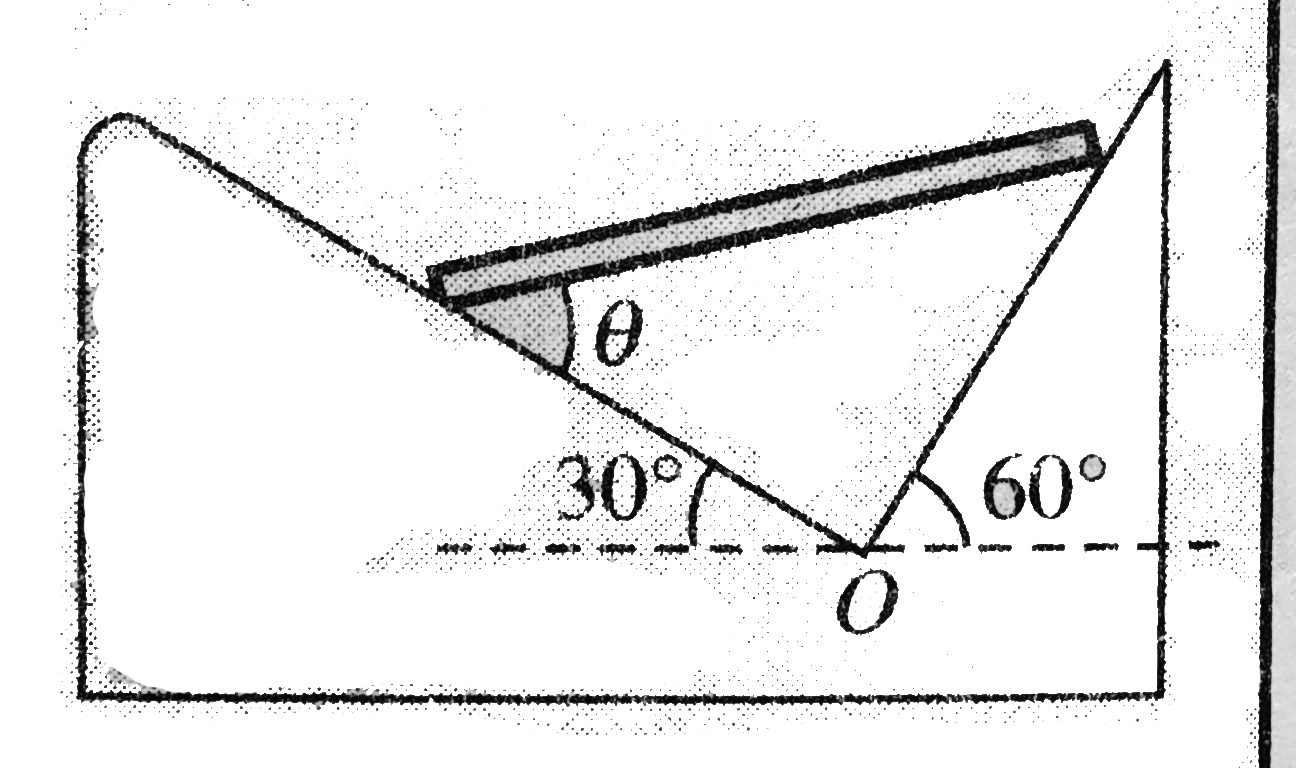
A uniform rod of weight `F_(g)` and length `L` is supported at its ends by a frictionless through as shown in figure. (a) Show that the centre of gravity of the rod must be vertically over point `O` when the rod is in equilibrium. (b) Determine the equilibrium value of the angle `theta`.

Text Solution

Verified by Experts
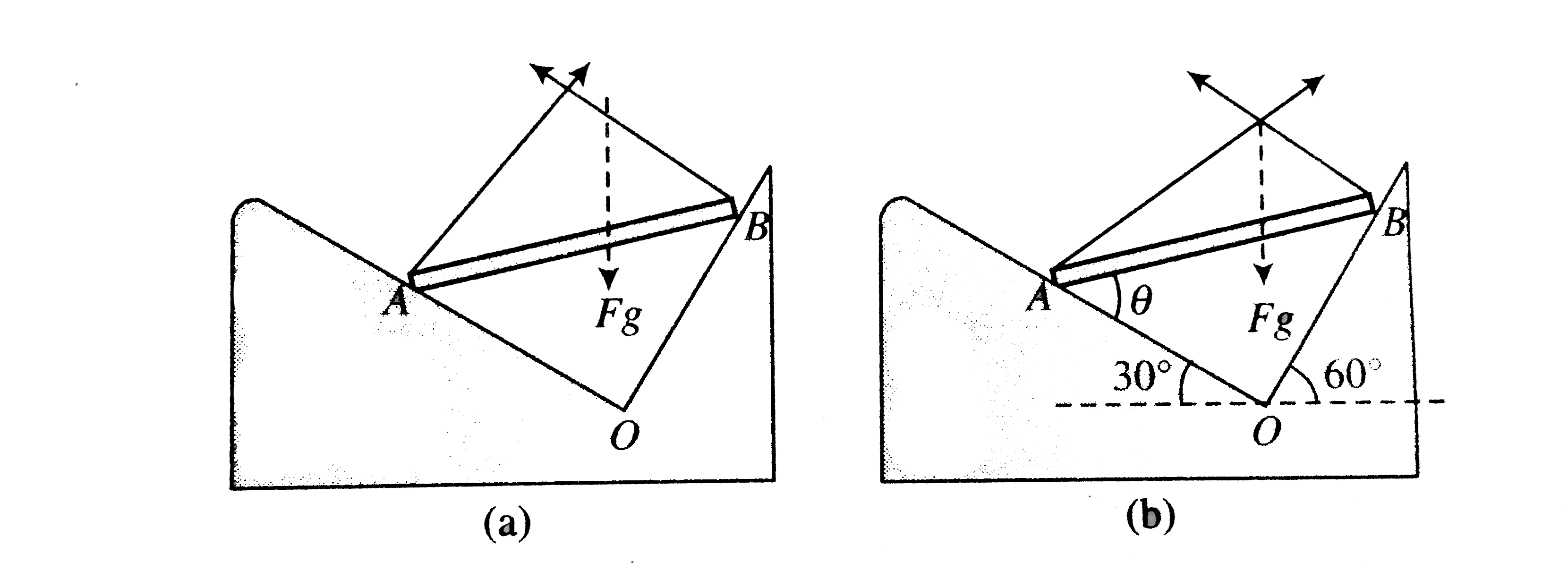
a. Just three forces act on the rod forces perpendicular to the sides of the through at `A` and `B`, and its weight. The lines of action of `A` and `B` will intersect at a point above the rod. They will have no torque about this point. The rod's weight will cause a torque about the point of intersection as in figure a. and the rod will not be equlibrium unles the centre of the rod lies vertically below the intersection point as is shown in figure b.

All three forces must be concurrent. Then the line of action of the weight is a diagonal of the rectangle formed by the through and the normal forces, and the rod's centre of gravity is vertically above the bottom of the trough.
b. In figure b, `vecAOcos30^@=vecBOcos60.0^@`
`L^(2)=|vecAO|^(2)+|vecBO|^(2)+|vecAO^(2)((cos^(2)30^@)/(cos^(2)60^@))`
`vecAO=L/(sqrt(1+(cos^(2)30^@)/(cos^(2)60^@)))=L/2`
so `costheta=(|vecAO|)/L=1/2` and `theta=60^@`
Promotional Banner

Topper's Solved these Questions

  • RIGID BODY DYNAMICS 1

    CENGAGE PHYSICS ENGLISH|Exercise Exercise 2.4|11 Videos
  • RIGID BODY DYNAMICS 1

    CENGAGE PHYSICS ENGLISH|Exercise Subjective|13 Videos
  • RIGID BODY DYNAMICS 1

    CENGAGE PHYSICS ENGLISH|Exercise Exercise 2.2|17 Videos
  • PROPERTIES OF SOLIDS AND FLUIDS

    CENGAGE PHYSICS ENGLISH|Exercise INTEGER_TYPE|2 Videos
  • RIGID BODY DYNAMICS 2

    CENGAGE PHYSICS ENGLISH|Exercise Interger|2 Videos

Similar Questions

Explore conceptually related problems

A uniform rod of mass M and length L is held vertically upright on a horizontal surface as shown in figure. Assuming zero potential energy at the base of the rod, determine the potential energy of the rod.

A uniform rod of mass m and length l is lying on a smooth table. An impulse J acts on the rod momentarily as shown in figure at point R. Just after that:

A uniform rod of mass m length l is attached to smooth hinge at end A and to a string at end B as shown in figure. It is at rest. The angular acceleration of the rod just after the string is cut is :

A smooth rod length l is kept inside a trolley at an angle theta as shown in the figure. What should be the acceleration a of the trolley so that the rod remain in equilibrium with respect to it?

A uniform rod of length L pivoted at the bottom of a pond of depth L//2 stays in stable equilibrium as shown in the figure. Find the angle 0 if the density of the material of the rod is half of the density of water.

A uniform rod of mass m and length L is kept on a horizontal table with L/4 length on the table as shown in figure. As the string attached to the end B is cut, the angular acceleration of the rod about point C will be

A rod of length l is pivoted about a horizontal , frictionless pin through one end. The rod is released from ret in a vertical position. Find the velocity of the CM of the rod when the rod is inclined at an angle theta from the vertical.

A uniform rod of length L pivoted at the bottom of a pond of depth L//2 stays in stable equilibrium as shown in the figure. Find the force acting at the pivoted end of the rod in terms of mass m of the rod.

A uniform rod AB of mass m and length L rotates about a fixed vertical axis making a constant angle theta with it as shown in figure. The rod is rotated about this axis, so that point B the free end of the rod moves with a uniform speed V in the horizontal plane then the angular momentum of the rod about the axis is:

A uniform rod AB of mass m and length L rotates about a fixed vertical axis making a constant angle theta with it as shown in figure. The rod is rotated about this axis, so that point B the free end of the rod moves with a uniform speed V in the horizontal plane then the angular momentum of the rod about the axis is:

