Home
Class 11
PHYSICS
A cylinder rests on a horizontal rotatin...

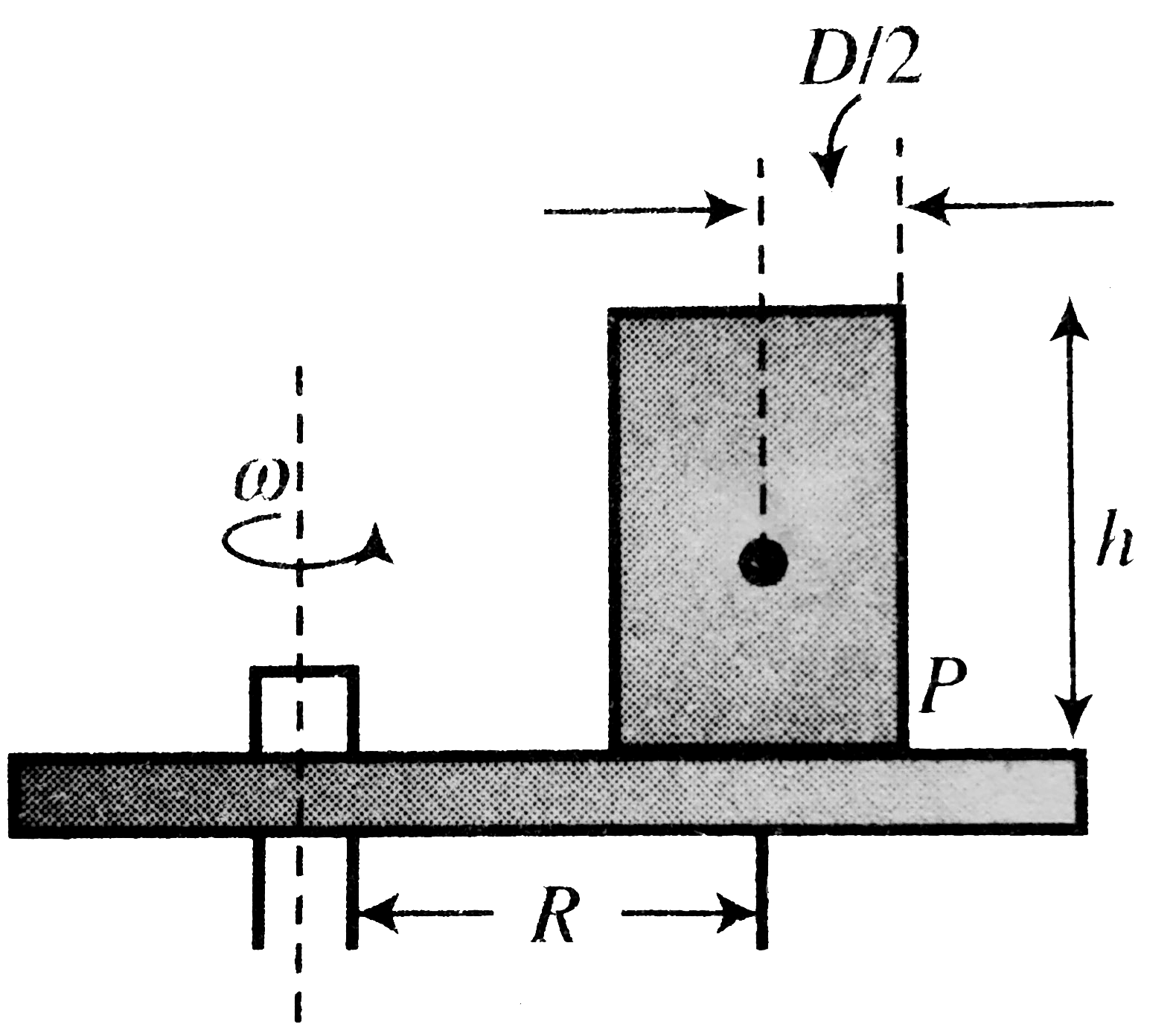
A cylinder rests on a horizontal rotating disc, as shown in the figure. Find at what angular velocity, `omega`, the cylinder falls off the disc, if the distance between the axes of the disc and cylinder is `R`, and the coefficient of friction `mugtD//h` where `D` is the diameter of the cylinder and It is its height.

Text Solution

Verified by Experts

The correct Answer is:
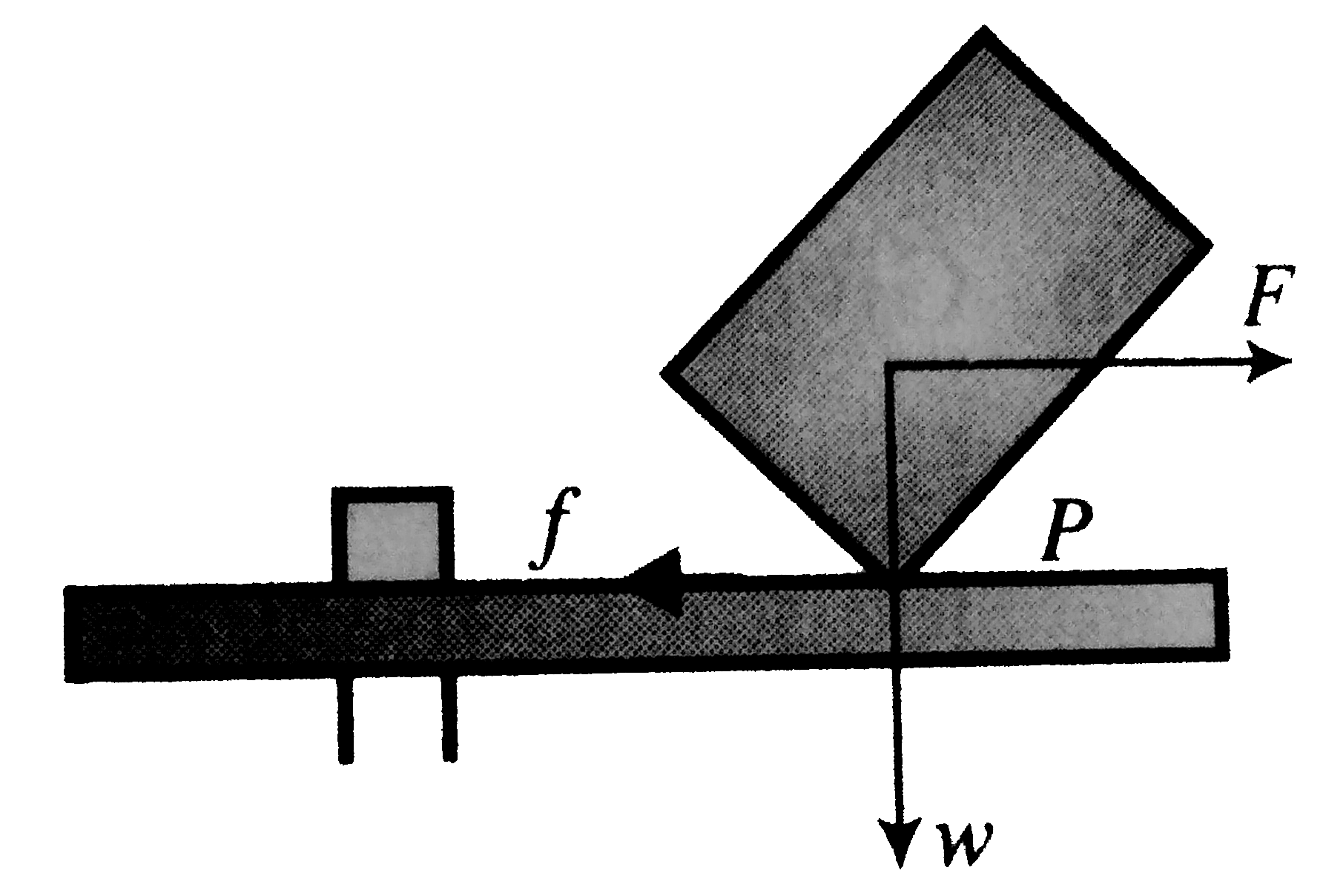
`sqrt(D)/(hR)`

The centripetal force that keeps the cylinder at rest on the disc is the frictioal force `f`. According to a non inertial observer on disc a pseudo force the cylinder reacts with an equal and oppostite force, `F`, which sometimes is reffered to as the centrifugal force.

`F=momega^(2)R`
where `M` is the mass of the cylinder.
The cylinder can fall off either by slipping away or by tilting about point `P`, depending of whichever takes place first. the critical agular speed `w_(1)` for slipping occurs when `F` equals `f:F=f`
`Momega_(1)^(2)R+mugM`
where `g` is the gravitational acceleration. Hence `omega_(1)=sqrt((mug)/R)`
`F` ties to rotaste the cylinder about `P`, but the weight `W` opposes it. The rotatiion becomes pssible, when the torque caused by `W`.
`Fh/2=W D/2implies F=W D/h`
`Momega_(2)^(2)R=Mg D/h`
giving `omega_(2)=sqrt(D/(hR))`
Since we are given `mugtD/h`, we see that `omega_(1)gtomega_(2)` and the cylinder falls off by rolling over at `omega=omega_(2).`
Promotional Banner

Topper's Solved these Questions

  • RIGID BODY DYNAMICS 1

    CENGAGE PHYSICS ENGLISH|Exercise Single Correct|97 Videos
  • RIGID BODY DYNAMICS 1

    CENGAGE PHYSICS ENGLISH|Exercise Multiple Correct|9 Videos
  • RIGID BODY DYNAMICS 1

    CENGAGE PHYSICS ENGLISH|Exercise Exercise 2.4|11 Videos
  • PROPERTIES OF SOLIDS AND FLUIDS

    CENGAGE PHYSICS ENGLISH|Exercise INTEGER_TYPE|2 Videos
  • RIGID BODY DYNAMICS 2

    CENGAGE PHYSICS ENGLISH|Exercise Interger|2 Videos

Similar Questions

Explore conceptually related problems

A solid cylinder of mass M and radius R rolls down an inclined plane of height h. The angular velocity of the cylinder when it reaches the bottom of the plane will be :

A force F is applied horizontally on a cylinder in the line of centre as shown in the figure. The cylinder is on a rough surface of coefficient of fricition mu . The direction of the friction force acting on the cylinder will be

A circular disc is rotating about its own axis at an angular velocity omega . If P is exact midpoint of dise between axis and rim of disc then angular velocity of Pis

A cylinder of weight W is resting on a V-groove as shown in figure .Draw its free body diagram.

Two discs A and B are in contact and rotating with angular velocity with angular velocities omega_(1) and omega_(2) respectively as shown. If there is no slipping between the discs, then

Two cylinders having radii 2R and R and moment of inertia 4I and I about their central axes are supported by axles perpendicular to their planes. The large cylinder is initially rotating clockwise with angular velocity omega_(0) . The small cylinder is moved to the right until it touches the large cylinder and is caused to rotate by the frictional force between the two. Eventually slipping ceases and the two cylinders rotate at constant rates in opposite directions. During this

A disc is given an initial angular velocity omega_(0) and placed on a rough horizontal surface as shown Fig. The quantities which will not depend on the coefficient of friction is/are

Two cylinders having radii 2R and R and moment of inertia 4I and I about their central axes are supported by axles perpendicular to their planes. The large cylinder is initially rotating clockwise with angular velocity omega_(0) . The small cylinder is moved to the right until it touches the large cylinder and is caused to rotate by the frictional force between the two. Eventually slipping ceases and the two cylinders rotate at constant rates in opposite directions. During this (A) angular momentum of system is conserved (B) kinetic energy is conserved (C neither the angular momentum nor the kinetic energy is conserved (D) both the angular momentum and kinetic energy are conserved

A disc of mass M and radius R rolls on a horizontal surface and then rolls up an inclined plane as shown in the figure. If the velocity of the disc is v, the height to which the disc will rise will be:

A uniform circular cylinder of mass m and radius r is given an initial angular velocity omega_() and no initial translational velocity it is placed in contact with a plane inclined at an angle alpha to the horizontal. If there is a coefficient of friction mu for sliding between the cylinder and plane. Find the distance the cylinder moves up before sliding stops also calculate the maximum distance it travels up the plane assume mugttanalpha .

