Home
Class 11
PHYSICS
A wheel of radius R=10 cm and moment of ...

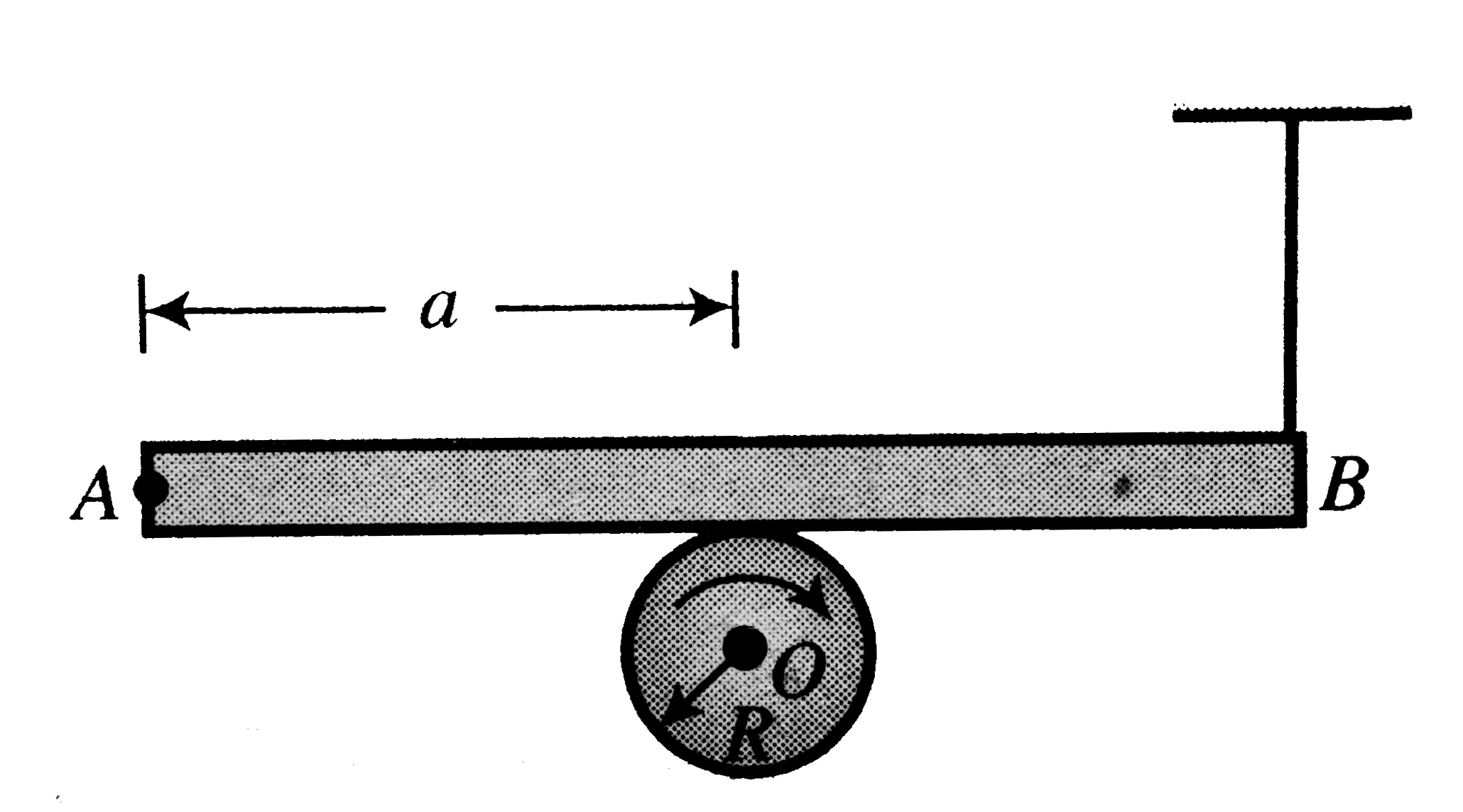
A wheel of radius `R=10 cm` and moment of inertia `I=0.05kg m^(2)` is rotating about a fixed horizontal axis `O` with angular velocity `omega_(0)=10rads^(-1)`. A uniform riigid rod of mass `m=3 kg` and length `l=50 cm` is hinged at one end `A` such that it can rotate at end `A` in a vertical plane. End `B` of the rod is tied with a thread as shown in figure such that the rod is horizontal and is just in contact with the surface of rotating wheel. Horizontal distance between axis of rotation `O` of cylinder and `A` is equal to `a = 30 cm`.
If the wheel stops rotating after one second after the thread has burnt, calculate coefficient of friction ,`mu` between the rod and the surface of the wheel. `(g = 10 ms^(-2))`

Text Solution

Verified by Experts

The correct Answer is:
`0.2`

When thread is burnt, rod rest the wheel, therefore, a normal reaction comes into existence, due to which friction is developed. This friction produces a retarding moment on the wheel and the wheel ultimately stops rotating.
To calculate retarding moment produced by the friction, first consider rotational motion of the wheel,
`omega_(0)=10 rad//s^(-1) omega=0, t=1` second , `a=?`
Using `omega=omega_(0)+at, alpha=-10rad s^-(12)`
Retardtion moment `tau=I|alpha|=0.5Nm`
Let friction between rod and wheel be `F`, then `tau=FR` or `F=2` newton.
Let normal reacton exerted by wheel on rod be `N`.
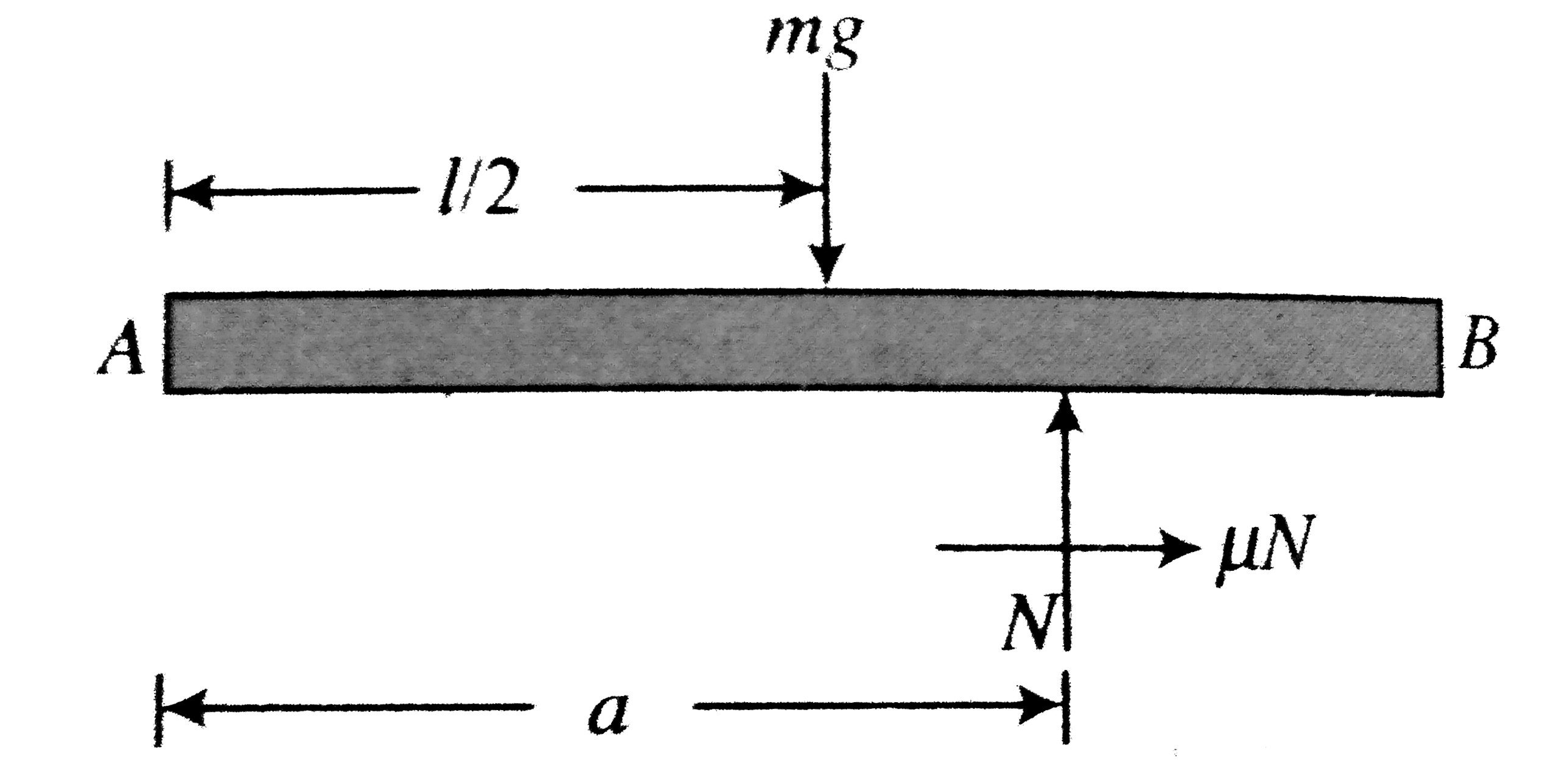
Considering free body diagram of the rod.

Taking moment about `A`
`N.a=mgl/2` or `N=25newton `
But friction `F=muN`
`mu=0.2`
Promotional Banner

Topper's Solved these Questions

  • RIGID BODY DYNAMICS 1

    CENGAGE PHYSICS ENGLISH|Exercise Single Correct|97 Videos
  • RIGID BODY DYNAMICS 1

    CENGAGE PHYSICS ENGLISH|Exercise Multiple Correct|9 Videos
  • RIGID BODY DYNAMICS 1

    CENGAGE PHYSICS ENGLISH|Exercise Exercise 2.4|11 Videos
  • PROPERTIES OF SOLIDS AND FLUIDS

    CENGAGE PHYSICS ENGLISH|Exercise INTEGER_TYPE|2 Videos
  • RIGID BODY DYNAMICS 2

    CENGAGE PHYSICS ENGLISH|Exercise Interger|2 Videos

Similar Questions

Explore conceptually related problems

A uniform rod of mass m and length L is hinged about one end and can freely rotate in a vertical plane. The angular velocity of the rod, when it falls from position P to Q. through an angle alpha starting from rest, is

A rod of mass 2 kg ad length 2 m is rotating about its one end O with an angular velocity omega=4rad//s . Find angular momentum of the rod about the axis rotation.

A uniform rod AB of mass m and length 2a is falling freely without rotation under gravity with AB horizontal. Suddenly the end A is fixed when the speed of the rod is v. The angular speed which the rod begains to rotate is

A uniform rod of mass m and length l rotates in a horizontal plane with an angular velocity omega about a vertical axis passing through one end. The tension in the rod at a distance x from the axis is

A uniform rod of mass m and length l is fixed from Point A , which is at a distance l//4 from one end as shown in the figure. The rod is free to rotate in a vertical plane. The rod is released from the horizontal position. What is the reaction at the hinge, when kinetic energy of the rod is maximum?

A uniform rod AB of mass m = 2 kg and length l = 1.0 m is placed on a sharp support P such that a = 0.4 m and b = 0.6 m . A. spring of force constant k= 600 N//m is attached to end B as shown in Fig. To keep the rod horizontal, its end A is tied with a thread such that the spring is B elongated by 1 CM . Calculate reaction of support P when the thread is burnt.

A uniform rod mass m and length l is provided at one end and is rotated with constant angular velocity omega in a horizontal plane. Tension in the rod at a distance (√3l/2) from pivoted end is (Assume gravity free space)

A rod PQ of mass M and length L is hinged at end P. The rod is kept horizontal by a massless string tied to point Q as shown in figure. When string is cut, the intial angular acceleration of the rod is

A rod PQ of mass M and length L is hinged at end P . The rod is kept horizontal by a massless string tied to point Q as shown in the figure. When string is cut, the initial angular accleration of the rod is.

A L shaped rod of mass M is free to rotate in a vertical plane about axis A A as shown in figure. Maximum angular acceleration of rod is

