Home
Class 11
PHYSICS
A horizontal force F is applied at the t...

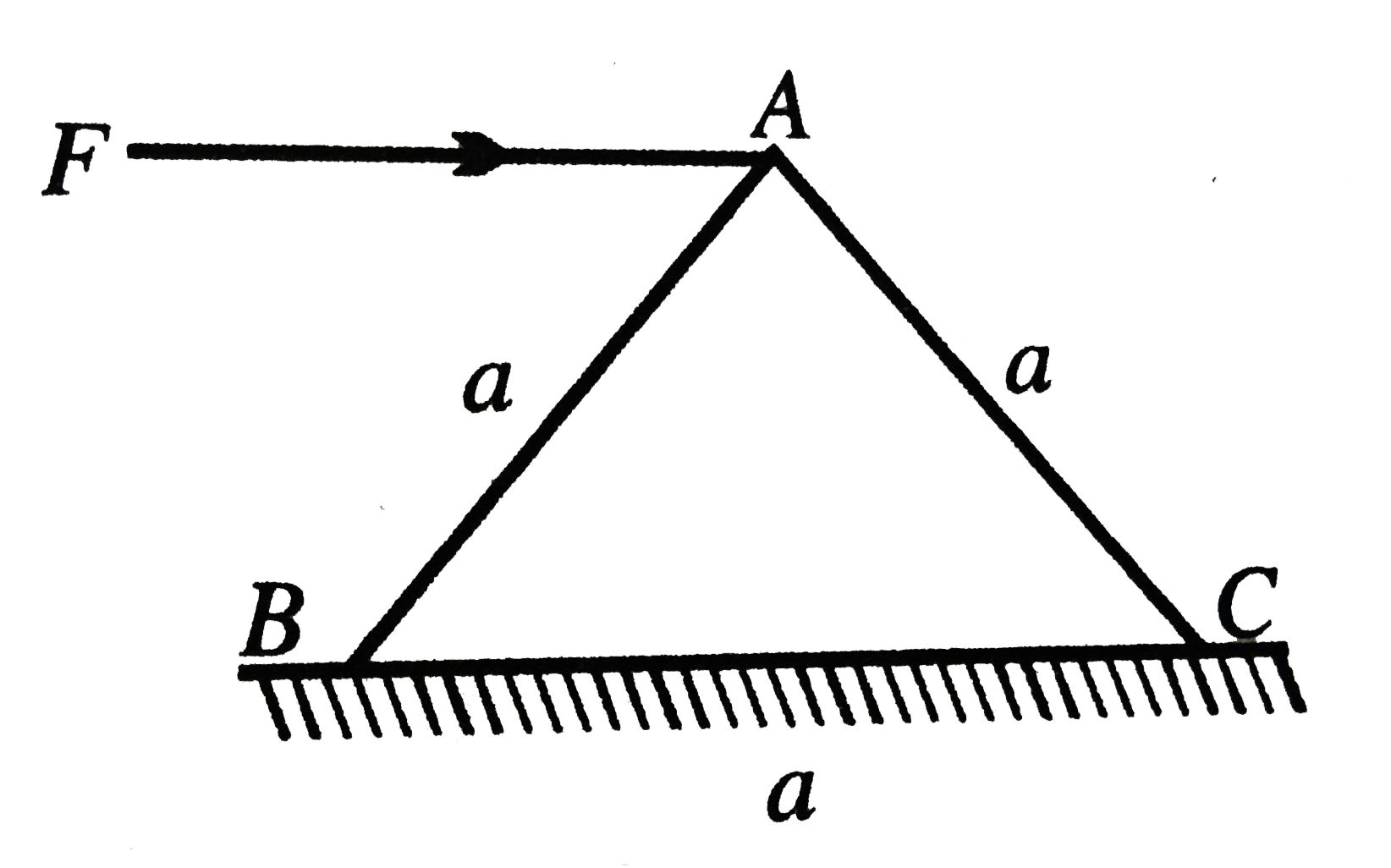
A horizontal force `F` is applied at the top of an equilateral triangular block having mass `m`. The minimum coefficient of friction required to topple the block before translation will be

A

`2/(sqrt(3))`

B

`1/3`

C

`1/(sqrt(3))`

D

`1/2`

Text Solution

Verified by Experts

The correct Answer is:
C

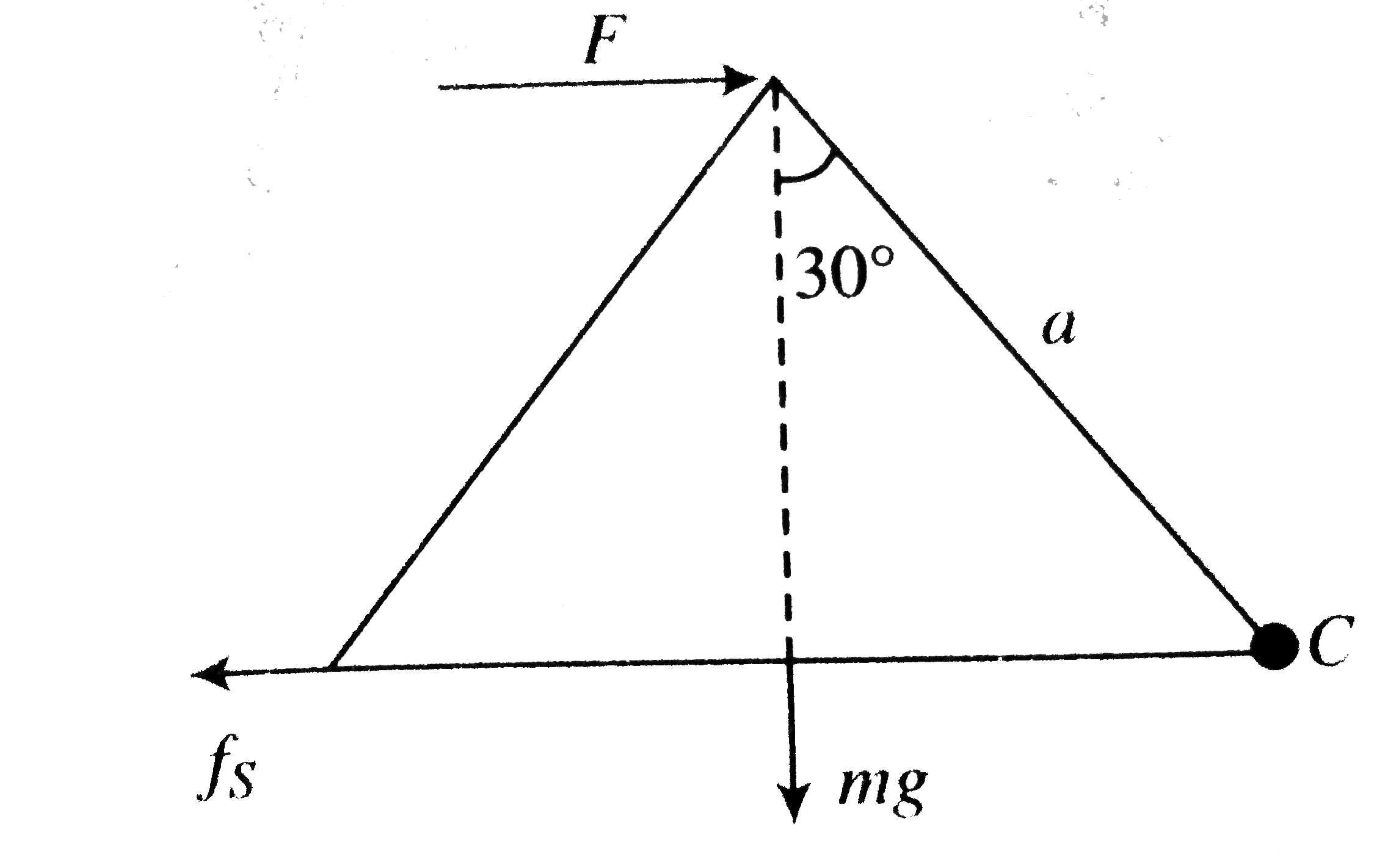
About `C`,for toppling `tau_(F)gttau_(mg)`

`F acos30^@gtmga/2impliesFgt(mg)/(sqrt(3))`
If no translation then `f_(x)=Fgt(mg)/(sqrt(3))`
but `f_(s)lemumg`
`implies (mg)/(sqrt(3))lemu mgimpliesmuge1/(sqrt(3))`
Promotional Banner

Topper's Solved these Questions

  • RIGID BODY DYNAMICS 1

    CENGAGE PHYSICS ENGLISH|Exercise Multiple Correct|9 Videos
  • RIGID BODY DYNAMICS 1

    CENGAGE PHYSICS ENGLISH|Exercise Linked Comprehension|28 Videos
  • RIGID BODY DYNAMICS 1

    CENGAGE PHYSICS ENGLISH|Exercise Subjective|13 Videos
  • PROPERTIES OF SOLIDS AND FLUIDS

    CENGAGE PHYSICS ENGLISH|Exercise INTEGER_TYPE|2 Videos
  • RIGID BODY DYNAMICS 2

    CENGAGE PHYSICS ENGLISH|Exercise Interger|2 Videos

Similar Questions

Explore conceptually related problems

A horizontal force F is applied at the top of an equilateral triangular block having mass m. The minimum coefficient of friction required to topple the block before translation is mu ,find 100 mu ? ( sqrt(3) = 1.74)

A cubical box of side length L rests on a rough horizontal surface having coefficient of friction mu . A variable horizontal force F=alpha t is applied on the top of the block as shown in figure, where alpha is a constant and t is time. The coefficient of friction is sufficient so that the block does not slide before toppling. The graph between torque due to normal reaction about end B and time before toppling start is

force F is applied at the topmost point of block of mass M. The force required to topple the block before sliding is (µ = coefficient of friction)

A cubical block of edge length 1 m and density 800 kg m^-3 rests on a rough horizontal surface with coefficient of friction mu . A horizontal force F is applied on the block as shown in figure. If the coefficient of friction is sufficiently large so that the block does not slide bofore toppling, then the minimum value of F to topple the block is [Take g = 10 ms^-2 ]

A block of mass m lying on a rough horizontal plane is acted upon by a horizontal force P and another force Q inclined at an angle theta to the vertical. The minimum value of coefficient of friction of friction between the block and the surface for which the block will remain in equilibrium is

A block of mass m lying on a rough horizontal plane is acted upon by a horizontal force P and another force Q inclined at an angle theta to the vertical. The minimum value of coefficient of friction of friction between the block and the surface for which the block will remain in equilibrium is

A block of mass m lying on a rough horizontal plane is acted upon by a horizontal force P and another force Q inclined at an angle theta to the vertical. The minimum value of coefficient of friction of friction between the block and the surface for which the block will remain in equilibrium is

A cubical box of side L rests on a rough horizontal surface with coefficient of friction p. A horizontal force F is a applied on the block as shown in Fig. 15.4.6. If the coefficient of friction is sufficiently high so that the block does not slide before toppling, the minimum force required to topple the block is

Minimum horizontal force (F) required to move the block shown in diagram is__

An equilateral prism of mass m rests on a rough horizontal surface with cofficent of friction mu . A horizontal force F is applied on the prism as shown in the figure. If the cofficent of the friction is sufficently high so that the prism does not slide before toppling, then the minimum force required to topple the prism is

CENGAGE PHYSICS ENGLISH-RIGID BODY DYNAMICS 1-Single Correct
  1. Four forces of the same magnitude act on a square as shown in figure. ...

    Text Solution

    |

  2. Given a uniform disc of mass M and radius R. A small disc of radius R/...

    Text Solution

    |

  3. A horizontal force F is applied at the top of an equilateral triangula...

    Text Solution

    |

  4. The line of action of the resultant of two like parallel forces shifts...

    Text Solution

    |

  5. ABC is a triangular plate of uniform A thickness. The sides are in the...

    Text Solution

    |

  6. Let l be the moment of inertia of a uniform square plate about an axi...

    Text Solution

    |

  7. In a rectangle ABCD, AB = 2l and BC = l. Axes xx and yy pass through c...

    Text Solution

    |

  8. A uniform thin rod is bent in the form of closed loop ABCDEFA as shown...

    Text Solution

    |

  9. Figure shows an arrangement of masses hanging from a ceiling. In equil...

    Text Solution

    |

  10. Two identical uniform discs of mass m and radius r are arranged as sho...

    Text Solution

    |

  11. A uniform triangular plate ABC of moment of mass m and inertia I (abou...

    Text Solution

    |

  12. ABC is an equilateral triangle with O as its centre. F(1), F(2) and F(...

    Text Solution

    |

  13. Two discs have same mass and thickness. Their materials are of densiti...

    Text Solution

    |

  14. Let I(A) and I(B) be moments of inertia of a body about two axes A and...

    Text Solution

    |

  15. In a rectangle ABCD, AB = 2l and BC = l. Axes xx and yy pass through c...

    Text Solution

    |

  16. For the same total mass, which of the following will have the largest ...

    Text Solution

    |

  17. A uniform plane sheet of metal in the form of a triangle ABC has BC gt...

    Text Solution

    |

  18. The masses of two uniform discs are in the ratio 1 : 2 and their diame...

    Text Solution

    |

  19. There are four solid balls with their centres at the four corners of a...

    Text Solution

    |

  20. if l(1) is the moment of inertia of a thin rod about an axis perpendic...

    Text Solution

    |

