Home
Class 11
PHYSICS
A clockwise torque of 6N-m is applied to...

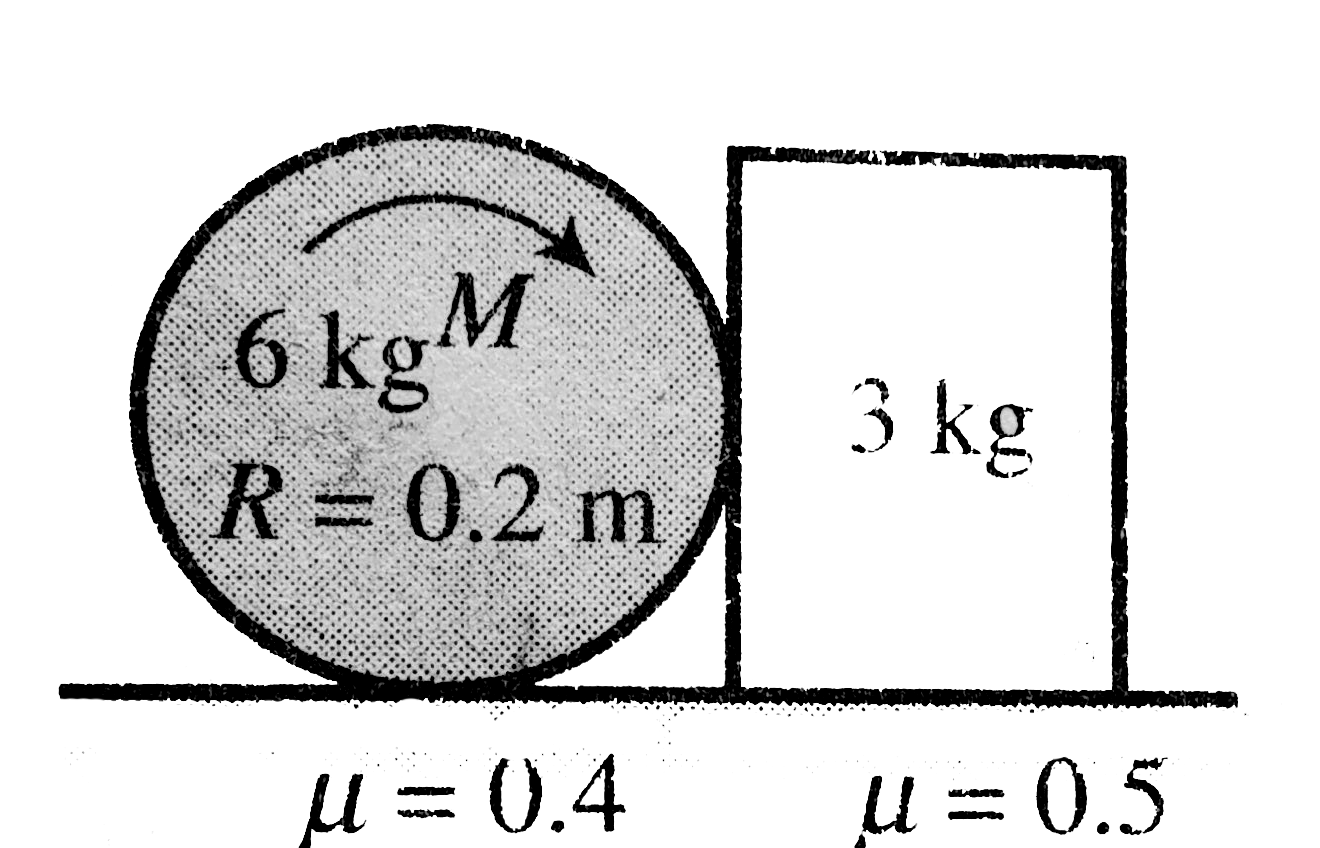
A clockwise torque of `6N-m` is applied to the circular cylinder as shown in the figure. There is no friction between the cylinder and the block.

A

A) The cylinder will be slipping but the system does not move forward

B

B)The system cannot move forward for any torque applied to the cylinder

C

C)The acceleration of the system will be `1m//s^(2)` forward

D

D)The angular acceleration of the cylinder is `10 rad s^(-2)`

Text Solution

Verified by Experts

The correct Answer is:
C, D

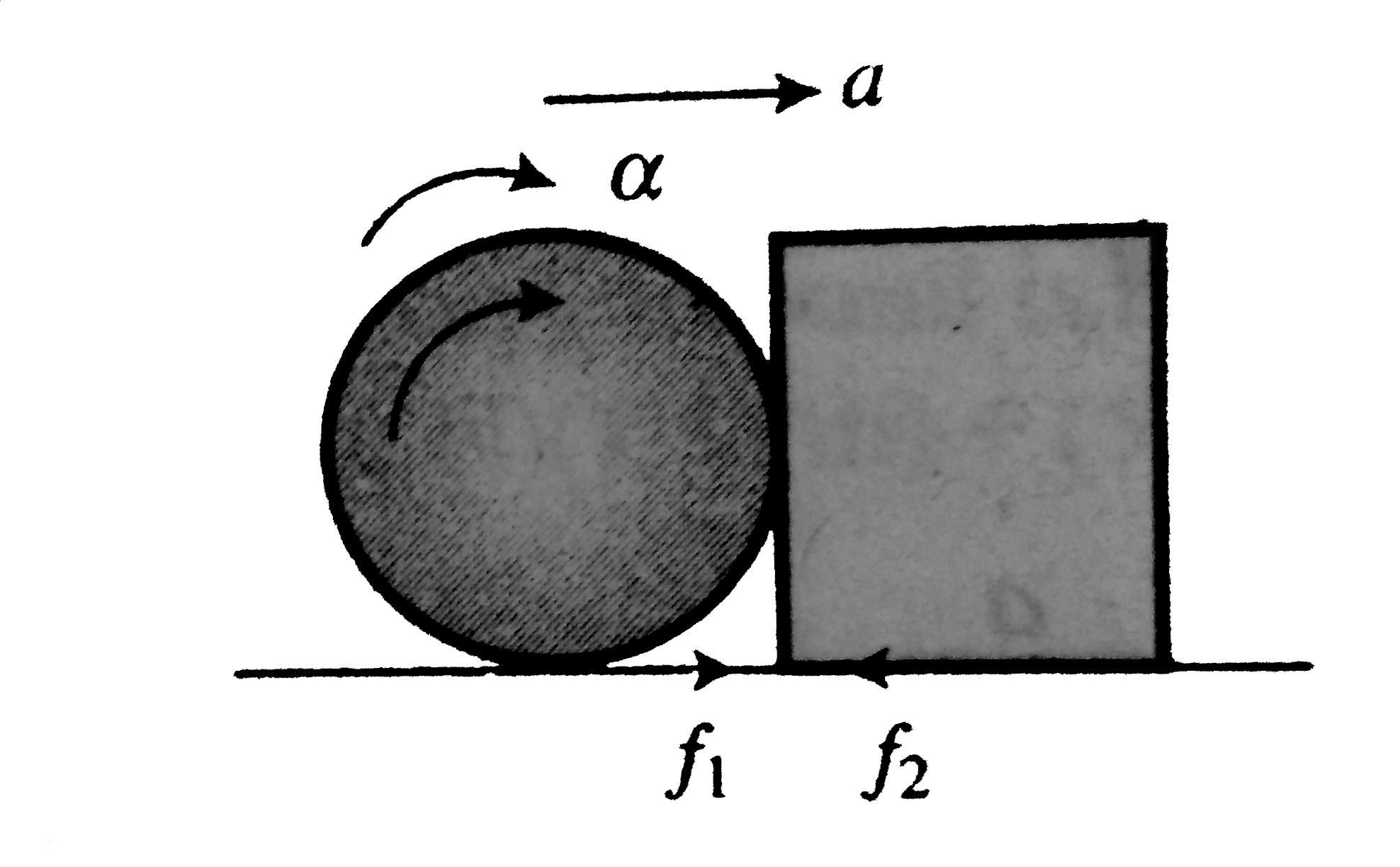
`a=(f_(1)-f_(2))/(m_(1)+m_(2))=(0.4xx6g-0.5x3g)/(6+3)`

`implies a=1ms^(-2)`
`alpha=(tau_("applied")-tau_("friction"))/I=(6-f_(1)R)/(1/26(R)^(2))`
`=(6-0.4x6g(.2))/(1/2xx6xx(0.2)^(2))=10rads^(-2)`
Promotional Banner

Topper's Solved these Questions

  • RIGID BODY DYNAMICS 1

    CENGAGE PHYSICS ENGLISH|Exercise Linked Comprehension|28 Videos
  • RIGID BODY DYNAMICS 1

    CENGAGE PHYSICS ENGLISH|Exercise Integer|11 Videos
  • RIGID BODY DYNAMICS 1

    CENGAGE PHYSICS ENGLISH|Exercise Single Correct|97 Videos
  • PROPERTIES OF SOLIDS AND FLUIDS

    CENGAGE PHYSICS ENGLISH|Exercise INTEGER_TYPE|2 Videos
  • RIGID BODY DYNAMICS 2

    CENGAGE PHYSICS ENGLISH|Exercise Interger|2 Videos

Similar Questions

Explore conceptually related problems

A block of mass 2 kg is placed on the floor. The coefficient of static friction is 0.4. A force F of 3 N is applied on the block as shown in figure. The force of friction between the block and the floor is (Take g=10 m s^(-2) )

A force of 100 N is applied on a block of mass 3 kg as shown in figure. The coefficient of friction between the surface and the block is 1/4 .Then the friction force acting on the block is

A plank of mass 10 kg and a block of mass 2 kg are placed on a horizontal plane as shown in the figure. There is no friction between plane and plank. The coefficient of friction between block and plank is 0.5 .A force of 60 N is applied on plank horizontally. In first 2 s the work done by friction on the block is

A slab of 40 kg lying on a frictionales floor and a block of 10 kg rests on the slab as shown in the figure. The coefficients of static and kinetic friction between the slab and the block are 0.6 and 0.4 respectively. If a force of 100 N is applied on the block, then the acceleration the slab will be (g = 10 m//s^(2))

A block of weight 30 N is in contact with a rough wall. A force of 50 N is applied as shown in the figure. Find the coefficient of static friction between the wall and the block assuming the block is just about to slip.

A block B is pulled by a force of 18 N applied to a light pulley as shown in the figure. If the coefficient of friction is 0.4 and the acceleration of the block is 0.5 ms^(-2) , the mass of the block is (g = 10 m//s^2)

A force of 200N is applied as shown in the figure on block of 3 kg. The coefficient of friction between the block and the wall is 0.3. Find the friction acting on the block. (in N) {Take g = 10 m//s^(2)

If two equal and opposite defirming forces are applied parallel to the cross sectional area of the cylinder as shown in the figure, there is a relative displacement between the oppsite faces of the cylinder. The ratio of Ax to L is known as

A block of mass m is placed on the top of another block of mass M as shown in the figure. The coefficient of friction between them is mu . The maximum acceleration with which the block M may move so that m also moves along with it is

Two blocks of masses M = 3 kg and m = 2 kg are in contact on a horizontal table. A constant horizontal force F = 5 N is applied to block M as shown. There is a constant frictional force of 2 N between the table and the block m but no frictional force between the table and the first block M, then acceleration of the two blocks is

