Home
Class 12
PHYSICS
If i(1)=3 sin omega t and (i2) = 4 cos o...

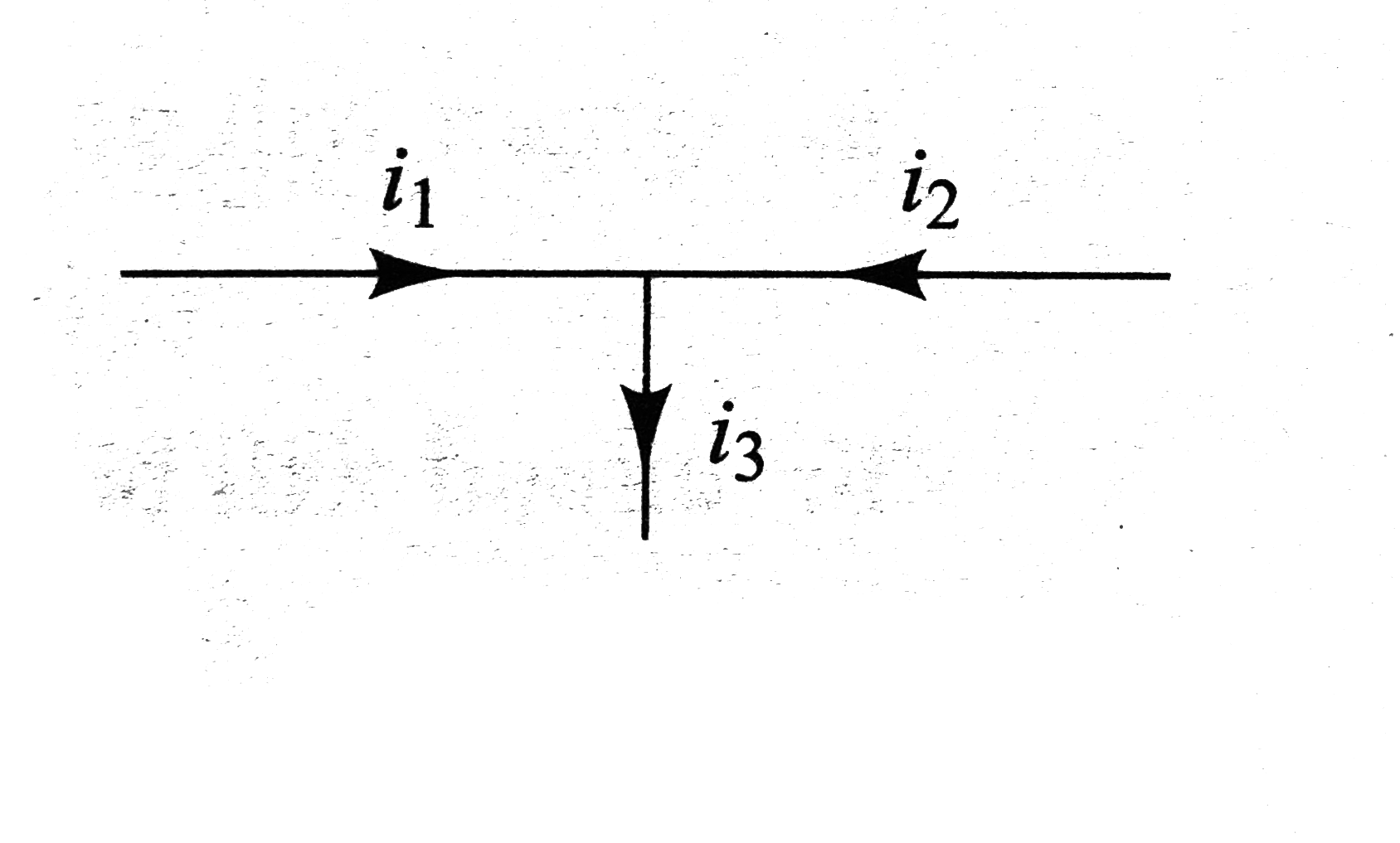
If `i_(1)=3 sin omega t and (i_2) = 4 cos omega t,` then `(i_3)` is

A

`5 sin(omega t +53^(@))`

B

`5 sin(omega t +37^(@))`

C

`5 sin(omega t +45^(@))`

D

`5 sin(omega t +35^(@))`

Text Solution

Verified by Experts

The correct Answer is:
A

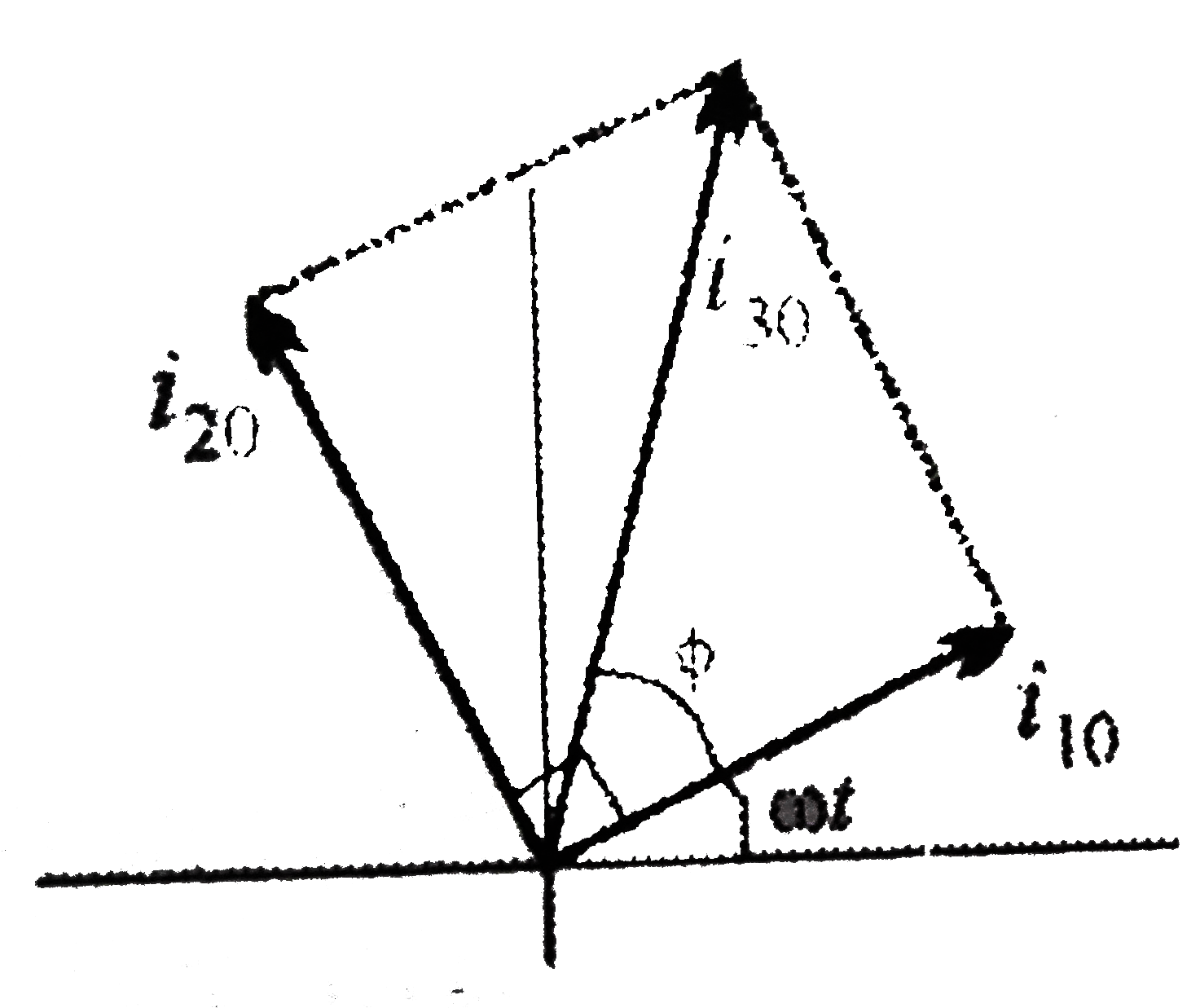
`(i_3)=(i_1)+(i_2)=3 sin omega t + 4 cos omega t `
`=3 sin omega t + 4 sin (omega t + 90^(@))`
`(i_(30))=sqrt(I_(10)^(2)+I_(20)^(2))=sqrt(3^(2)+4^(2))=5`
`tan(phi) = 4/3 implies phi = 53^(@)`
so, `(i_3)=(I_(30) sin(omega t+phi)=5 sin (omega t+53^(@)).
Promotional Banner

Topper's Solved these Questions

  • ALTERNATING CURRENT

    CENGAGE PHYSICS ENGLISH|Exercise Exercises Multiple Correct|5 Videos
  • ALTERNATING CURRENT

    CENGAGE PHYSICS ENGLISH|Exercise Exercises Assertion-reasoning|7 Videos
  • ALTERNATING CURRENT

    CENGAGE PHYSICS ENGLISH|Exercise Exercises Subjective|15 Videos
  • ATOMIC PHYSICS

    CENGAGE PHYSICS ENGLISH|Exercise ddp.4.3|15 Videos

Similar Questions

Explore conceptually related problems

In the given figure, if i_(1)=3 sin omegat and i_(2)=4 cos omegat, then i_(3) is

Two particle A and B execute simple harmonic motion according to the equation y_(1) = 3 sin omega t and y_(2) = 4 sin [omega t + (pi//2)] + 3 sin omega t . Find the phase difference between them.

x_(1) = 3 sin omega t , x_(2) = 4 cos omega t . Find (i) amplitude of resultant SHM, (ii) equation of the resultant SHM.

x_(1) = 3 sin omega t , x_(2) = 4 cos omega t Find (i) amplitude of resultant SHM, (ii) equation of the resultant SHM.

x_(1) = 3 sin omega t implies x_(2) = 4 cos omega t . Find (i) amplitude of resultant SHm, (ii) equation of the resultant SHm.

The displacement of two interfering light waves are y_(1)=4 sin omega t" and "y_(2)= 3 cos (omega t) . The amplitude of the resultant waves is (y_(1)" and "y_(2) are in CGS system)

When two displacement represented by y_(1) = a sin (omega t) and y_(2) = b cos (omega t) are superimposed, the motion is

Statement-1 : The superposition of the waves y_(1) = A sin(kx - omega t) and y_(2) = 3A sin (kx + omega t) is a pure standing wave plus a travelling wave moving in the negative direction along X-axis Statement-2 : The resultant of y_(1) & y_(2) is y=y_(1) + y_(2) = 2A sin kx cos omega t + 2A sin (kx + omega t) .

The emf and current in a circuit are such that E = E_(0) sin omega t and I = I_(0) sin (omega t - theta) . This AC circuit contains

Find the resultant amplitude and the phase difference between the resultant wave and the first wave , in the event the following waves interfere at a point , y_(1) = ( 3 cm) sin omega t , y_(2) = ( 4 cm) sin (omega t + (pi)/( 2)), y_(3) = ( 5 cm ) sin ( omega t + pi)

CENGAGE PHYSICS ENGLISH-ALTERNATING CURRENT-Exercises Single Correct
  1. Determine the rms value of a semi-circular current wave which has a ma...

    Text Solution

    |

  2. An alternating voltage E = 200sqrt 2sin(100t) is connected to a muF ca...

    Text Solution

    |

  3. Which voltmeter will give zero reading at resonance?

    Text Solution

    |

  4. A 50 W, 100V lamp is to be connected to an ac mains of 200V, 50 Hz. Wh...

    Text Solution

    |

  5. A capacitor of 10 (mu)F and an inductor of 1 H are joined in series. A...

    Text Solution

    |

  6. If i(1)=3 sin omega t and (i2) = 4 cos omega t, then (i3) is

    Text Solution

    |

  7. When an AC source of emf E=E(0)sin(100t) is connected across a circuit...

    Text Solution

    |

  8. In an ac circuit the potential differences across an inductance and re...

    Text Solution

    |

  9. Current in an ac circuit is given by I= 3 sin omega t + 4 cos omega t,...

    Text Solution

    |

  10. A current source sends a current I=(i0) cos (omegat), When connected a...

    Text Solution

    |

  11. In the circuit shown in fig. X(C ) = 100 Omega,(XL)=200 Omega and R=10...

    Text Solution

    |

  12. For an LCR series circuit with an aac source of angular frequency omeg...

    Text Solution

    |

  13. The value of current in two series LCR circuits at resonance is same, ...

    Text Solution

    |

  14. In series L-C-R circuit voltage drop across resistance is 8 V and acro...

    Text Solution

    |

  15. In a black box of unknown elements (L or R or any other combination), ...

    Text Solution

    |

  16. The voltage time (V-t) graoh for triangular wave having peak value (V0...

    Text Solution

    |

  17. The average value of voltage (V) in one time period will be

    Text Solution

    |

  18. What reading would you expact of a square-wave current, suitching rapo...

    Text Solution

    |

  19. The power factor of the circuit is (1)/(sqrt2)). The capacitance of th...

    Text Solution

    |

  20. In an ideal transformer, the voltagae and the current in the primary c...

    Text Solution

    |

