Home
Class 11
CHEMISTRY
An organic reaction occurs by using reag...

An organic reaction occurs by using reagents called electrophiles and nucleophiles via the formation of some reactive intermediates called carbocations, carbanions, free radicals, carbenes, nitrenes, radical cations, and radical anions.
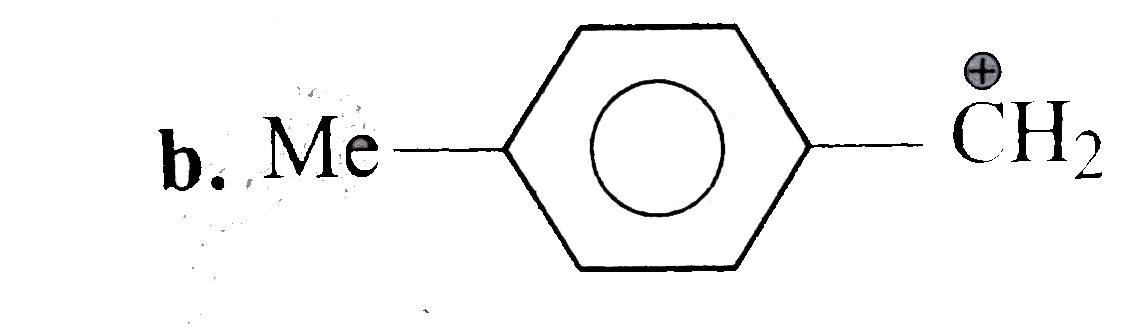
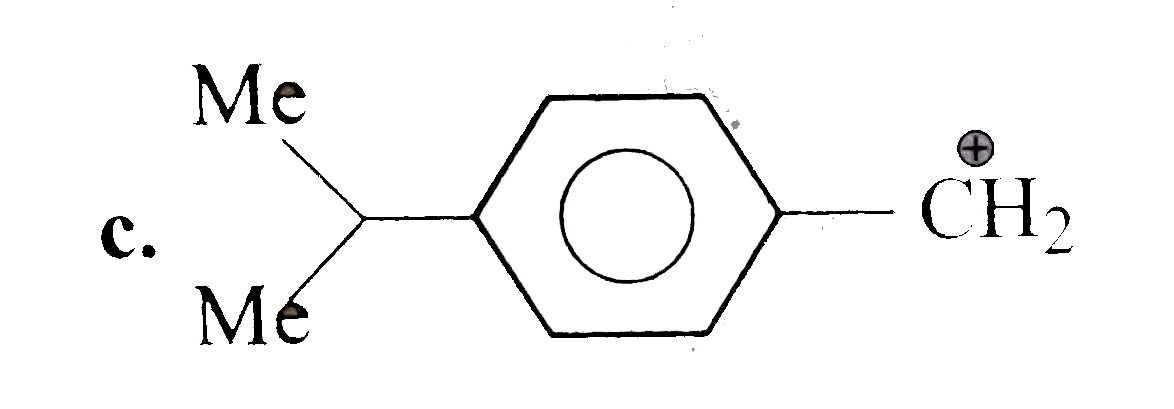
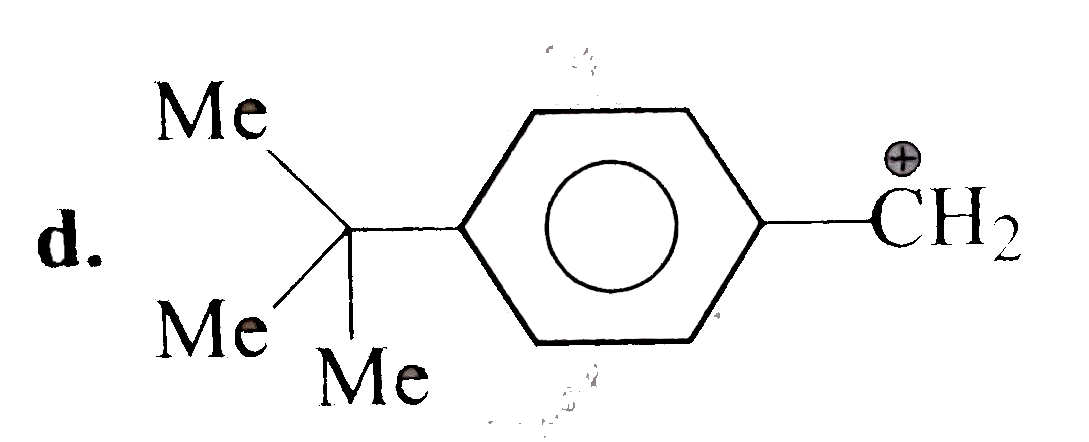
The most stable carbocation is :

A

`Ph overset (oplus) CH_2`

B

C

D

Text Solution

AI Generated Solution

The correct Answer is:

To determine the most stable carbocation among the given options, we will analyze the stability based on three main factors: hyperconjugation, resonance, and inductive effect. ### Step-by-Step Solution: 1. **Identify the Carbocations**: - Let's denote the carbocations as A, B, C, and D based on the options provided. Each carbocation has a different number of alkyl groups attached to the positively charged carbon. 2. **Understand Hyperconjugation**: - Hyperconjugation refers to the stabilizing interaction that results from the overlap of a σ-bond orbital with an empty p-orbital on the positively charged carbon. The more alkyl groups attached to the carbocation, the more hyperconjugation can occur, leading to increased stability. 3. **Analyze Each Carbocation**: - **Carbocation A**: Has 1 alkyl group (1 α-H). - **Carbocation B**: Has 2 alkyl groups (2 α-H). - **Carbocation C**: Has 3 alkyl groups (3 α-H). - **Carbocation D**: Has no alkyl groups (0 α-H). 4. **Evaluate Stability Based on Hyperconjugation**: - Carbocation A (1 α-H) has limited hyperconjugation. - Carbocation B (2 α-H) has moderate hyperconjugation. - Carbocation C (3 α-H) has the highest hyperconjugation due to the presence of 3 alkyl groups. - Carbocation D (0 α-H) has no hyperconjugation. 5. **Consider Resonance**: - If any of the carbocations can undergo resonance, it will further stabilize the carbocation. However, in this case, we focus primarily on hyperconjugation since the question emphasizes the stability of carbocations. 6. **Conclusion**: - Based on the analysis, Carbocation C, which has the most alkyl groups (3 α-H), is the most stable due to the maximum hyperconjugation effect. ### Final Answer: The most stable carbocation is **Carbocation C**.

To determine the most stable carbocation among the given options, we will analyze the stability based on three main factors: hyperconjugation, resonance, and inductive effect. ### Step-by-Step Solution: 1. **Identify the Carbocations**: - Let's denote the carbocations as A, B, C, and D based on the options provided. Each carbocation has a different number of alkyl groups attached to the positively charged carbon. 2. **Understand Hyperconjugation**: ...
Promotional Banner

Topper's Solved these Questions

  • GENERAL ORGANIC CHEMISTRY

    CENGAGE CHEMISTRY ENGLISH|Exercise Multiple Correct|22 Videos
  • GENERAL ORGANIC CHEMISTRY

    CENGAGE CHEMISTRY ENGLISH|Exercise Single Correct|23 Videos
  • GENERAL ORGANIC CHEMISTRY

    CENGAGE CHEMISTRY ENGLISH|Exercise Concept|17 Videos
  • CLASSIFICATION AND NOMENCLATURE OF ORGANIC COMPOUNDS

    CENGAGE CHEMISTRY ENGLISH|Exercise Analytical and Descriptive Type|3 Videos
  • HYDROGEN, WATER AND HYDROGEN PEROXIDE

    CENGAGE CHEMISTRY ENGLISH|Exercise Subjective Archive (Subjective)|3 Videos

Similar Questions

Explore conceptually related problems

An organic reaction occurs by using reagents called electrophiles and nucleophiles via the formation of some reactive intermediates called carbocations, carbanions, free radicals, carbenes, nitrenes, radical cations, and radical anions. The most stable carbanion is :

An organic reaction occurs by using reagents called electrophiles and nucleophiles via the formation of some reactive intermediates called carbocations, carbanions, free radicals, carbenes, nitrenes, radical cations, and radical anions. The least stable carbocation is :

An organic reaction occurs by using reagents called electrophiles and nucleophiles via the formation of some reactive intermediates called carbocations, carbanions, free radicals, carbenes, nitrenes, radical cations, and radical anions. The most stable free radical is :

An organic reaction occurs by using reagents called electrophiles and nucleophiles via the formation of some reactive intermediates called carbocations, carbanions, free radicals, carbenes, nitrenes, radical cations, and radical anions. Which of the following contains electrophiles only ?

An organic reaction occurs by using reagents called electrophiles and nucleophiles via the formation of some reactive intermediates called carbocations, carbanions, free radicals, carbenes, nitrenes, radical cations, and radical anions. Which of the following contains nucleophiles only ?

The most Carbocations, carbanions, free radicals and radical cation are reactive carbon intermediates. Their hybrid orbitals respectively are

Classify each of the following as homolysis or heterolysis. Identify the reaction intermediates produced , as free radical, carbocation and carbanion.

Reaction intermdiates are short lived species and are highly reactive. They are formed by heterolytic and homolytic bond fission. There are various types of reaction intermediates in which the most important are carbocation , carbanion and free radical. Carbocation is an organic species in which carbon have positive charge and six electrons in its outermost shell. The stability of carbocation can be increased by positive inductive effect, hyperconjugation and delocalisation. If alpha -atom with respect to carbocation has one or more lone pair of electron then lone pair of electron strongly stabilises the carbocation due to octet completion. Species in which carbon have negative charge is called carbanion. Carbanion carries three bond pairs and one lone pair. The stability of carbanion can be increased by negative inductive effect, negative mesomeric effect and delocalisation. Free radical is a species which have seven electrons in its outermost shell. The stability of free radical can be increased by hyperconjugation and delocalisation. The stability order of following carbocations is

Reaction intermdiates are short lived species and are highly reactive. They are formed by heterolytic and homolytic bond fission. There are various types of reaction intermediates in which the most important are carbocation , carbanion and free radical. Carbocation is an organic species in which carbon have positive charge and six electrons in its outermost shell. The stability of carbocation can be increased by positive inductive effect, hyperconjugation and delocalisation. If alpha -atom with respect to carbocation has one or more lone pair of electron then lone pair of electron strongly stabilises the carbocation due to octet completion. Species in which carbon have negative charge is called carbanion. Carbanion carries three bond pairs and one lone pair. The stability of carbanion can be increased by negative inductive effect, negative mesomeric effect and delocalisation. Free radical is a species which have seven electrons in its outermost shell. The stability of free radical can be increased by hyperconjugation and delocalisation. Which of the following is the most stable carbanion intermediate ?

Reaction intermdiates are short lived species and are highly reactive. They are formed by heterolytic and homolytic bond fission. There are various types of reaction intermediates in which the most important are carbocation , carbanion and free radical. Carbocation is an organic species in which carbon have positive charge and six electrons in its outermost shell. The stability of carbocation can be increased by positive inductive effect, hyperconjugation and delocalisation. If alpha -atom with respect to carbocation has one or more lone pair of electron then lone pair of electron strongly stabilises the carbocation due to octet completion. Species in which carbon have negative charge is called carbanion. Carbanion carries three bond pairs and one lone pair. The stability of carbanion can be increased by negative inductive effect, negative mesomeric effect and delocalisation. Free radical is a species which have seven electrons in its outermost shell. The stability of free radical can be increased by hyperconjugation and delocalisation. The stability order of following free radicals is: C_(6)H_(5)underset(I)CH_(2)overset(*)CH_(2)" "CH_(3)underset(II)CH_(2)overset(*)CH_(2)" "underset(" "III)(C_(6)H_(5))overset(*)CH_(2)" "underset(IV)(CH_(3)^(*)

CENGAGE CHEMISTRY ENGLISH-GENERAL ORGANIC CHEMISTRY-Comprehension
  1. An organic reaction occurs by using reagents called electrophiles and ...

    Text Solution

    |

  2. An organic reaction occurs by using reagents called electrophiles and ...

    Text Solution

    |

  3. An organic reaction occurs by using reagents called electrophiles and ...

    Text Solution

    |

  4. An organic reaction occurs by using reagents called electrophiles and ...

    Text Solution

    |

  5. An organic reaction occurs by using reagents called electrophiles and ...

    Text Solution

    |

  6. An organic reaction occurs by using reagents called electrophiles and ...

    Text Solution

    |

  7. Carbene intermediates are produced by the photolysis of diazomethane (...

    Text Solution

    |

  8. Carbene intermediates are produced by the photolysis of diazomethane (...

    Text Solution

    |

  9. Carbene intermediates are produced by the photolysis of diazomethane (...

    Text Solution

    |

  10. Carbene intermediates are produced by the photolysis of diazomethane (...

    Text Solution

    |

  11. Carbene intermediates are produced by the photolysis of diazomethane (...

    Text Solution

    |

  12. Consider the following reaction : , . The compound D is an ortho...

    Text Solution

    |

  13. Consider the following reaction : , . The m-isomer of D and E i...

    Text Solution

    |

  14. Consider the following reaction : , . The decreasing order of a...

    Text Solution

    |

  15. Consider the following reaction : , . Which of the above three ...

    Text Solution

    |

  16. Consider the Hofmann ammonolysis reaction : R-X +ddotNH(3)rarr under...

    Text Solution

    |

  17. Consider the Hofmann ammonolysis reaction : R-X +ddotNH(3)rarr under...

    Text Solution

    |

  18. Consider the Hofmann ammonolysis reaction : R-X +ddotNH(3)rarr under...

    Text Solution

    |

  19. Consider the Hofmann ammonolysis reaction : R-X +ddotNH(3)rarr under...

    Text Solution

    |

  20. Consider the Hofmann ammonolysis reaction : R-X +ddotNH(3)rarr under...

    Text Solution

    |
