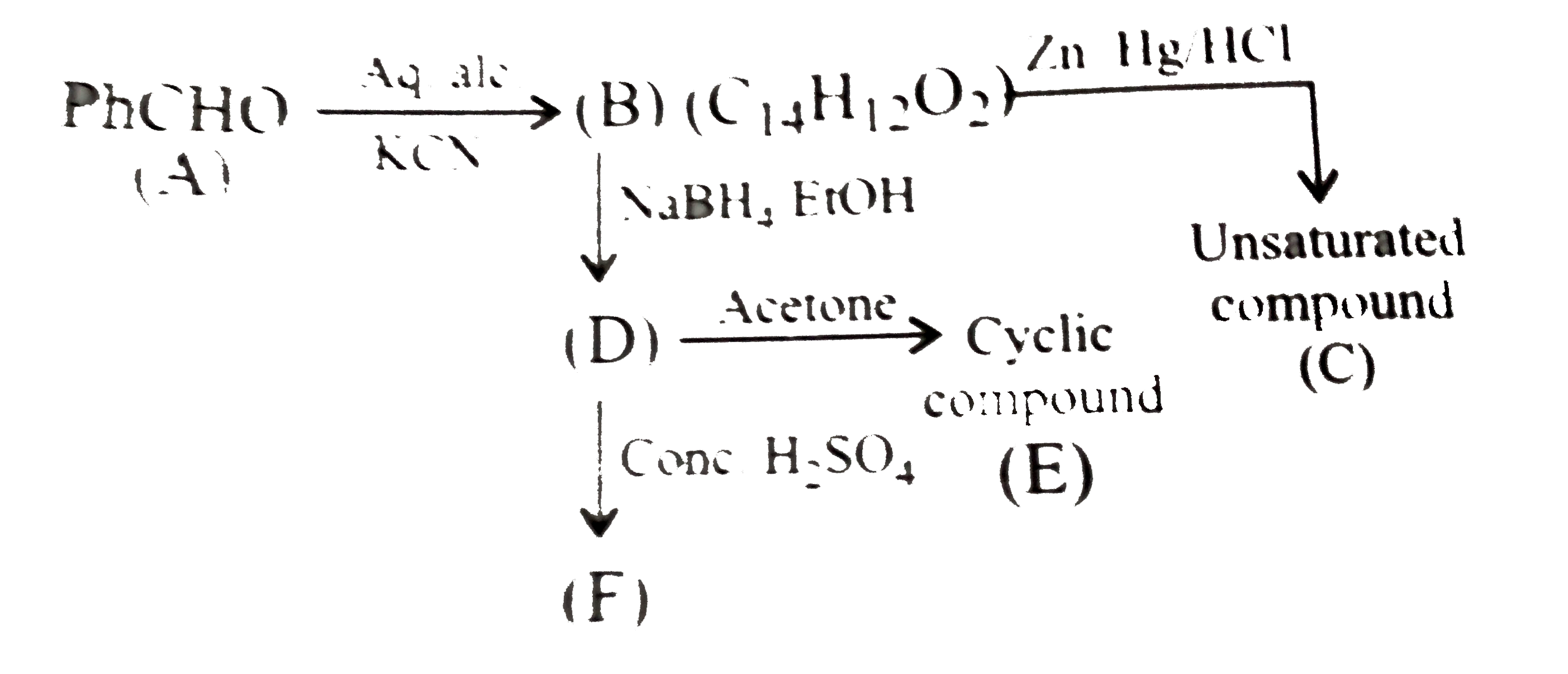
A
B
C
D
Text Solution
Verified by Experts
The correct Answer is:



Topper's Solved these Questions
ALIPHATIC AND AROMATIC ALDEHYDES AND KETONES
CENGAGE CHEMISTRY ENGLISH|Exercise Exercises Multiple Correct|33 VideosALIPHATIC AND AROMATIC ALDEHYDES AND KETONES
CENGAGE CHEMISTRY ENGLISH|Exercise Exercises Single Correct|71 VideosALIPHATIC AND AROMATIC ALDEHYDES AND KETONES
CENGAGE CHEMISTRY ENGLISH|Exercise Exercises Concept Application|20 VideosALCOHOL,PHENOL AND ETHERS
CENGAGE CHEMISTRY ENGLISH|Exercise Archives Analytical And Descriptive|15 VideosAPPENDIX INORGANIC VOLUME 2
CENGAGE CHEMISTRY ENGLISH|Exercise Short Answer Type|179 Videos
Similar Questions
Explore conceptually related problems
CENGAGE CHEMISTRY ENGLISH-ALIPHATIC AND AROMATIC ALDEHYDES AND KETONES-Exercises Linked Comprehension
- Compound (C ) is:
Text Solution
|
- Compound (D) is:
Text Solution
|
- The convertion of (A) to (B) is called:
Text Solution
|
- Compound (B) is:
Text Solution
|
- Compound (C ) is:
Text Solution
|
- Compound (D) is:
Text Solution
|
- Compound (E ) is:
Text Solution
|
- Compound (F) is:
Text Solution
|
- Consider the following reaction in which compound (A) on reaction with...
Text Solution
|
- Consider the following reaction in which compound (A) on reaction with...
Text Solution
|
- Consider the following reaction in which compound (A) on reaction with...
Text Solution
|
- Compound (C ) is:
Text Solution
|
- Compound (D) is:
Text Solution
|
- Compound (E ) is:
Text Solution
|
- Compound (F) is:
Text Solution
|
- Which of the statements is/are correct in the formation of (E ) from (...
Text Solution
|
- i. iv. Compound (X) has the highest melting point among its isomer...
Text Solution
|
- i. iv. Compound (X) has the highest melting point among its isomer...
Text Solution
|
- i. iv. Compound (X) has the highest melting point among its isome...
Text Solution
|
- i. iv. Compound (X) has the highest melting point among its isome...
Text Solution
|