Home
Class 12
CHEMISTRY
Compound C(4)H(8)O(2) exists in various ...

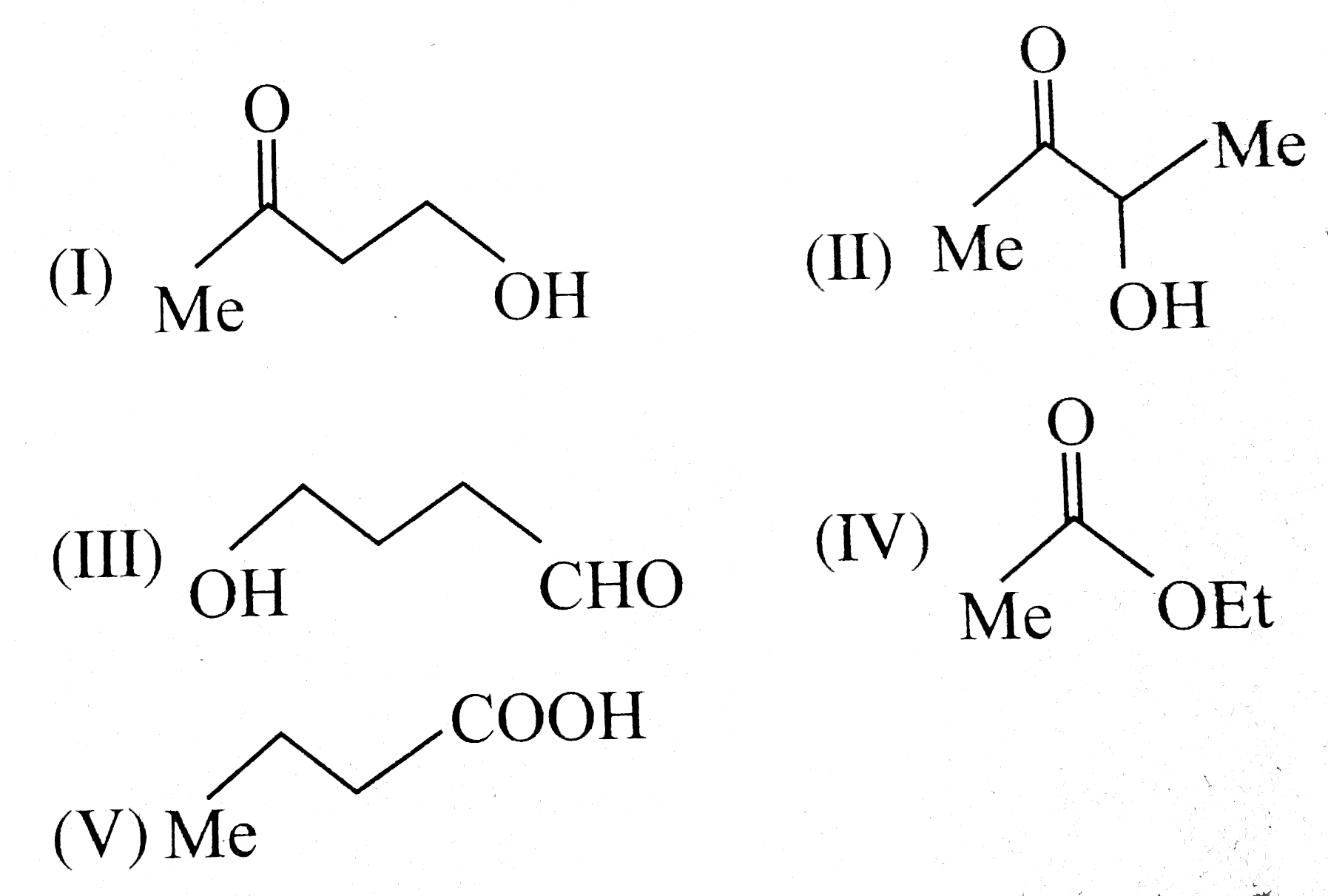
Compound `C_(4)H_(8)O_(2)` exists in various strutures as shown:

Which statement(s) is/are correct?

A

a.Compounds I and II give iodoform test. Compound I gives white turbidity on heating with Lucas reagent, while compound II reduces Tollens reagent.

B

b.Compound III gives silver mirror with `[Ag(NH_(3))_(2)]^(o+)` and does not react with NaOBr.

C

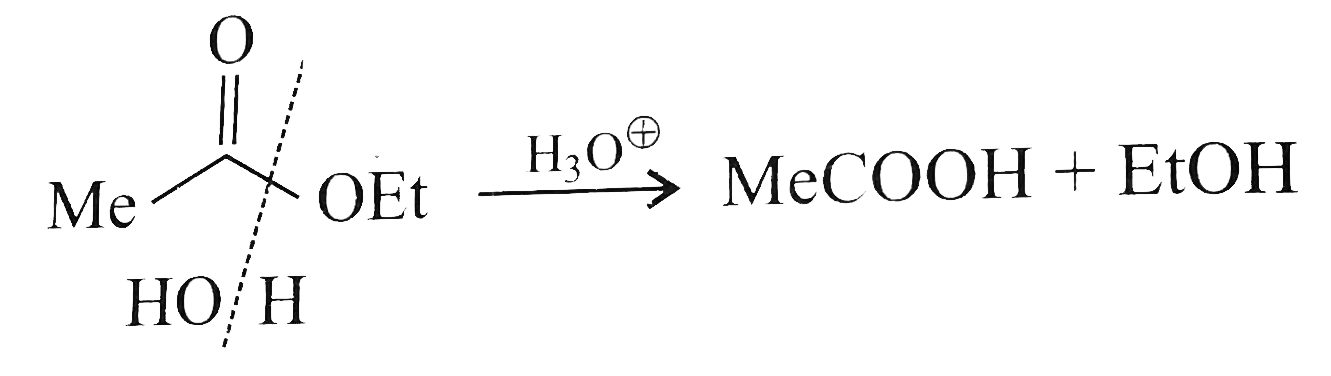
c.Compound IV on acid hydrolysis gives `C_(2)H_(5)COOH` and `MeOH`

D

d.Compound V on heating is decarboxylated to propane.

Text Solution

Verified by Experts

The correct Answer is:
A, B

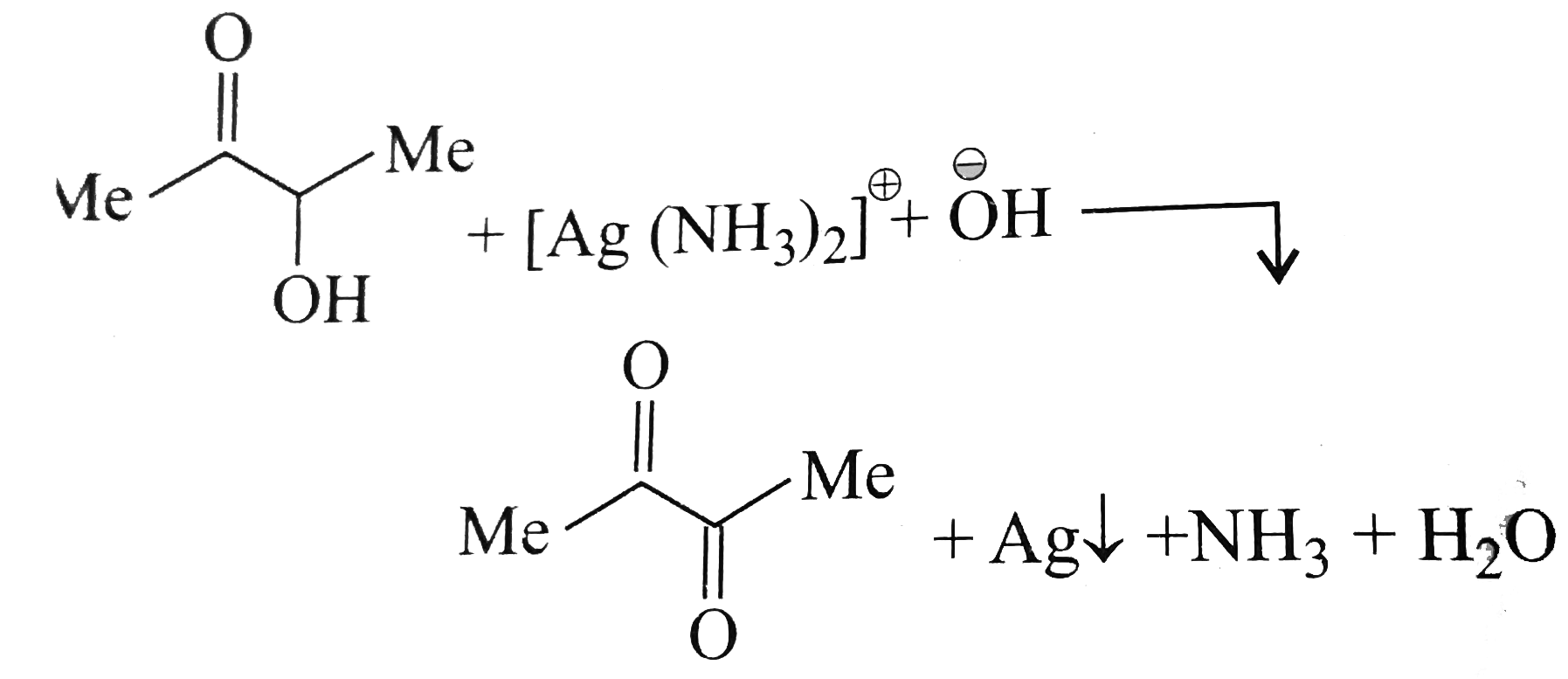
a. Compound (I) contains `(Me-overset(O)overset(||)(C )-)` group hence gives iodoform test. It also contains `1^(@)` alcoholic with Lucas reagent (anhydrous `ZnCl_(2): "conc". HCl=1:1)`. Compound (II) reduces Tollensreagent although it does not contain `(-CHO)` group but T.R. test is also given by `alpha`-hydroxy ketones.

So the statement `(a)` is correct.
b. Compound (III) is an aldehyde, so it gives positive T.R. test but it does not give halform reaction with NaOBr or `(NaOH+Br_(2))`, since it does not contain `(CH_(3)-CHO)` group. So the statement `(b)` is also correct.
c.
d. Compound `(V)` on heating cannot decarboxylate, but with soda lime it can decarboxylate to give propane. Only acids containing `beta-keto` group can easily undergo decarboxylation on heating.
So the statement (d) is wrong.
Hence, the answer are `(a)` and `(b)`.
Promotional Banner

Topper's Solved these Questions

  • REDUCTION AND OXIDATION REACTION OF ORGANIC COMPOUNDS

    CENGAGE CHEMISTRY ENGLISH|Exercise Exercise (Single Correct)|90 Videos
  • REDUCTION AND OXIDATION REACTION OF ORGANIC COMPOUNDS

    CENGAGE CHEMISTRY ENGLISH|Exercise Exercise (Assertion And Reasoning)|10 Videos
  • REDUCTION AND OXIDATION REACTION OF ORGANIC COMPOUNDS

    CENGAGE CHEMISTRY ENGLISH|Exercise Exercise (Linked Comprehension)|52 Videos
  • QUALITATIVE INORGANIC SALT ANALYSIS

    CENGAGE CHEMISTRY ENGLISH|Exercise Viva Voce Questions And Part-C (Analysis Of Cations)|42 Videos
  • SOLID STATE

    CENGAGE CHEMISTRY ENGLISH|Exercise Ex 1.2 (Objective)|9 Videos

Similar Questions

Explore conceptually related problems

C_(4)H_(8)O_(2) represents :-

Compound (A) , an alkene with molecule formula (C_(5)H_(10)) exists in various strictures. On mononcholorination and dichlorination, it again shows various structures and streoisomers. Which isomer of (A) shows styereoisomerism ?

A mixture of n_(1) moles of Na_(2)C_(2)O_(4) and NaHC_(2)O_(4) is titrated separately with H_(2)O_(2) and KOH , to reach at equivalence point. Which of the following statement is/are correct?

Compound (A) C_(5)H_(8)O_(2) liberated CO_(2) on reaction with sodium bicarbonate. It exists in two forms neither of which is optically active. It yielded compound (B) C_(5)H_(10)O_(2) on hydrogenation. Compound (B) can be separated into enantiomorphs. Write structures of (A) and (B).

8 gm H_(2) and 32 gm O_(2) is allowed to recant to form water then which of the following statement is correct ?

An organic compound (A) , C_(4)H_(8)Cl_(2) on hydrolysis forms another compound (B) , C_(4)H_(8)O . If (B) does not responds to iodo form test , then identify possible structures of (A) and (B).

An optically active compound H(C_(5)H_(6)O) on treatment with H_(2) in the presence of Lindlar's catalyst gave a compound I (C_(5)H_(8)O) . Upon hydrogenation with H_(2) and Pd/C, Compound H gave J (C_(5)H_(12)O) . Both I and J were found to b optically inactive. Select the correct statements.

(C) overset(H_(3)O^(+)//H_(2)O)(rarr)(E) (D) overset(H_(3)O^(+)//H_(2)O)(rarr) (F) Which of the following statements is // are correct ?

CENGAGE CHEMISTRY ENGLISH-REDUCTION AND OXIDATION REACTION OF ORGANIC COMPOUNDS-Exercise (Multiple Correct)
  1. In Q. No. 3, direct conversion of II to V can be carried by:

    Text Solution

    |

  2. Consider the following reactions: Which of the following group(s)...

    Text Solution

    |

  3. Compound C(4)H(8)O(2) exists in various strutures as shown: Whic...

    Text Solution

    |

  4. Consider the following Baeyer-Villiger oxidation.

    Text Solution

    |

  5. Select the correct Baeyer-Villiger oxidation reaction:

    Text Solution

    |

  6. Select the correct group(s) of reagent(s) used in the following conver...

    Text Solution

    |

  7. Which statements(s) is//are correct:

    Text Solution

    |

  8. Which of the following statement(s) is/are correct?

    Text Solution

    |

  9. In Q.No. 11, which of the following reagents can be used to convert (A...

    Text Solution

    |

  10. Which of the following will give yellow precipitate with KOI?

    Text Solution

    |

  11. Which of the following will undergo periodic oxidation?

    Text Solution

    |

  12. Which of the following reactions is not correct ?

    Text Solution

    |

  13. Which of the following reactions is//are correct?

    Text Solution

    |

  14. Which statement(s) is/are wrong?

    Text Solution

    |

  15. Which of the following reaction(s) is/are correct?

    Text Solution

    |

  16. Which of the following reaction(s) is/are wrong?

    Text Solution

    |

  17. Which of the following reactions is/are wrong?

    Text Solution

    |

  18. Which of the following unbalanced reactions is/are correct?

    Text Solution

    |

  19. Which of the following methods is/are correct for the synthesis of ben...

    Text Solution

    |

  20. Which of the following reaction is/are correct?

    Text Solution

    |