
Home
Class 12
CHEMISTRY
Which of the following reaction(s) is/ar...

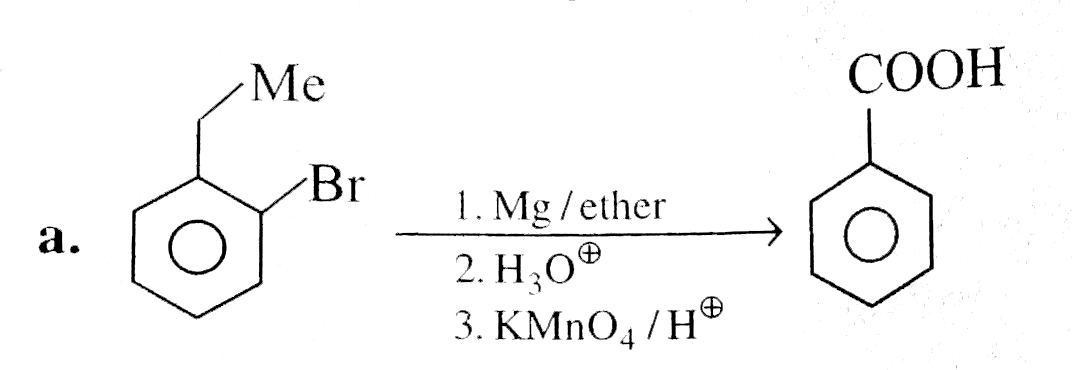
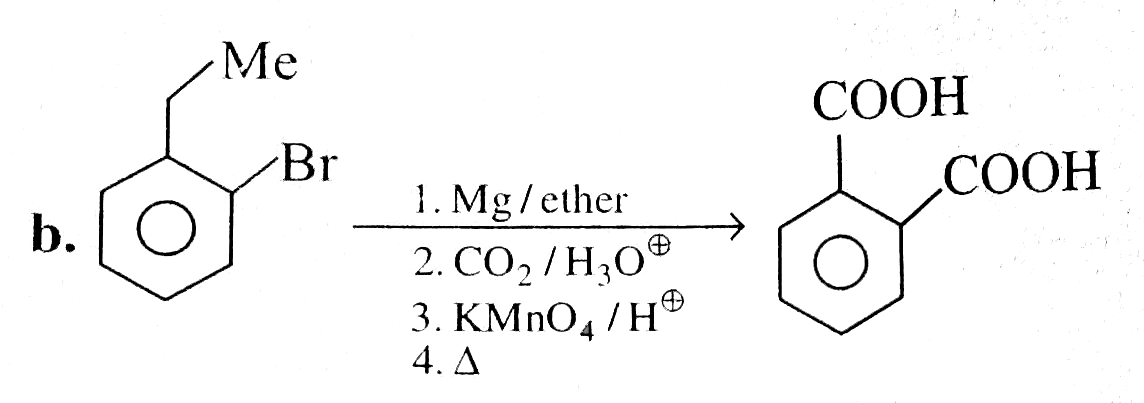
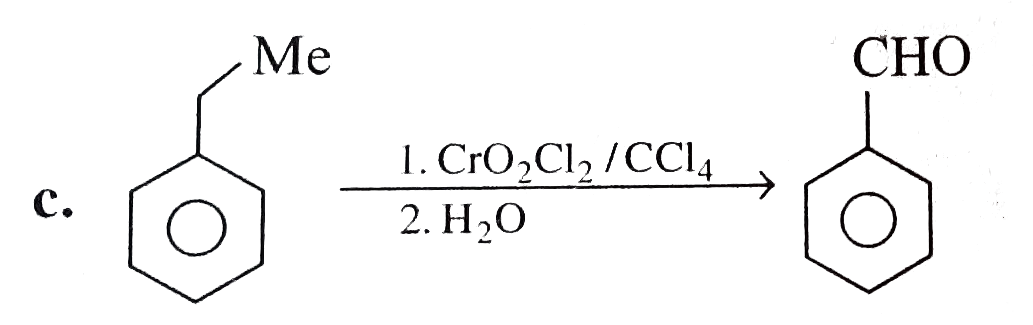
Which of the following reaction(s) is/are wrong?

A

a.

B

b.

C

c.

D

d.

Text Solution

AI Generated Solution

The correct Answer is:

To determine which of the reactions are wrong, we will analyze each reaction step by step. ### Step 1: Analyze Reaction A 1. **Starting Material**: A phenyl ring with an ethyl group (–CH2CH3) and a bromine atom (–Br) in the ortho position. 2. **Reagent**: Magnesium (Mg) in ether. 3. **Reaction**: The bromine reacts with magnesium to form a Grignard reagent (C6H5CH2CH3MgBr). 4. **Outcome**: The ethyl group remains intact, and the Grignard reagent is formed correctly. **Conclusion for Reaction A**: This reaction is correct. ### Step 2: Analyze Reaction B 1. **Starting Material**: The same phenyl ring with an ethyl group and bromine. 2. **Reagent**: Grignard reagent (from Reaction A) treated with CO2 followed by H3O+. 3. **Reaction**: The Grignard reagent reacts with CO2 to form benzoic acid (C6H5COOH) while the ethyl group remains unchanged. 4. **Next Step**: KMnO4 in the presence of H+ is used, which oxidizes the ethyl group to a carboxylic acid (–COOH). 5. **Outcome**: The final product should be phthalic acid (C6H4(COOH)2) after heating, which forms an anhydride. **Conclusion for Reaction B**: The formation of an anhydride from phthalic acid is not correctly represented in the steps provided, making this reaction wrong. ### Step 3: Analyze Reaction C 1. **Starting Material**: The same phenyl ring with an ethyl group. 2. **Reagent**: Chromyl chloride (CrO2Cl2) in CCl4. 3. **Reaction**: This is an ethyl reaction that should yield an aldehyde. 4. **Outcome**: The expected product should maintain the same number of carbons as the starting material. However, the reaction indicates a loss of one carbon atom. **Conclusion for Reaction C**: The product has one less carbon than the reactant, indicating that this reaction is also wrong. ### Step 4: Analyze Reaction D 1. **Starting Material**: The same phenyl ring with an ethyl group. 2. **Reagent**: KMnO4 in H+. 3. **Reaction**: This reaction oxidizes the side chain to benzoic acid. 4. **Outcome**: The product is correctly formed as benzoic acid. **Conclusion for Reaction D**: This reaction is correct. ### Final Conclusion - **Wrong Reactions**: B and C - **Correct Reactions**: A and D ### Summary of Wrong Reactions: - **B**: Incorrect due to the misrepresentation of anhydride formation. - **C**: Incorrect due to loss of carbon in the product. ---

To determine which of the reactions are wrong, we will analyze each reaction step by step. ### Step 1: Analyze Reaction A 1. **Starting Material**: A phenyl ring with an ethyl group (–CH2CH3) and a bromine atom (–Br) in the ortho position. 2. **Reagent**: Magnesium (Mg) in ether. 3. **Reaction**: The bromine reacts with magnesium to form a Grignard reagent (C6H5CH2CH3MgBr). 4. **Outcome**: The ethyl group remains intact, and the Grignard reagent is formed correctly. ...
Promotional Banner

Topper's Solved these Questions

  • REDUCTION AND OXIDATION REACTION OF ORGANIC COMPOUNDS

    CENGAGE CHEMISTRY ENGLISH|Exercise Exercise (Single Correct)|90 Videos
  • REDUCTION AND OXIDATION REACTION OF ORGANIC COMPOUNDS

    CENGAGE CHEMISTRY ENGLISH|Exercise Exercise (Assertion And Reasoning)|10 Videos
  • REDUCTION AND OXIDATION REACTION OF ORGANIC COMPOUNDS

    CENGAGE CHEMISTRY ENGLISH|Exercise Exercise (Linked Comprehension)|52 Videos
  • QUALITATIVE INORGANIC SALT ANALYSIS

    CENGAGE CHEMISTRY ENGLISH|Exercise Viva Voce Questions And Part-C (Analysis Of Cations)|42 Videos
  • SOLID STATE

    CENGAGE CHEMISTRY ENGLISH|Exercise Ex 1.2 (Objective)|9 Videos

Similar Questions

Explore conceptually related problems

Which of the following reaction(s) is/are correct?

Which of the following statement(s) is/are wrong ?

Which of the following reaction are wrong?

Which of the following statements is/are wrong ?

Which of the following statements is//are wrong?

Which of the following statements is//are wrong?

Which of the following statements is/are wrong?

Which of the following statements is/are wrong?

Which of the following statements is/are wrong?

Which of the following statements is/are wrong ?

CENGAGE CHEMISTRY ENGLISH-REDUCTION AND OXIDATION REACTION OF ORGANIC COMPOUNDS-Exercise (Multiple Correct)
  1. Which of the following reactions is//are correct?

    Text Solution

    |

  2. Which statement(s) is/are wrong?

    Text Solution

    |

  3. Which of the following reaction(s) is/are correct?

    Text Solution

    |

  4. Which of the following reaction(s) is/are wrong?

    Text Solution

    |

  5. Which of the following reactions is/are wrong?

    Text Solution

    |

  6. Which of the following unbalanced reactions is/are correct?

    Text Solution

    |

  7. Which of the following methods is/are correct for the synthesis of ben...

    Text Solution

    |

  8. Which of the following reaction is/are correct?

    Text Solution

    |

  9. Which of the following methods is/are correct for the synthesis of

    Text Solution

    |

  10. Which of the following on oxidation with alkaline KMnO(4) follwed by a...

    Text Solution

    |

  11. Which of the following methods can be used to prepare propanoic acid?

    Text Solution

    |

  12. Which of the following statements is/are correct about formic acid?

    Text Solution

    |

  13. Which of the following can reduce Benedict's solution?

    Text Solution

    |

  14. Benzoic acid and carbolic acid can be distiguished by:

    Text Solution

    |

  15. Which of the following compounds will not give haloform reaction?

    Text Solution

    |

  16. Which of the following compounds do(es) not react with H(2)+Pd+C?

    Text Solution

    |

  17. Which of the following compounds reacts with NaCNBH(3)?

    Text Solution

    |

  18. Acetonitrile (Meoverset(o+)(N)-=overset(ɵ)(C )) on reaction with Cl(2)...

    Text Solution

    |

  19. Alkyl isocyanides (Roverset(o+)(N)-=overset(ɵ)(C )) are reduced to 2^(...

    Text Solution

    |

  20. Methanamide is reduced to methanamine with:

    Text Solution

    |
