Home
Class 12
CHEMISTRY
Which of the following compounds do(es) ...

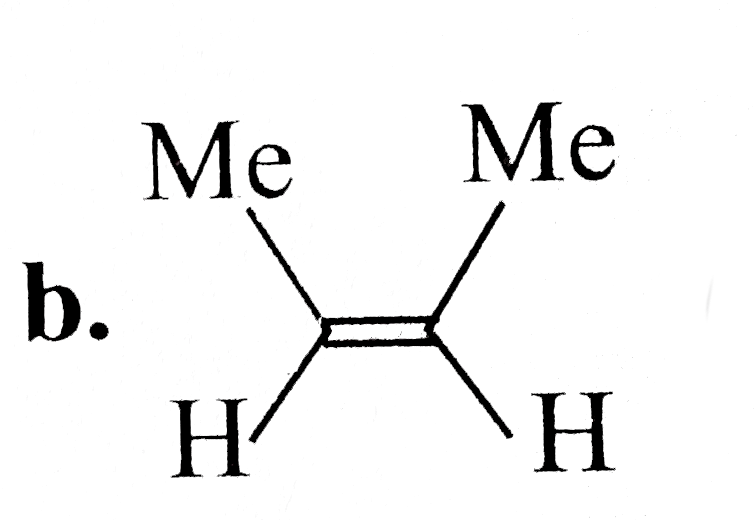
Which of the following compounds do(es) not react with `H_(2)+Pd+C`?

A

a.`Me- -= -Me`

B

b.

C

c.`MeCOMe`

D

d.`Me-N_(3)`

Text Solution

AI Generated Solution

The correct Answer is:

To determine which of the following compounds does not react with `H2 + Pd + C`, we need to analyze the nature of the compounds and the reaction conditions. The compounds in question are likely to include different types of functional groups, such as alkynes, alkenes, azides, and ketones. ### Step-by-Step Solution: 1. **Understanding the Reaction:** - The combination of `H2`, palladium (Pd), and carbon (C) is commonly used in catalytic hydrogenation reactions. This process typically reduces multiple types of unsaturated compounds, including alkynes (triple bonds), alkenes (double bonds), and some azides. 2. **Analyzing Each Compound:** - **Option A: Alkyne (e.g., MeC≡CMe)** - Alkynes can be reduced to alkenes and then to alkanes. When treated with `H2 + Pd + C`, the triple bond will first convert to a double bond and then to a single bond upon further hydrogenation. - **Conclusion:** This compound will react. - **Option B: Alkene (e.g., MeCH=CHMe)** - Alkenes can also be reduced to alkanes. The double bond will break, and hydrogen will be added across the double bond. - **Conclusion:** This compound will react. - **Option C: Azide (e.g., MeN3)** - Azides can be reduced to amines. The nitrogen-nitrogen bonds can be broken, and hydrogen can be added to form an amine. - **Conclusion:** This compound will react. - **Option D: Ketone (e.g., MeC(=O)Me)** - Ketones are generally more stable and require stronger reducing agents to convert to alcohols. The reaction with `H2 + Pd + C` is not favorable because the carbon-oxygen double bond is stable and does not easily undergo reduction without a stronger nucleophile. - **Conclusion:** This compound will NOT react. 3. **Final Answer:** - The compound that does not react with `H2 + Pd + C` is **Option C: Ketone (MeC(=O)Me)**.

To determine which of the following compounds does not react with `H2 + Pd + C`, we need to analyze the nature of the compounds and the reaction conditions. The compounds in question are likely to include different types of functional groups, such as alkynes, alkenes, azides, and ketones. ### Step-by-Step Solution: 1. **Understanding the Reaction:** - The combination of `H2`, palladium (Pd), and carbon (C) is commonly used in catalytic hydrogenation reactions. This process typically reduces multiple types of unsaturated compounds, including alkynes (triple bonds), alkenes (double bonds), and some azides. 2. **Analyzing Each Compound:** ...
Promotional Banner

Topper's Solved these Questions

  • REDUCTION AND OXIDATION REACTION OF ORGANIC COMPOUNDS

    CENGAGE CHEMISTRY ENGLISH|Exercise Exercise (Single Correct)|90 Videos
  • REDUCTION AND OXIDATION REACTION OF ORGANIC COMPOUNDS

    CENGAGE CHEMISTRY ENGLISH|Exercise Exercise (Assertion And Reasoning)|10 Videos
  • REDUCTION AND OXIDATION REACTION OF ORGANIC COMPOUNDS

    CENGAGE CHEMISTRY ENGLISH|Exercise Exercise (Linked Comprehension)|52 Videos
  • QUALITATIVE INORGANIC SALT ANALYSIS

    CENGAGE CHEMISTRY ENGLISH|Exercise Viva Voce Questions And Part-C (Analysis Of Cations)|42 Videos
  • SOLID STATE

    CENGAGE CHEMISTRY ENGLISH|Exercise Ex 1.2 (Objective)|9 Videos

Similar Questions

Explore conceptually related problems

Which of the following compounds does not react with NaOH ?

Which of the following compounds does not react with NaHSO_(3) ?

Which of the following compound will not react with l_(2)//OH^(-) .

Which of the following compound will not react with I_(2)//OH^(-) .

Which of the following compounds reacts with NaCNBH_(3) ?

Which of the following compound react with B_(2)H_(6) ?

Which of the following compound does not react with Tollen's reagent?

CENGAGE CHEMISTRY ENGLISH-REDUCTION AND OXIDATION REACTION OF ORGANIC COMPOUNDS-Exercise (Multiple Correct)
  1. Which of the following reactions is//are correct?

    Text Solution

    |

  2. Which statement(s) is/are wrong?

    Text Solution

    |

  3. Which of the following reaction(s) is/are correct?

    Text Solution

    |

  4. Which of the following reaction(s) is/are wrong?

    Text Solution

    |

  5. Which of the following reactions is/are wrong?

    Text Solution

    |

  6. Which of the following unbalanced reactions is/are correct?

    Text Solution

    |

  7. Which of the following methods is/are correct for the synthesis of ben...

    Text Solution

    |

  8. Which of the following reaction is/are correct?

    Text Solution

    |

  9. Which of the following methods is/are correct for the synthesis of

    Text Solution

    |

  10. Which of the following on oxidation with alkaline KMnO(4) follwed by a...

    Text Solution

    |

  11. Which of the following methods can be used to prepare propanoic acid?

    Text Solution

    |

  12. Which of the following statements is/are correct about formic acid?

    Text Solution

    |

  13. Which of the following can reduce Benedict's solution?

    Text Solution

    |

  14. Benzoic acid and carbolic acid can be distiguished by:

    Text Solution

    |

  15. Which of the following compounds will not give haloform reaction?

    Text Solution

    |

  16. Which of the following compounds do(es) not react with H(2)+Pd+C?

    Text Solution

    |

  17. Which of the following compounds reacts with NaCNBH(3)?

    Text Solution

    |

  18. Acetonitrile (Meoverset(o+)(N)-=overset(ɵ)(C )) on reaction with Cl(2)...

    Text Solution

    |

  19. Alkyl isocyanides (Roverset(o+)(N)-=overset(ɵ)(C )) are reduced to 2^(...

    Text Solution

    |

  20. Methanamide is reduced to methanamine with:

    Text Solution

    |
