


Home
Class 12
CHEMISTRY
(+) - Arabinose is (2R,3S,4S) - aldopent...

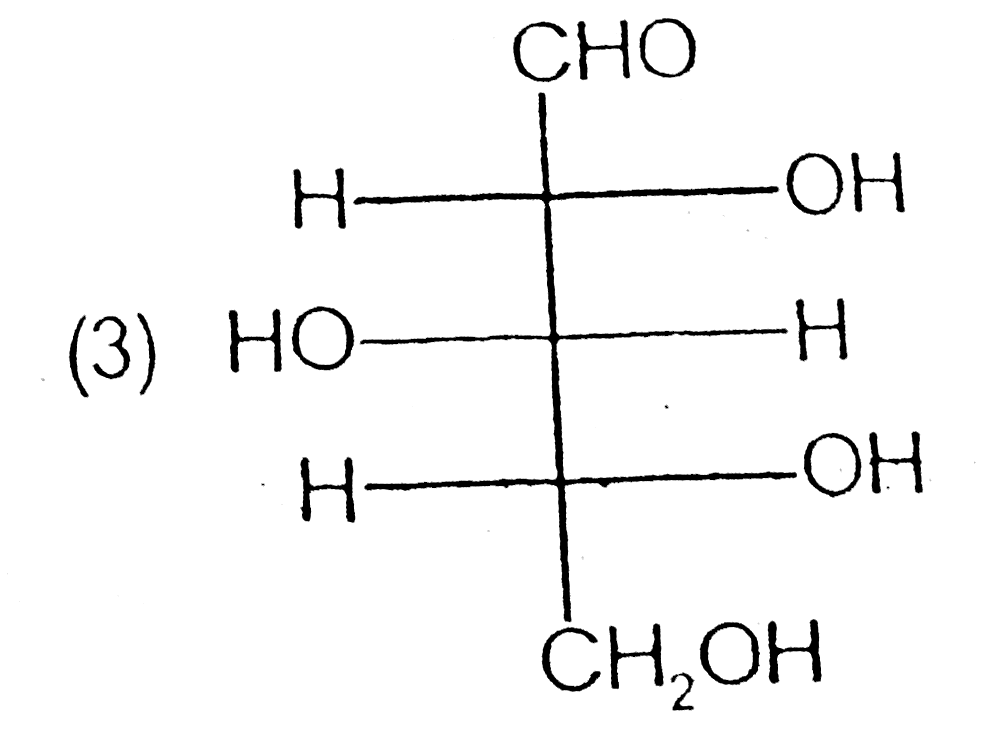
`(+) -` Arabinose is `(2R,3S,4S) -` aldopentose. Which of the following is `(+)` arabinose ?

A

B

C

D

Text Solution

AI Generated Solution

The correct Answer is:

To determine which of the given options corresponds to the `(+)` arabinose with the configuration `(2R, 3S, 4S)`, we will analyze each option step by step based on the stereochemistry rules. ### Step 1: Understanding the Configuration We know that `(+)` arabinose is an aldopentose with the following configurations: - Position 2: R - Position 3: S - Position 4: S ### Step 2: Analyzing the Options We will analyze each option to determine the stereochemistry at positions 2, 3, and 4. #### Option 1: 1. **Position 2**: - Identify the groups attached to the chiral carbon. - Assign priorities based on atomic number. - Determine the configuration (R or S). - Since the least priority group is on the horizontal axis, the configuration is reversed. 2. **Position 3**: - Repeat the process of identifying groups, assigning priorities, and determining configuration. - Again, reverse the configuration due to the least priority group being on the horizontal axis. 3. **Position 4**: - Follow the same steps as above. After analyzing, we find that this option does not match the required configurations. #### Option 2: 1. **Position 2**: - Assign priorities and determine configuration. - Reverse the configuration due to the least priority group on the horizontal axis. 2. **Position 3**: - Assign priorities and determine configuration. - Reverse the configuration due to the least priority group on the horizontal axis. 3. **Position 4**: - Assign priorities and determine configuration. - Reverse the configuration due to the least priority group on the horizontal axis. After analysis, we find that this option matches the required configurations `(2R, 3S, 4S)`. #### Option 3: 1. **Position 2**: - Follow the same steps as above. 2. **Position 3**: - Follow the same steps as above. 3. **Position 4**: - Follow the same steps as above. This option does not match the required configurations. #### Option 4: 1. **Position 2**: - Follow the same steps as above. 2. **Position 3**: - Follow the same steps as above. 3. **Position 4**: - Follow the same steps as above. This option also does not match the required configurations. ### Conclusion After analyzing all options, we conclude that **Option 2** corresponds to `(+)` arabinose with the configuration `(2R, 3S, 4S)`.
Promotional Banner

Topper's Solved these Questions

  • BIOMOLECULES

    AAKASH INSTITUTE ENGLISH|Exercise Section-C (Objective Type Questions (More than one option is correct))|10 Videos
  • BIOMOLECULES

    AAKASH INSTITUTE ENGLISH|Exercise Section-D (Comprehension Questions )|9 Videos
  • BIOMOLECULES

    AAKASH INSTITUTE ENGLISH|Exercise Objective type question(Objective Type Questions (One option is correct))|5 Videos
  • AMINES

    AAKASH INSTITUTE ENGLISH|Exercise Assignment Section -J (Aakash Challengers Questions)|9 Videos
  • CHEMICAL BONDING AND MOLECULAR STRUCTURE

    AAKASH INSTITUTE ENGLISH|Exercise Assignment Section J (Aakash Challengers Questions)|10 Videos

Similar Questions

Explore conceptually related problems

Which of the following is an example of aldopentose

Which of the following compounds is D-aldopentose?

Threonine is (2S,3R) -2- amino -3- hydroxybutanoic acid. Which of the following is threonine ?

Excess of Ag_(2)SO_(4)(s), BaSO_(4)(s) , and Ba_(3)(PO_(4))_(2)(s) are simultaneously in euqilibrium with distilled water. Which of the following is (are) true? Assume no hydrolysis of dissolved ions.

For a reaction P + Q to 2R + S . Which of the following statements is incorrect?

Consider two regions: R_1: Point P is nearer to (1,0) then to x=-1. R_2: Point P is nearer to (0,0) then to (8,0). Then which of the following statements are true: Statement 1 : The area of the region common to R_1 and R_2 is (128)/3s q dotu n i t s . Statement 2 : The area bounded by x=4sqrt(y) and y=4 is (32)/3s qdotu n i t s .

The rate of disapperance of Q in the reaction 2P+Q to 2R+3S is 2 times 10^-2 moles l^-1 s^-1 . Which of the following statement is not true?

If A = {p,q,r, s} and B = {1, 2, 3} , find which of the following is not a function from A to B R 1​={(p,1),(q,2),(r,1),(s,2)}

If A = {p,q,r, s} and B = {1, 2, 3} , find which of the following is not a function from A to B? (i) R1={(p,1),(q,2),(r,1),(s,2)} (ii) R2={(p,1),(q,1),(r,1),(s,1)}
