Home
Class 12
PHYSICS
A body performs S.H.M. Its kinetic energ...

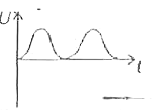
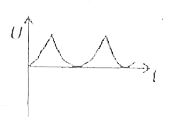
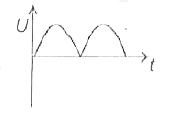
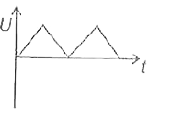
A body performs S.H.M. Its kinetic energy K varies with time t as indicated by graph

A

B

C

D

Text Solution

AI Generated Solution

The correct Answer is:

To solve the problem regarding the variation of kinetic energy (K) of a body performing simple harmonic motion (SHM) with time (t), we can follow these steps: ### Step 1: Understand the Kinetic Energy Formula The kinetic energy (K) of a body is given by the formula: \[ K = \frac{1}{2} mv^2 \] where \( m \) is the mass of the body and \( v \) is its velocity. ### Step 2: Write the Velocity Equation for SHM In simple harmonic motion, the velocity \( v \) can be expressed as: \[ v = A \omega \cos(\omega t + \alpha) \] where: - \( A \) is the amplitude, - \( \omega \) is the angular frequency, - \( \alpha \) is the phase constant. ### Step 3: Substitute Velocity into the Kinetic Energy Formula Now, substitute the expression for velocity into the kinetic energy formula: \[ K = \frac{1}{2} m (A \omega \cos(\omega t + \alpha))^2 \] This simplifies to: \[ K = \frac{1}{2} m A^2 \omega^2 \cos^2(\omega t + \alpha) \] ### Step 4: Analyze the Kinetic Energy Expression From the expression \( K = \frac{1}{2} m A^2 \omega^2 \cos^2(\omega t + \alpha) \), we can observe: - The term \( \cos^2(\omega t + \alpha) \) is always non-negative (i.e., it is always greater than or equal to zero). - Therefore, the kinetic energy \( K \) will always be a positive quantity or zero. ### Step 5: Determine the Graph of Kinetic Energy Since \( K \) varies with \( \cos^2(\omega t + \alpha) \), the graph of kinetic energy versus time will resemble the graph of \( \cos^2 \) function, which oscillates between 0 and a maximum value (when \( \cos^2 \) is 1). ### Step 6: Choose the Correct Option From the options provided, we need to identify the graph that represents the positive oscillation of kinetic energy, which is consistent with the behavior of \( \cos^2 \) function. The correct option will be the one that shows a graph oscillating between 0 and a maximum positive value. ### Final Conclusion Thus, based on the analysis, the correct option is the one that represents the kinetic energy graph as a function of time that is always non-negative. ---
Promotional Banner

Topper's Solved these Questions

  • OSCILLATIONS

    AAKASH INSTITUTE ENGLISH|Exercise Assignment (Section C) (PREVIOUS YEARS QUESTIONS)|43 Videos
  • OSCILLATIONS

    AAKASH INSTITUTE ENGLISH|Exercise Assignment (Section D) (ASSERTION-REASON TYPE QUESTIONS)|13 Videos
  • OSCILLATIONS

    AAKASH INSTITUTE ENGLISH|Exercise Assignment (Section - A) (OBJECTIVE TYPE QUESTIONS)|60 Videos
  • NUCLEI

    AAKASH INSTITUTE ENGLISH|Exercise ASSIGNMENT (SECTION-D)|10 Videos
  • PHYSICAL WORLD

    AAKASH INSTITUTE ENGLISH|Exercise ASSIGNMENT (Section-B)|4 Videos

Similar Questions

Explore conceptually related problems

A body is performing SHM, then its

A particle starts moving from the origin & moves along positive x-direction. Its rate of change of kinetic energy with time shown on y-axis varies with time t as shown in the graph. If position, velocity acceleration & kinetic energy of the particle at any time t are x,v a & k respectively then which of the option (s) may be correct ?

A body of mass 1 kg starts moving from rest t = 0 in a circular path of radius 8 m. Its kinetic energy varies with time as k = 2t^(2) J then the correct statement are:

A particle starts moving from rest the origin & moves along positive x- direction . Its rate of change of kinetic energy with time shown on y- axis veries with time t as shown in the graph. If position, velocity , acceleration & kinetic energy of the particle at any time t are x,v,a,& k respectively then which of the option (s) may be correct ?

In S.H.M., potential energy (U) V/s, time (t) . Graph is

A particle is performing S.H.M. Its total energy ie E When the displacement of the particle is half of its amplitude, its K.E. will be

A particle falls from rest under gravity. Its potential energy with respect to the ground (PE) and its kinetic energy (KE) are plotted against time (t). Choose the correct graph.

A particle falls from rest under gravity. Its potential energy with respect to the ground (PE) and its kinetic energy (KE) are plotted against time (t). Choose the correct graph.

The total energy of the body executing S.H.M. is E. Then the kinetic energy when the displacement is half of the amplitude is

A particle moves vertically with an upwards initial speed v_0 = 10.5 ms^(-1). If its acceleration varies with time as shown in a-t graph in figure, find the velocity of the particles at t = 4s.

AAKASH INSTITUTE ENGLISH-OSCILLATIONS-Assignment (Section - B) (OBJECTIVE TYPE QUESTIONS)
  1. A particle execute SHM and its position varies with time as x = A sin ...

    Text Solution

    |

  2. A particle of mass m in a unidirectional potential field have potentia...

    Text Solution

    |

  3. A particle is executing SHM and its velocity v is related to its posit...

    Text Solution

    |

  4. A loaded vertical spring executes simple harmonic oscillations with pe...

    Text Solution

    |

  5. A body performs S.H.M. Its kinetic energy K varies with time t as ind...

    Text Solution

    |

  6. A particle is performing SHM energy of vibration 90J and amplitude 6cm...

    Text Solution

    |

  7. The variations of potential energy (U) with position x for three simpl...

    Text Solution

    |

  8. If the particle repeats its motion after a fixed time interval of 8 s ...

    Text Solution

    |

  9. A particle is executing SHM with total mechanical energy 90J and ampli...

    Text Solution

    |

  10. A linear harmonic oscillator of force constant 6 xx 10^(5) N/m and amp...

    Text Solution

    |

  11. A seconds pendulum is mounted in a rocket. Its period of oscillation d...

    Text Solution

    |

  12. The curve between square of frequency of oscillation and length of the...

    Text Solution

    |

  13. A simple pendulum of mass m executes SHM with total energy E. if at an...

    Text Solution

    |

  14. There is a rod of length l and mass m. It is hinged at one end to the ...

    Text Solution

    |

  15. A rectangular block of mass m and area of cross-section A floats in a ...

    Text Solution

    |

  16. When a mass of 5 kg is suspended from a spring of negligible mass and ...

    Text Solution

    |

  17. In the figure shown, there is friction between the blocks P and Q but ...

    Text Solution

    |

  18. A flat horizontal board moves up and down under SHM vertically with am...

    Text Solution

    |

  19. A simple pendulum with iron bob has a time period T. The bob is now im...

    Text Solution

    |

  20. When a mass m attached to a spring it oscillates with period 4s. When ...

    Text Solution

    |
