Home
Class 12
MATHS
Sum of all the numbers that can be forme...

Sum of all the numbers that can be formed using all the digits `2, 3, 3, 4, 4, 4` is

A

`11111100`

B

`22222200`

C

`55555500`

D

`20333280`

Text Solution

Verified by Experts

The correct Answer is:
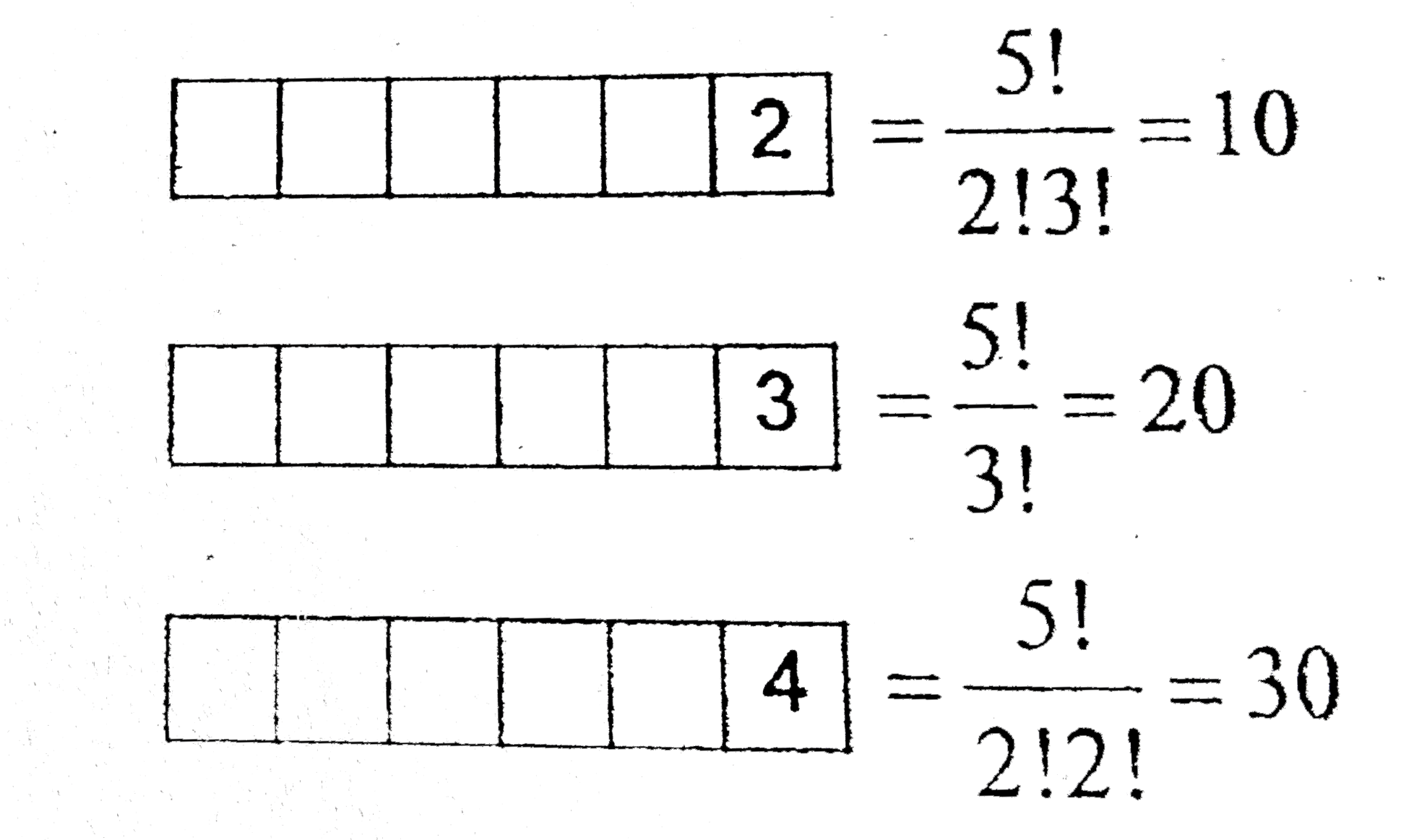
B


`:. "sum" = (2 xx 10) + (3 xx 20) + (4 xx 30) = 200`
of unit place
`:.` Reqd. sum
`= 200 (10^(5) + 10^(4) + 10^(3) + 10^(2) + 10^(1) + 10^(0))`
`= 200(111111) = 22 22 22 00`
Promotional Banner

Topper's Solved these Questions

  • TEST PAPERS

    RESONANCE ENGLISH|Exercise PART : 1MATHEMATICS SEC - 1|1 Videos
  • TEST PAPERS

    RESONANCE ENGLISH|Exercise PART : 1MATHEMATICS|9 Videos
  • TEST PAPER

    RESONANCE ENGLISH|Exercise MATHEMATICS|48 Videos
  • TEST SERIES

    RESONANCE ENGLISH|Exercise MATHEMATICS|132 Videos

Similar Questions

Explore conceptually related problems

The sum of all the numbers that can be formed by taking all digits 2,3,4,4,5 only is

Find the sum of all five digit numbers ,that can be formed using the digits 1, 2, 3, 4 and 5 (repetition of digits not allowed)

Find the sum of all five digit numbers ,that can be formed using the digits 1, 2, 3, 4 and 5 (repetition of digits not allowed)

The number of different numbers that can be formed by using all the digits 1, 2, 3, 4,3, 2,1 so that odd digits always occupy the odd places IS 1) 6 2)72 3) 60 4) 18

Find the sum of all the numbers that can be formed with the digits 2, 3, 4, 5 taken all at a time.

Find the sum of all the numbers that can be formed with the digits 2, 3, 4, 5 taken all at a time.

The sum of all 4 digit numbers that can be formed by using the digits 2, 4, 6, 8. (repetition of digits is not being allowed)

Sum of all the 4-digit numbers which can be formed using the digits 0, 3, 6, 9 (without repetition of digits) is 119988 (b) 115992 (c) 3996 (d) None of these

Find the number of 4-digit numbers that can be formed using the digits 1, 2, 3, 4, 5 if no digit is repeated. How many of these will be even?

The sum of all four-digit numbers that can be formed by using the digits 2, 4, 6, 8 (when repetition of digits is not allowed) is a. 133320 b. 5333280 c. 53328 d. none of these

RESONANCE ENGLISH-TEST PAPERS-MATHEMATICS
  1. Sum of all the numbers that can be formed using all the digits 2, 3, 3...

    Text Solution

    |

  2. The least positive vlaue of the parameter 'a' for which there exist at...

    Text Solution

    |

  3. The locus of the midpoint of a chord of the circle x^2+y^2=4 which sub...

    Text Solution

    |

  4. If f(x)=x + tan x and f si the inverse of g, then g'(x) equals

    Text Solution

    |

  5. Tangents PA and PB are drawn to parabola y^(2)=4x from any arbitrary p...

    Text Solution

    |

  6. If lim(nrarroo) (n.2^(n))/(n(3x-4)^(n)+n.2^(n+1)+2^(n))=1/2 where "n" ...

    Text Solution

    |

  7. Eccentricity of ellipse 2(x-y+1)^(2)+3(x+y+2)^(2)=5 is

    Text Solution

    |

  8. If (tan^(-1)x)^(3)+(tan^(-1)y)^(3)=1-3tan^(-1)x.tan^(-1)y. Then which ...

    Text Solution

    |

  9. If f:RrarrR is a continuous function satisfying f(0)=1 and f(2x)-f(x)=...

    Text Solution

    |

  10. tan^(-1)(sinx)=sin^(-1)(tanx) holds true for

    Text Solution

    |

  11. The function f(x) = (x^(2) - 1)|x^(2) - 3x + 3|+cos (|x|) is not diffe...

    Text Solution

    |

  12. Consider parabola P(1)-=y=x^(2) and P(2)-=y^(2)=-8x and the line L-=lx...

    Text Solution

    |

  13. If the normals at (x(i),y(i)) i=1,2,3,4 to the rectangular hyperbola x...

    Text Solution

    |

  14. Let f(x) = x^(3) - x^(2) + x + 1 and g(x) = {{:(max f(t)",", 0 le t le...

    Text Solution

    |

  15. The sum of the roots of the equation tan^(-1)(x+3)-tan^(-1)(x-3)="sin"...

    Text Solution

    |

  16. For an ellipse having major and minor axis along x and y axes respecti...

    Text Solution

    |

  17. If f:[0,1]rarrR is defined as f(x)={(x^(3)(1-x)"sin"1/(x^(2)) 0ltxle1)...

    Text Solution

    |

  18. If f(x)=root (3)(8x^(3)+mx^(2))-nx such that lim(xrarroo)f(x)=1 then

    Text Solution

    |

  19. For the curve y=4x^3-2x^5, find all the points at which the tangents p...

    Text Solution

    |

  20. Minimum value of (sin^(-1)x)^(2)+(cos^(-1)x)^(2) is greater than

    Text Solution

    |

  21. If y + b = m(1)(x + a) and y + b = m(2)(x+a) are two tangents to the p...

    Text Solution

    |

