Home
Class 12
CHEMISTRY
Most elements form oxides and hydroxides...

Most elements form oxides and hydroxides with different characteristics. Often, regular periodic trends are observed in these oxides and hydroxides. Hydroxides of `Na` and `Mg` are distinctly alkaline, while oxides of `N` and `S` are distinctly acidic.
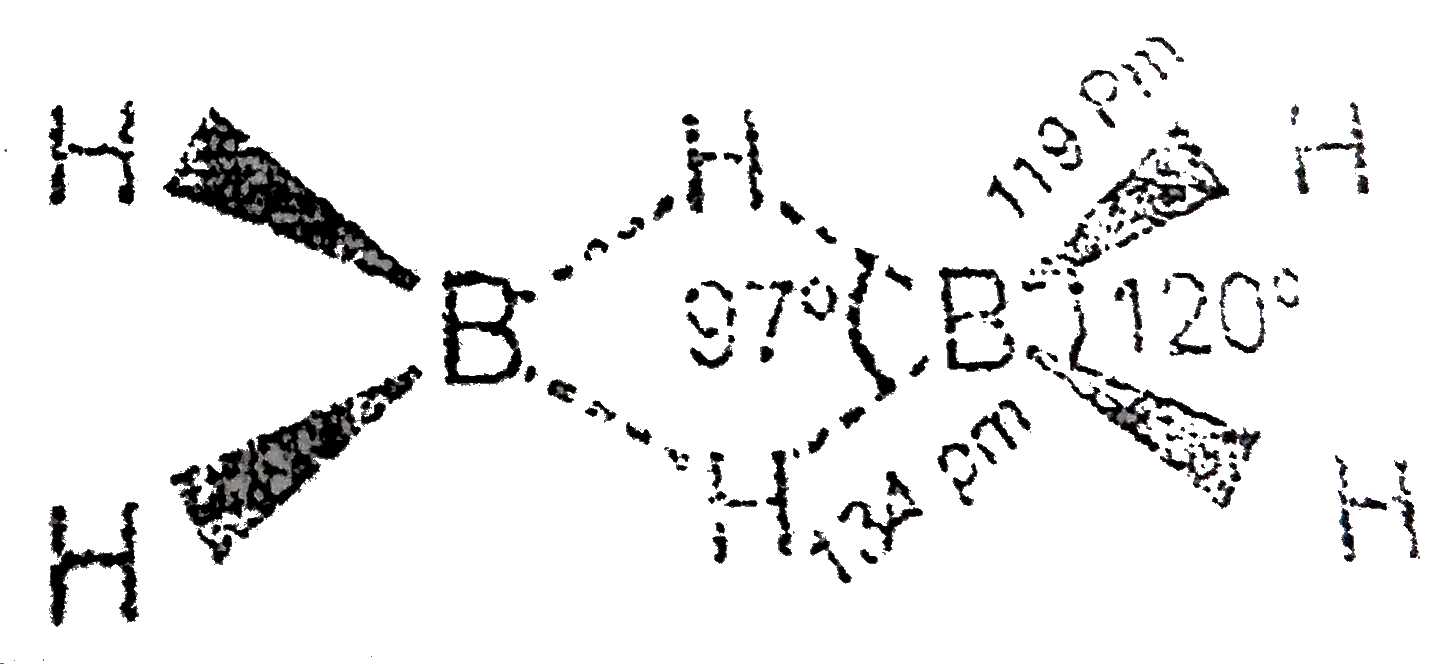
Draw the structure of `B_(2)H_(6)`.

A

Two centered `3e^(-)` bond square

B

Three centered `2e^(-)` bond square

C

Four centered `2e^(-)` bond square

D

Four centered `4e^(-)` bond square

Text Solution

Verified by Experts

The correct Answer is:

B
Promotional Banner

Topper's Solved these Questions

  • P-BLOCK ELEMENT (BORON AND CARBON FAMILY)

    RESONANCE ENGLISH|Exercise PART - III : OLYMPIAD PROBLEMS (PREVIOUS YEARS) STAGE - V (INTERNATIONAL CHEMISTRY OLYMPIAD (IChO)) Problem 1|1 Videos
  • P-BLOCK ELEMENT (BORON AND CARBON FAMILY)

    RESONANCE ENGLISH|Exercise PART - III : OLYMPIAD PROBLEMS (PREVIOUS YEARS) STAGE - V (INTERNATIONAL CHEMISTRY OLYMPIAD (IChO)) Problem 3|8 Videos
  • P-BLOCK ELEMENT (BORON AND CARBON FAMILY)

    RESONANCE ENGLISH|Exercise PART - III : OLYMPIAD PROBLEMS (PREVIOUS YEARS) STAGE - II (INDIAN NATIONAL CHEMISTRY OLYMPIAD (INCHO)) Problem 1|11 Videos
  • P BLOCK ELEMENTS

    RESONANCE ENGLISH|Exercise PART -II|23 Videos
  • P-BLOCK ELEMENTS (HALOGEN & NOBLE GASES)

    RESONANCE ENGLISH|Exercise APSP PART-3|22 Videos

Similar Questions

Explore conceptually related problems

Most elements form oxides and hydroxides with different characteristics. Often, regular periodic trends are observed in these oxides and hydroxides. Hydroxides of Na and Mg are distinctly alkaline, while oxides of N and S are distinctly acidic. Draw the structure of sulfur dioxide

Most elements form oxides and hydroxides with different characteristics. Often, regular periodic trends are observed in these oxides and hydroxides. Hydroxides of Na and Mg are distinctly alkaline, while oxides of N and S are distinctly acidic. Write the general formula of arachano-boranes.

Discuss the important characteristics of oxides, hydroxides, and carbonates of group 2 elements.

State the general trend in periodicity in properties of oxides, hydroxides, oxy-acids and hydrides of compounds of elements across a period and down a group.

An element of group 2 forms covalent oxide which is amphoteric in nature and dissolves in water to give an amphoteric hydroxide. Identify the element and write chemical reactions of the hydroxide of the element with an alkali and an acid.

On exposure to air, alkali metals get tranished due to formation of oxides, hydroxides and carbonates on their surface. When heated in air or oxygen they burn vigourously forming different types of oxides depending upon the nature of the metal. The formation and stability of these metals can be explained on the basis of size of alkali metal ion and the anion. Peroxides are colourless, while superoxides are coloured. The normal oxides are basic while peroxides and superoxides act as oxidising agents. Na_(2)O_(2) has light yellow colour. This is due to

An element is placed in 2^("nd") group and 3^("rd") period of the periodic table, burns is presence of xygen of form a basic oxide (a) Identify the element (b) Write the electronic configuration (c) Write a balanced equation when it burns in the presence of air (d) Write a balanced when this oxide is dissolved in water (e) Draw the electron dot structure for the formation of this oxide.

An alkaline earth metal 'M' readily forms water soluble sulphate and water insoluble hydroxide. Its oxide MO is very stable to heat and does not have rock - salt structure. M is

On exposure to air, alkali metals get tranished due to formation of oxides, hydroxides and carbonates on their surface. When heated in air or oxygen they burn vigourously forming different types of oxides depending upon the nature of the metal. The formation and stability of these metals can be explained on the basis of size of alkali metal ion and the anion. Peroxides are colourless, while superoxides are coloured. The normal oxides are basic while peroxides and superoxides act as oxidising agents. On heating in excess of oxygen, potassium gives

The binary compounds of oxygen with other elements are called oxides. They are classified depending either upon their acid-base characteristics or on the basis of oxygen content. (a) Normal oxides : These oxides which contain oxygen atom as permitted by the normal oxidation number, i.e., -2 normal oxide may be acidic, basic, amphoteric or neutral. (b) Polyoxides : The oxides which contain oxygen atoms different than those permitted by the normal oxidation number of -2 . (i) Peroxides : Two oxygen atoms are linked to each other and oxyegen has -1 oxidation number. They contain (O -O)^(2-) unit. (ii) Superoxodes : These oxides contain (O-O)^(-1) unit, i.e., each O-atom has oxidation number -1//2 . (c) Suboxides : These contain low content of oxygen than expected. (d) Mixed oxides : These oxides are made of two simpler oxides. Which of the following pairs contains amphoteric oxides ?
