Home
Class 12
CHEMISTRY
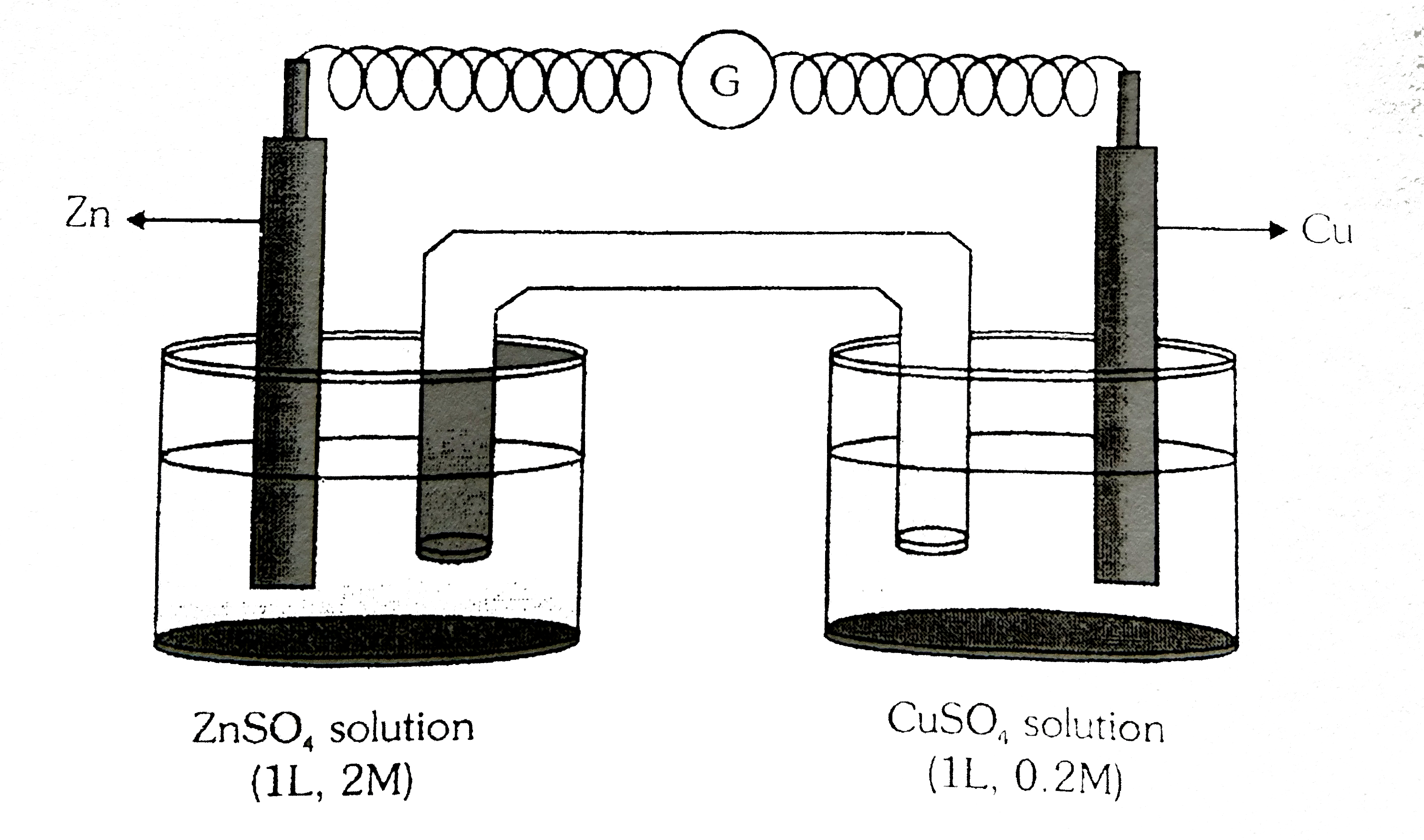
Given: E(Zn^(+2)//Zn)^(@) =- 0.76V E...


Given:
`E_(Zn^(+2)//Zn)^(@) =- 0.76V`
`E_(Cu^(+2)//Cu)^(@) = +0.34V`
`K_(f)[Cu(NH_(3))_(4)]^(2+) = 4 xx 10^(11)`
`(2.303R)/(F) = 2 xx 10^(-4)`
When 1 mole of `NH_(3)` added to cathode compartement than emf of cell is (at 298K)`:

A

0.81 V

B

1.91 V

C

1.1 V

D

0.72 V

Text Solution

Verified by Experts

The correct Answer is:

A

`undersetunderset(x)(0.2)(Cu^(+2))+undersetunderset(1-0.8)(1)(4NH_(3))hArrundersetunderset(0.2)(0)([Cu(CH_(3))_(4)]^(+2))`
`K_(f)=4.0xx10^(11)=(0.2)/(x xx(0.2)^(4))=(1)/(x xx(0.2)^(3))`
`x=(10^(-11))/((0.2)^(3)xx4)`
`x=3.125xx10^(-10)`
`[Cu^(+2)]=3.125xx10^(-10)`
`E_(cell)=0.75+0.34-(0.0591)/(2)log((2)/(3.125xx10^(-10))`
`=1.1-(0.0591)/(2)(10-0.194)=1.1-0.29=0.81"volt"`
Promotional Banner

Topper's Solved these Questions

  • ELECTROCHEMISRY

    RESONANCE ENGLISH|Exercise Exercise 3|7 Videos
  • ELECTROCHEMISRY

    RESONANCE ENGLISH|Exercise Part 2|23 Videos
  • ELECTROCHEMISRY

    RESONANCE ENGLISH|Exercise Objective Questions|41 Videos
  • ELECTRO CHEMISTRY

    RESONANCE ENGLISH|Exercise PHYSICAL CHEMITRY (ELECTROCHEMISTRY)|53 Videos
  • EQUIVALENT CONCEPT & TITRATIONS

    RESONANCE ENGLISH|Exercise Part -IV|22 Videos

Similar Questions

Explore conceptually related problems

Given: E_(Zn^(+2)//Zn)^(@) =- 0.76V E_(Cu^(+2)//Cu)^(@) = +0.34V K_(f)[Cu(NH_(3))_(4)]^(2+) = 4 xx 10^(11) (2.303R)/(F) = 2 xx 10^(-4) Find emf at cell of 200K if E^(@) values are independent of temperature [log 2= 0.3]

Given: E_(Zn^(+2)//Zn)^(@) =- 0.76V E_(Cu^(+2)//Cu)^(@) = +0.34V K_(f)[Cu(NH_(3))_(4)]^(2+) = 4 xx 10^(11) (2.303R)/(F) = 2 xx 10^(-4) At what concentration of Cu^(+2) emf of the cell will be zero (at 298K) and concentration of Zn^(+2) is remains same:

E_(Cu^(2+)//Cu)^(@) =0.43V E_(Cu^(+)//Cu)^(@)=0.55V E_(Cu^(2+)//Cu^(+))^(@) =

E_(Cu^(2+)//Cu)^(@)=0.34V E_(Cu^(+)//Cu)^(@)=0.522V E_(Cu^(2+)//Cu^(+))^(@)=

E_(Cu^(2+)//Cu)^(@)=0.34V E_(Cu^(+)//Cu)^(@)=0.522V E_(Cu^(2+)//Cu^(+))^(@)=

Given E_(Ag^(+)//Ag)^(@)=+0.80 V, E_(Cu^(2+)//Cu)^(@)=+0.34 V, E_(Fe^(3+)//Fe^(2+))^(@)=+0.76 V, E_(Ce^(4+)//Ce^(3+))^(@)=+1.60 V Which of the following statements is not correct ?

If E_(Cu^(2+)|Cu)^(@) = 0.34V and E_(Cu^(2+)|Cu^(+))^(@)= 0.15 V then the value for disproportion for Cu^(+) is :

E_(Cu^(+2)//Cu)^(@)=0.34V, E_(Zn//Zn^(+2))^(@)=0.76V A cell formed by the conbination of Cu and Zn (a) when CuSO_(4) is added to Cu^(+2) compartment what is the effect on emf of cell (b) when NH_(3) is added to Cu^(+2) compartment what is the effect on emf of cell (c ) When ZnSO_(4) is added to Zn^(+2) compartment is the effect on emf of cell (d) When Zn^(+2) is diluted what is the effect on emf of cell ?

E^(@) of Fe^(2 +) //Fe = - 0.44 V, E^(@) of Cu //Cu^(2+) = -0.34 V . Then in the cell

If E_((Mg)/(Mg^2+))^0 = +2.37 and E_((Cu)/(Cu^2+))^0 = -0.34 V then standard EMF of the cell, (Mg)/(Mg^(2+))/(Cu^(2+))/(Cu) is

RESONANCE ENGLISH-ELECTROCHEMISRY-Comprehension
  1. If an element can exist in several oxidation states, it is convernient...

    Text Solution

    |

  2. Given: E(Zn^(+2)//Zn)^(@) =- 0.76V E(Cu^(+2)//Cu)^(@) = +0.34V K...

    Text Solution

    |

  3. Given: E(Zn^(+2)//Zn)^(@) =- 0.76V E(Cu^(+2)//Cu)^(@) = +0.34V K...

    Text Solution

    |

  4. Given: E(Zn^(+2)//Zn)^(@) =- 0.76V E(Cu^(+2)//Cu)^(@) = +0.34V K...

    Text Solution

    |

  5. The molar conductance of NaCl varies with the concentration as shown i...

    Text Solution

    |

  6. The molar conductance of NaCl varies with the concentration as shown i...

    Text Solution

    |

  7. The molar conductance of NaCl varies with the concentration as shown i...

    Text Solution

    |

  8. Strong acid versus strong base: The principle of conductometric titr...

    Text Solution

    |

  9. The graph represents the titration curve for : a.Strong acid and stro...

    Text Solution

    |

  10. Tollen's reagent is used for the detection of aldehyde when a solution...

    Text Solution

    |

  11. Tollen reagent is used for the detection of aldehydes. When a solution...

    Text Solution

    |

  12. Tollen reagent is used for the detection of aldehydes. When a solution...

    Text Solution

    |

  13. We have taken a saturated solution of AgBrK(sp) of AgBr is 12 xx 10^(-...

    Text Solution

    |

  14. Chemical reaction involve interaction of atoms and molecules. A large ...

    Text Solution

    |

  15. If the cathode is a Hg electrode, the maximum weight (g) of amalgam fo...

    Text Solution

    |

  16. Chemical reaction involve interaction of atoms and molecules. A large ...

    Text Solution

    |

  17. Redox reactions play a pivotal role in chemistry and biology. The valu...

    Text Solution

    |

  18. Redox reactions play a pivotal role in chemistry and biology. The valu...

    Text Solution

    |

  19. Redox reactions play a pivotal role in chemistry and biology. The valu...

    Text Solution

    |

  20. For the reduction of NO(3)^(c-) ion in an aqueous solution, E^(c-) is ...

    Text Solution

    |
