Home
Class 11
CHEMISTRY
For a container contining A(g),B(g),C(g)...

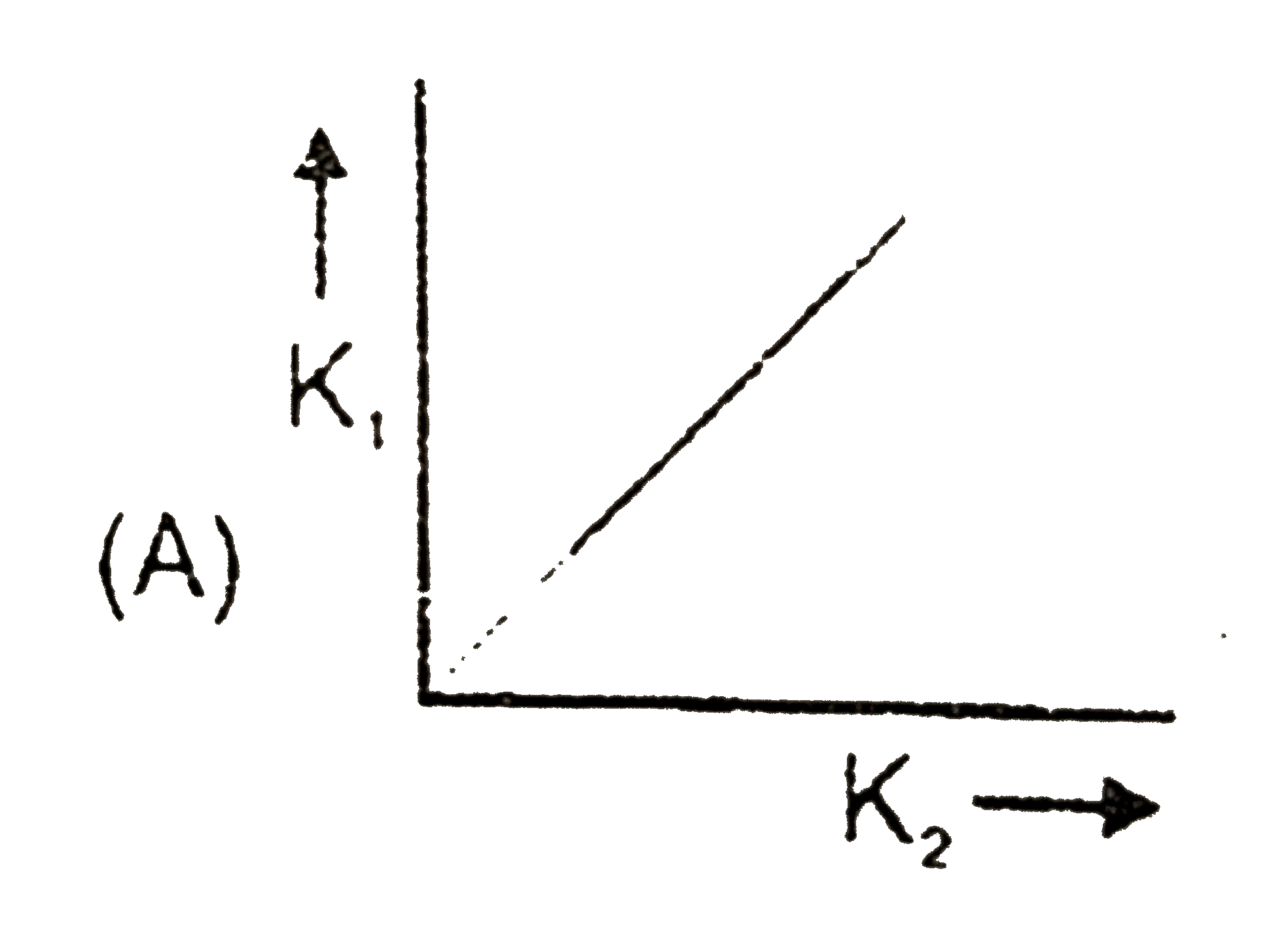
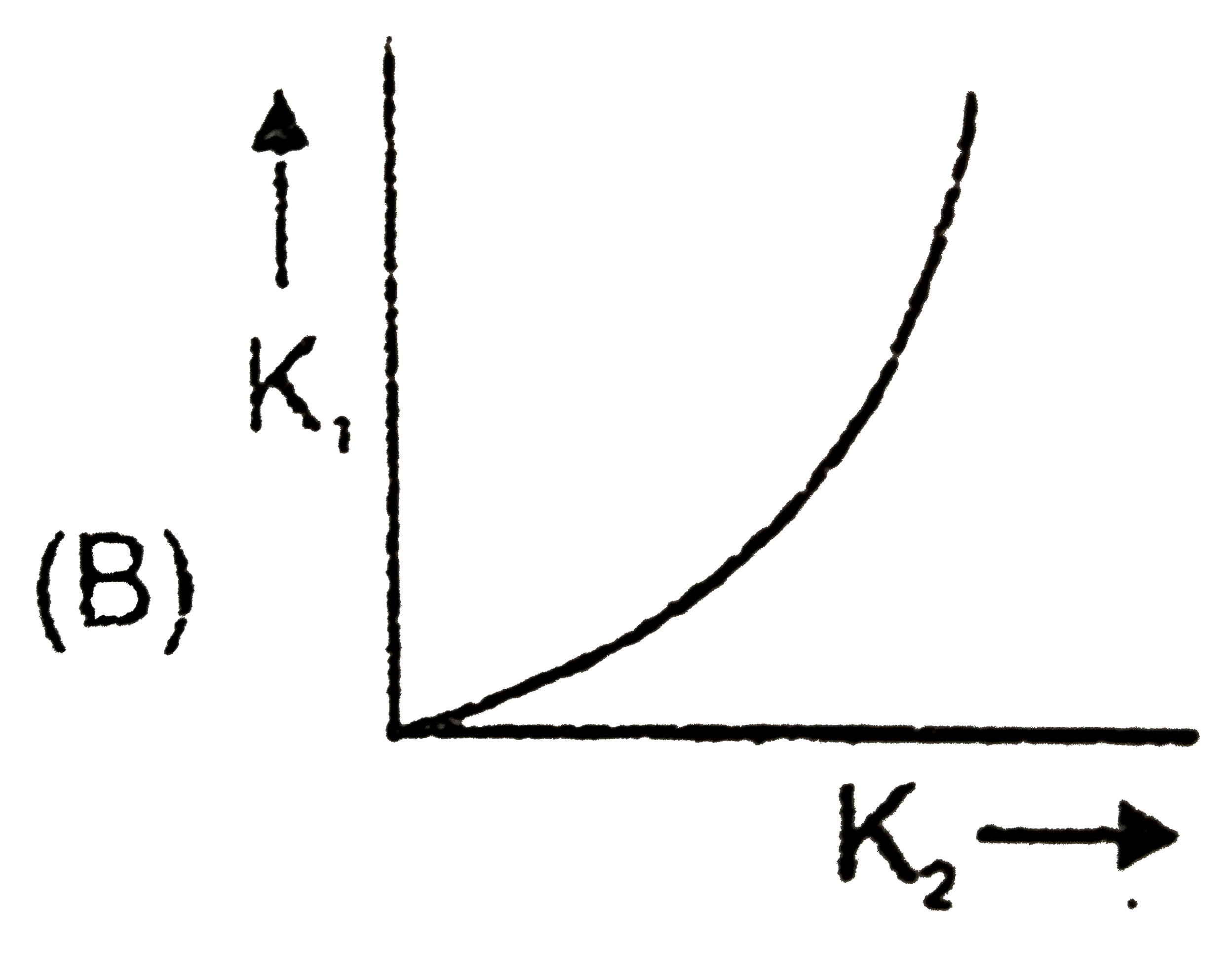
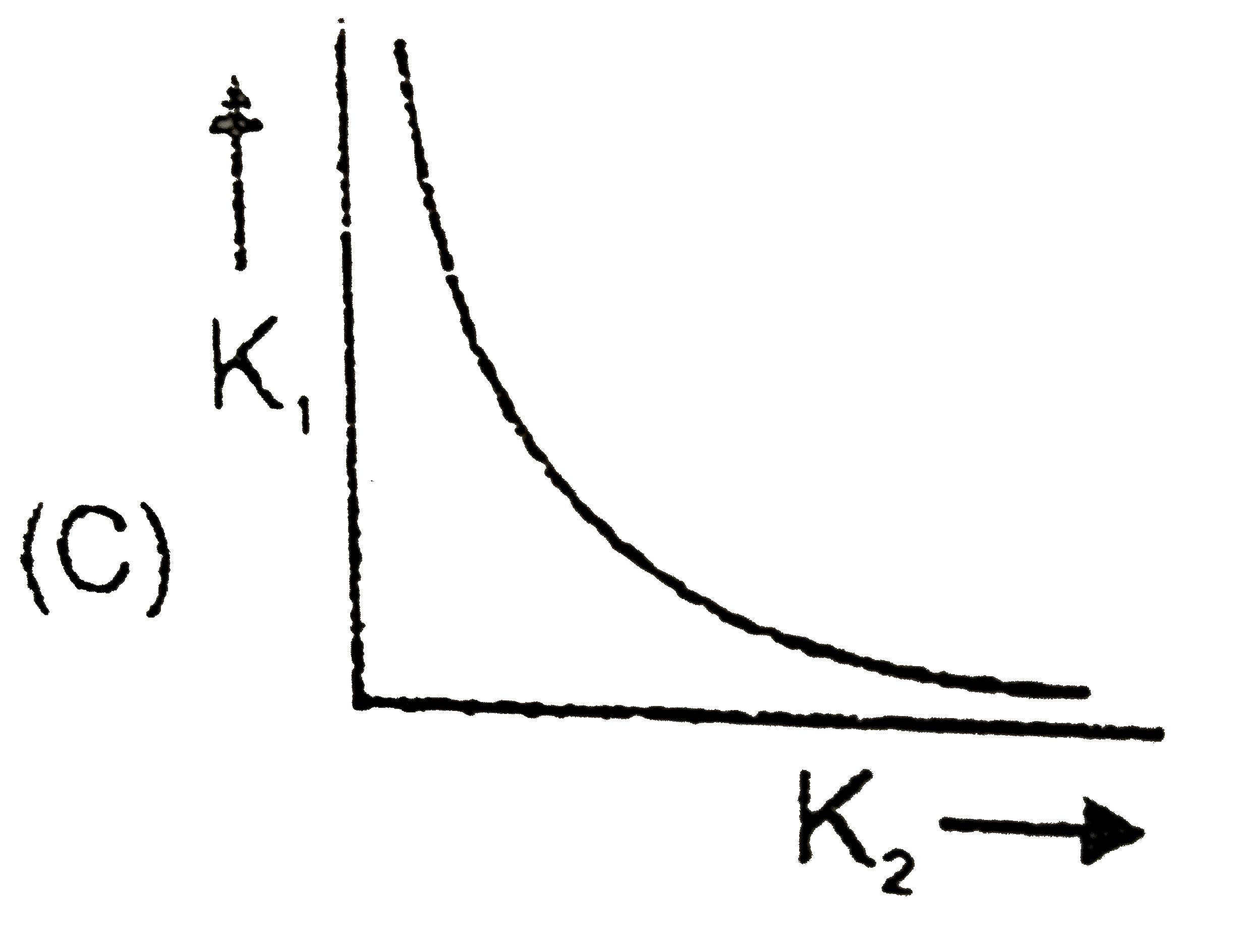
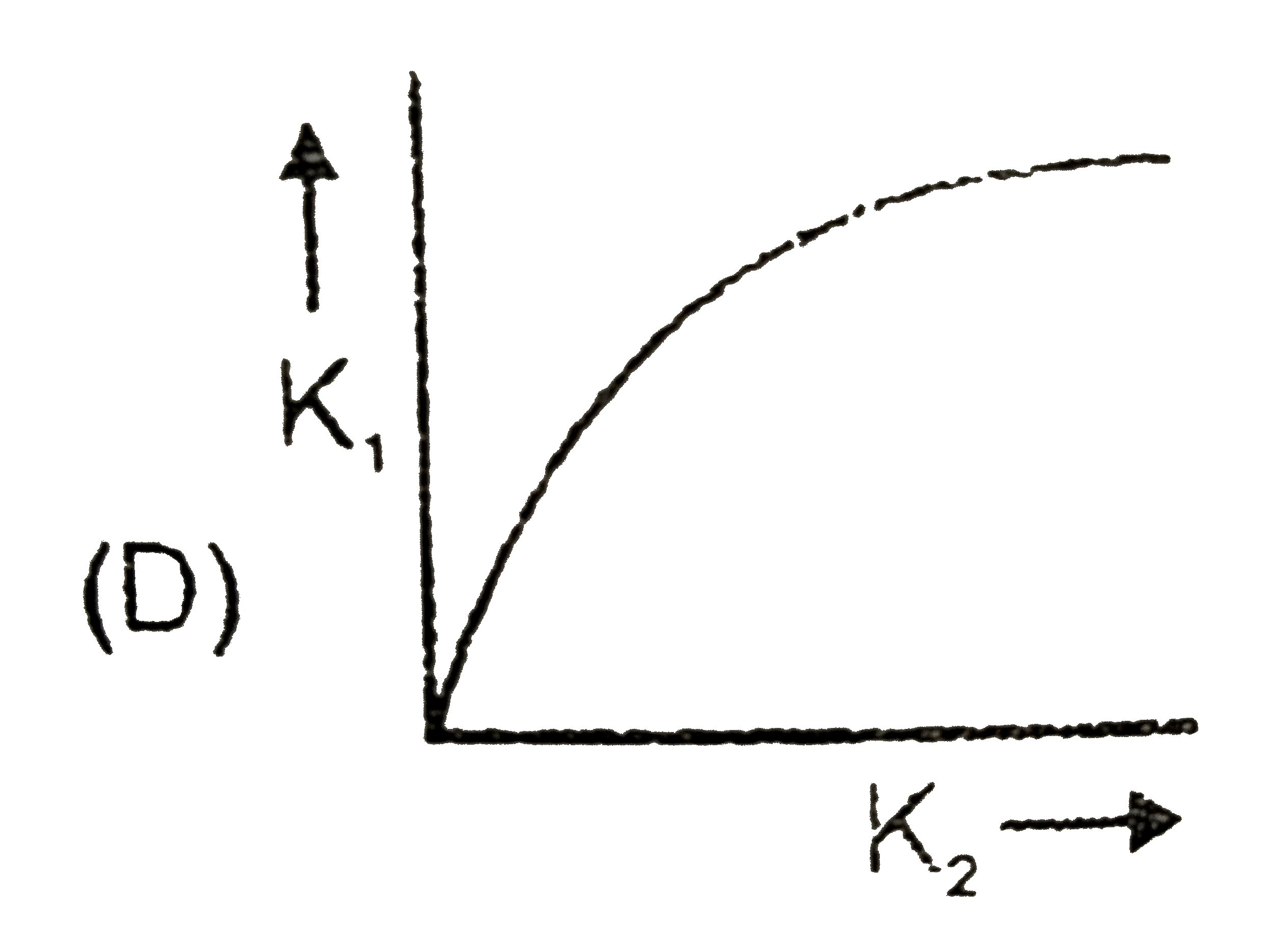
For a container contining `A(g),B(g),C(g) "&" D(g)` with rigid walls, an experiment is carried upon. This experiment involves increase in temperature of container in stepsof `1^(@)C` and system is allowed to attain equilibrium, followed by calculation of `K_(1) "&" K_(2)` at each step, where `K_(1) "&" K_(2)` are equilibrium constants for reaction (1) & (2) respectively.
`A(g)+2B(g)hArrC(g)+D(g)` ....(1)
`C(g)+D(g)hArrA(g)+2B(g)` .....(2)
Select the graph showing correct relationship-

A

B

C

D

Text Solution

AI Generated Solution

The correct Answer is:

To solve the problem, we need to analyze the two equilibrium reactions given and their corresponding equilibrium constants. Let's break it down step by step. ### Step 1: Write the Equilibrium Expressions For the two reactions provided, we need to write the expressions for the equilibrium constants \( K_1 \) and \( K_2 \). 1. **For Reaction (1)**: \[ A(g) + 2B(g) \rightleftharpoons C(g) + D(g) \] The equilibrium constant \( K_1 \) is given by: \[ K_1 = \frac{[C][D]}{[A][B]^2} \] 2. **For Reaction (2)**: \[ C(g) + D(g) \rightleftharpoons A(g) + 2B(g) \] The equilibrium constant \( K_2 \) is given by: \[ K_2 = \frac{[A][B]^2}{[C][D]} \] ### Step 2: Relate \( K_1 \) and \( K_2 \) From the expressions for \( K_1 \) and \( K_2 \), we can see that they are inversely related: \[ K_2 = \frac{1}{K_1} \] This means that if \( K_1 \) increases, \( K_2 \) must decrease, and vice versa. ### Step 3: Understand the Effect of Temperature As the temperature of the system is increased, the equilibrium constants \( K_1 \) and \( K_2 \) will change according to the nature of the reactions (endothermic or exothermic). However, since we are not given specific information about the enthalpy changes of the reactions, we can only conclude that the relationship \( K_1 \cdot K_2 = 1 \) holds true at all temperatures. ### Step 4: Graphical Representation Given that \( K_1 \) and \( K_2 \) are inversely related, we can conclude that the graph representing their relationship will show a hyperbolic curve where: - When \( K_1 \) is high, \( K_2 \) is low. - When \( K_2 \) is high, \( K_1 \) is low. ### Conclusion Thus, the correct graph that represents the relationship between \( K_1 \) and \( K_2 \) is the one that shows an inverse relationship. ### Final Answer The correct option is **Graph 3** (or option C). ---
Promotional Banner

Topper's Solved these Questions

  • CHEMICAL EQUILIBRIUM

    RESONANCE ENGLISH|Exercise Exercise-2 (Part-1)|28 Videos
  • CHEMICAL EQUILIBRIUM

    RESONANCE ENGLISH|Exercise Exercise-2 (Part-2)|22 Videos
  • CHEMICAL EQUILIBRIUM

    RESONANCE ENGLISH|Exercise Exercise-1 (Part-1)|38 Videos
  • CHEMICAL BONDING

    RESONANCE ENGLISH|Exercise ORGANIC CHEMISTRY(Fundamental Concept )|6 Videos
  • D & F-BLOCK ELEMENTS & THEIR IMPORTANT COMPOUNDS

    RESONANCE ENGLISH|Exercise Match the column|1 Videos

Similar Questions

Explore conceptually related problems

K_(1) and K_(2) are equilibrium constants for reaction (i) and (ii) N_(2)(g)+O_(2)(g) hArr 2NO(g) …(i) NO(g) hArr 1//2 N_(2)(g)+1//2O_(2)(g) …(ii) then,

K_(1) and K_(2) are equilibrium constants for reaction (i) and (ii) N_(2)(g)+O_(2)(g) hArr 2NO(g) …(i) NO(g) hArr 1//2 N_(2)(g)+1//2O_(2)(g) …(ii) then,

Equilibrium constant for the reaction 4A(g) harr B(g) + 2C (g) is- Given : 2A(g) harr B(g) + Y(g), kc_(1) = 8 C(g) harr A(g) + 1/2Y(g) , kc_(2) = 1/4

The equilibrium constant K_(p) for the reaction H_(2)(g)+I_(2)(g) hArr 2HI(g) changes if:

The K_c for given reaction will be A_2 (g) +2B (g) hArr C(g) +2D(s)

The equilibrium constant for the reaction A(g)hArrB(g) and B(g)hArrC(g) are K_1=10^(-2) and K_2=10^(-1) respectively . Equilibrium constant for the reaction (1/2)C(g)hArr(1/2)A(g) is

The relation between K_(P) and K_(C) for the reaction A(g)+B(g) hArr C(g)+2D(g) is -

K_(p)//K_(c) for the reaction CO(g)+1/2 O_(2)(g) hArr CO_(2)(g) is

K_(p)//K_(c) for the reaction CO(g)+1/2 O_(2)(g) hArr CO_(2)(g) is

consider the following gaseous equilibrium with equilibrium constant K_(1) and K_(2) respectively SO_(3)(g)hArrSO_(2)(g)+ 1//2O_(2) 2SO_(3)(g)hArr2SO_(2)(g)+O_(2)(g) The equilibrium constants are related as

RESONANCE ENGLISH-CHEMICAL EQUILIBRIUM-Exercise-1 (Part-2)
  1. The equilibrium constant of the reaction SO(2)(g) + 1//2O(2)(g)hArrSO(...

    Text Solution

    |

  2. Equilibrium constant for the reactions, 2 NO+O(2)hArr2 NO(2) "is" K(...

    Text Solution

    |

  3. For a container contining A(g),B(g),C(g) "&" D(g) with rigid walls, an...

    Text Solution

    |

  4. The equilibrium constant for N(2)(g)+O(2)(g)hArr2NO "is" K(1) and th...

    Text Solution

    |

  5. When alcohol (C(2)H(5)OH(l)) "and acetic acid" (CH(3)COOH(l)) are mixe...

    Text Solution

    |

  6. One litre of 2 M acetic acid and one litre of 3 M ethyl alcohol are mi...

    Text Solution

    |

  7. When alpha-D glucose is dissolved in water, it undergoes a partial con...

    Text Solution

    |

  8. For the dissociation reaction N(2)O(4) (g)hArr 2NO(2)(g), the degree o...

    Text Solution

    |

  9. The degree of dissociation of SO(3) is alpha at equilibrium pressure P...

    Text Solution

    |

  10. In the dissociation of N(2)O(4) into NO(2), (1+ alpha) values with the...

    Text Solution

    |

  11. N2O4rarr2NO2 In the above equation, alpha varies with (D)/(d) accordin...

    Text Solution

    |

  12. For the reaction N2O4 hArr 2NO2(g), if percentage dissociation of N2O4...

    Text Solution

    |

  13. At a certain temperature T, a compound AB(4)(g) dissociates as 2AB(4...

    Text Solution

    |

  14. The degree of dissociation of PCl(5)(g) for the equilibrium PCl(5)(g)h...

    Text Solution

    |

  15. At 727^(@)C and 1.2 atm of total equilibrium pressure, SO(3) is partia...

    Text Solution

    |

  16. Consider the following hypothetical equilibrium 2B(g)hArrB(2)(g) I...

    Text Solution

    |

  17. The vapour density of fully dissociated NH(4)Cl would be

    Text Solution

    |

  18. The degree of dissociation is 0.5 at 800K and 2 atm for the gaseous r...

    Text Solution

    |

  19. SO(3)(g)hArrSO(2)(g)+(1)/(2)O(2)(g) If observed vapour density of mi...

    Text Solution

    |

  20. What is the minimum mass of CaCO3(s), below which it decomposes comple...

    Text Solution

    |
