Home
Class 11
CHEMISTRY
In the dissociation of N(2)O(4) into NO(...

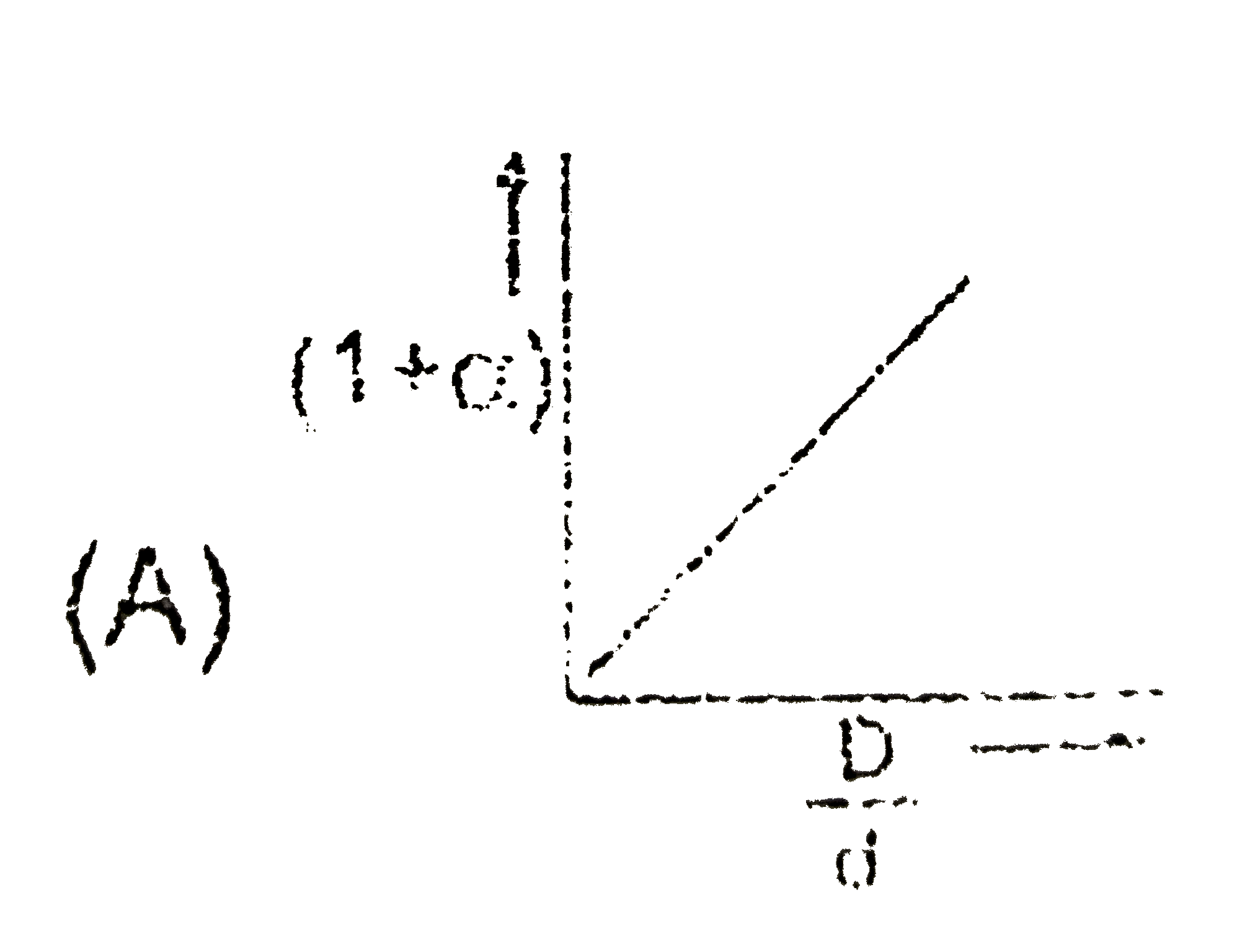
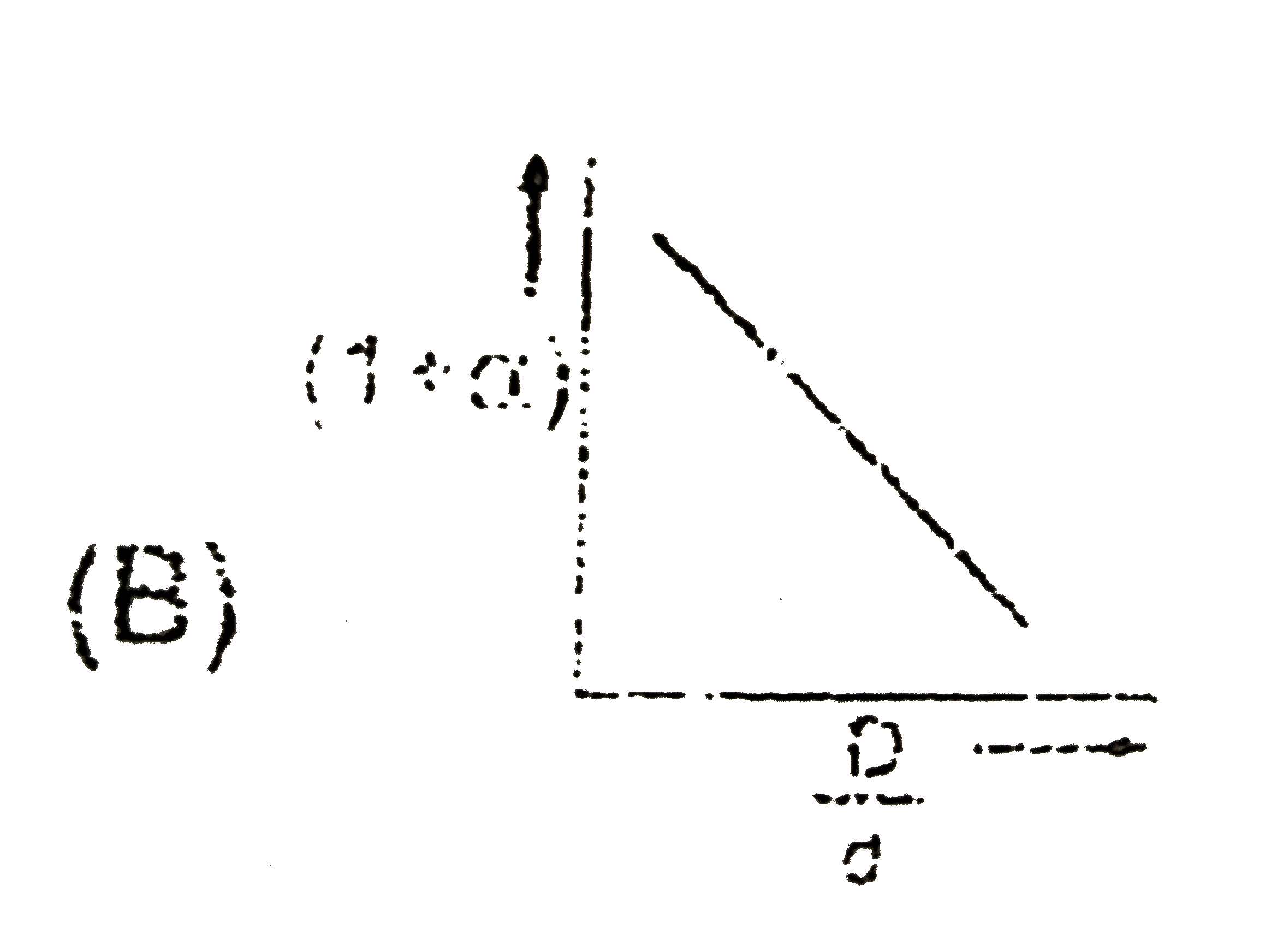
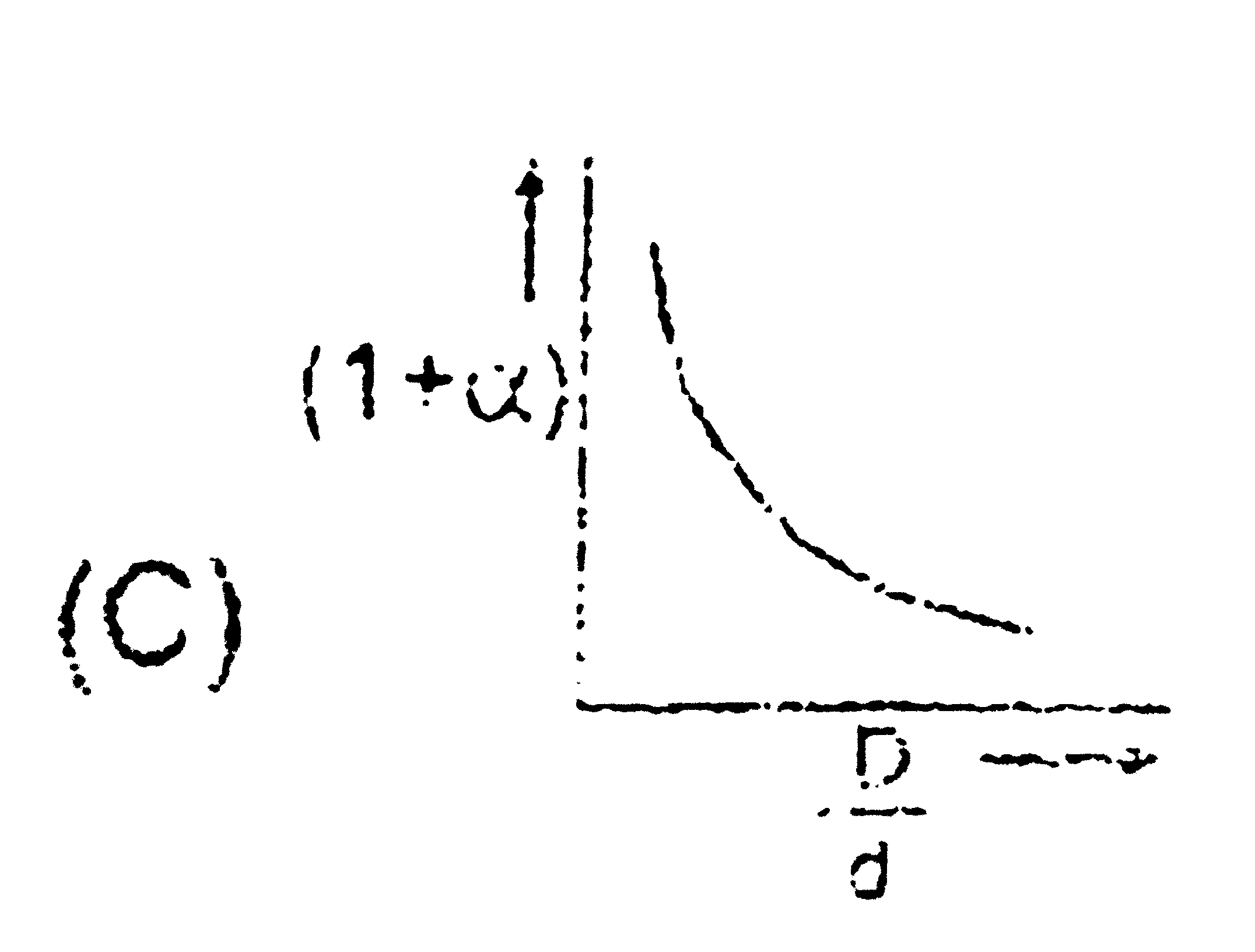
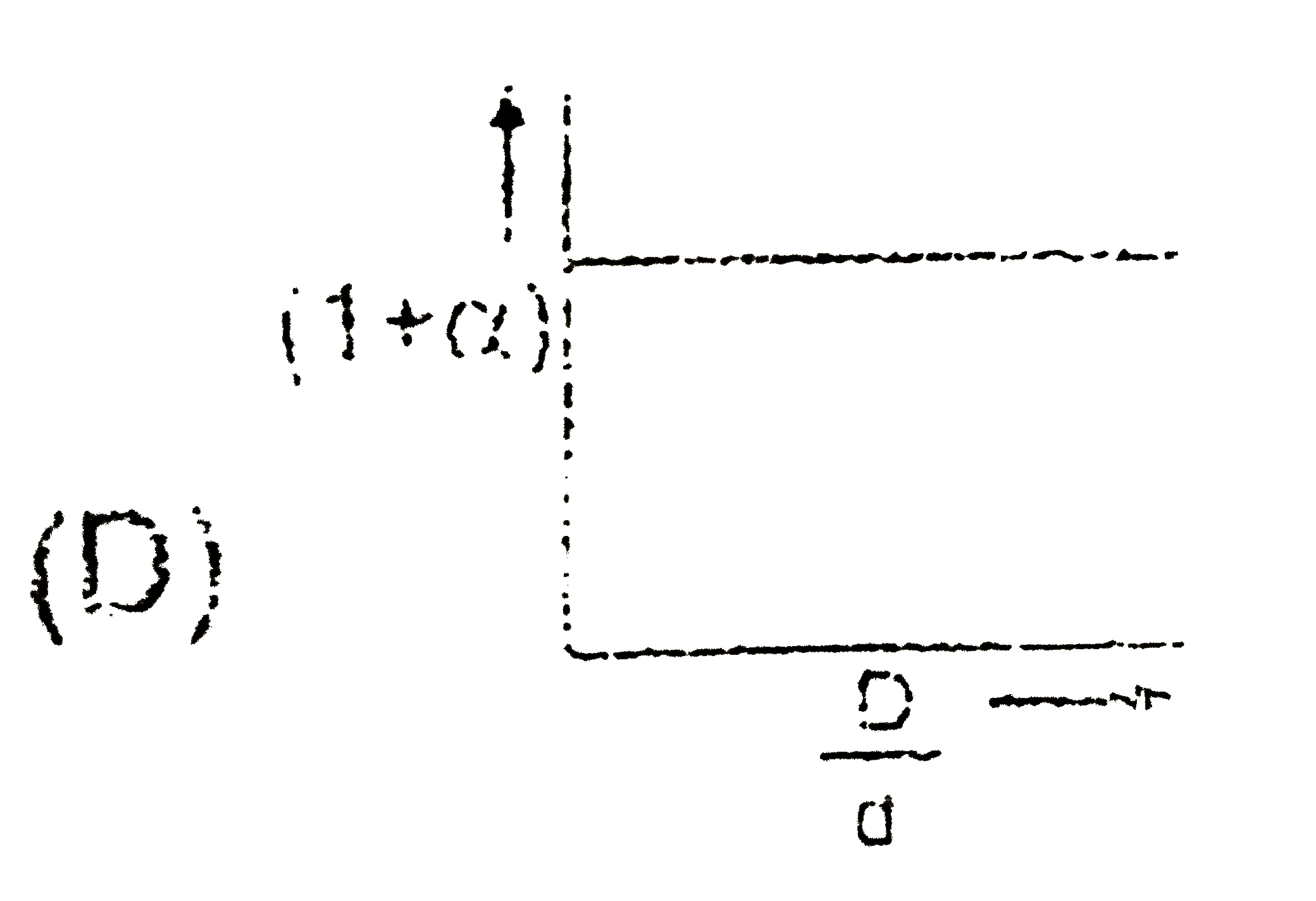
In the dissociation of `N_(2)O_(4)` into `NO_(2), (1+ alpha)` values with the vapour densities ratio `((D)/(d))` is given by: [`alpha` degree of dissociation, D-vapour density before dissociation, d-vapour density after dissociation]

A

B

C

D

Text Solution

AI Generated Solution

The correct Answer is:

To solve the problem regarding the dissociation of \( N_2O_4 \) into \( NO_2 \) and the relationship between the vapor densities before and after dissociation, we can follow these steps: ### Step-by-Step Solution: 1. **Write the Dissociation Reaction**: The dissociation of \( N_2O_4 \) can be represented as: \[ N_2O_4 \rightleftharpoons 2 NO_2 \] 2. **Set Up Initial and Equilibrium Conditions**: Assume we start with \( C \) moles of \( N_2O_4 \) and no \( NO_2 \): - Initial moles of \( N_2O_4 \) = \( C \) - Initial moles of \( NO_2 \) = 0 At equilibrium, if \( \alpha \) is the degree of dissociation: - Moles of \( N_2O_4 \) at equilibrium = \( C(1 - \alpha) \) - Moles of \( NO_2 \) at equilibrium = \( 2C\alpha \) 3. **Calculate Vapor Densities**: Vapor density is defined as the mass of the gas divided by the volume. Since we are dealing with moles, we can relate vapor density to the number of moles: - Initial vapor density \( D \) is proportional to the initial moles \( C \). - At equilibrium, the total moles of gas = Moles of \( N_2O_4 \) + Moles of \( NO_2 \): \[ \text{Total moles at equilibrium} = C(1 - \alpha) + 2C\alpha = C(1 + \alpha) \] - Therefore, the vapor density at equilibrium \( d \) is proportional to \( C(1 + \alpha) \). 4. **Set Up the Ratio of Vapor Densities**: The ratio of the vapor densities before and after dissociation can be expressed as: \[ \frac{D}{d} = \frac{C}{C(1 + \alpha)} = \frac{1}{1 + \alpha} \] 5. **Rearranging the Equation**: Rearranging the equation gives: \[ D = \frac{d}{1 + \alpha} \] This implies that: \[ \frac{D}{d} = \frac{1}{1 + \alpha} \] 6. **Establishing the Relationship**: From the equation \( \frac{D}{d} = \frac{1}{1 + \alpha} \), we can see that as \( \alpha \) increases, \( \frac{D}{d} \) decreases. This indicates an inverse relationship. 7. **Identifying the Correct Plot**: Given the relationship \( \frac{D}{d} = \frac{1}{1 + \alpha} \), we can conclude that the plot of \( \frac{D}{d} \) versus \( \alpha \) will not be a straight line through the origin but rather a hyperbolic curve. However, if we were to plot \( 1 + \alpha \) against \( \frac{D}{d} \), it would yield a straight line. ### Final Answer: The correct relationship is: \[ \frac{D}{d} = \frac{1}{1 + \alpha} \]
Promotional Banner

Topper's Solved these Questions

  • CHEMICAL EQUILIBRIUM

    RESONANCE ENGLISH|Exercise Exercise-2 (Part-1)|28 Videos
  • CHEMICAL EQUILIBRIUM

    RESONANCE ENGLISH|Exercise Exercise-2 (Part-2)|22 Videos
  • CHEMICAL EQUILIBRIUM

    RESONANCE ENGLISH|Exercise Exercise-1 (Part-1)|38 Videos
  • CHEMICAL BONDING

    RESONANCE ENGLISH|Exercise ORGANIC CHEMISTRY(Fundamental Concept )|6 Videos
  • D & F-BLOCK ELEMENTS & THEIR IMPORTANT COMPOUNDS

    RESONANCE ENGLISH|Exercise Match the column|1 Videos

Similar Questions

Explore conceptually related problems

During thermal dissociation of a gas, the vapour density.

The equation alpha=(D-d)/((n-1)d) is correctly matched for: ( alpha is the degree of dissociation, D and d are the vapour densities before and after dissociation, respectively).

The degree of dissociation of N_(2)O_(4) into NO_(2) at 1 atm 40^(@)C is 0.25 . Calculate its K_(p) at 40^(@)C .

The vapour density of fully dissociated NH_(4)Cl would be

A mixture contains N_(2)O_(4) and NO_(2) in the ratio 2:1 by volume. Calculate the vapour density of the mixture?

The degree of dissociation of N_(2) O_(4) into NO_(2) at one atmosphere and 40^(@) C is 0.310. calculate Kp at 40^(@) C

For the dissociation of PCl_(5) into PCl_(3) and Cl_(2) in gaseous phase reaction , if d is the observed vapour density and D the theoretical vapour density with 'alpha' as degree of dissociation ,variaton of D/d with 'alpha' is given by ?

Differentiate ionisation and dissociation

For the dissociation of PCI_(5) into PCI_(3) and Cl_(2) in gaseous phase reaction, If "d' is the observed vapour density and 'D' theoretical vapour density with 'alpha' as degree of dissociation. Variation of (D)/(d) with 'alpha' is given by which graph?

Ammonium chloride dissociates as, NH_(4)Cl(g) hArr NH_(3)(g)+HCl(g) The vapour density becomes half the initial value when degree of dissociation is 0.5 .

RESONANCE ENGLISH-CHEMICAL EQUILIBRIUM-Exercise-1 (Part-2)
  1. For the dissociation reaction N(2)O(4) (g)hArr 2NO(2)(g), the degree o...

    Text Solution

    |

  2. The degree of dissociation of SO(3) is alpha at equilibrium pressure P...

    Text Solution

    |

  3. In the dissociation of N(2)O(4) into NO(2), (1+ alpha) values with the...

    Text Solution

    |

  4. N2O4rarr2NO2 In the above equation, alpha varies with (D)/(d) accordin...

    Text Solution

    |

  5. For the reaction N2O4 hArr 2NO2(g), if percentage dissociation of N2O4...

    Text Solution

    |

  6. At a certain temperature T, a compound AB(4)(g) dissociates as 2AB(4...

    Text Solution

    |

  7. The degree of dissociation of PCl(5)(g) for the equilibrium PCl(5)(g)h...

    Text Solution

    |

  8. At 727^(@)C and 1.2 atm of total equilibrium pressure, SO(3) is partia...

    Text Solution

    |

  9. Consider the following hypothetical equilibrium 2B(g)hArrB(2)(g) I...

    Text Solution

    |

  10. The vapour density of fully dissociated NH(4)Cl would be

    Text Solution

    |

  11. The degree of dissociation is 0.5 at 800K and 2 atm for the gaseous r...

    Text Solution

    |

  12. SO(3)(g)hArrSO(2)(g)+(1)/(2)O(2)(g) If observed vapour density of mi...

    Text Solution

    |

  13. What is the minimum mass of CaCO3(s), below which it decomposes comple...

    Text Solution

    |

  14. If 50% of CO(2) converts to CO at the following equilibrium: (1)/(2)...

    Text Solution

    |

  15. Solid ammonium carbamate dissociate to give ammonia and carbon dioxide...

    Text Solution

    |

  16. For NH(4)HS(s)hArrNH(3)(g)+H(2)S(g) reaction started only with NH(4)HS...

    Text Solution

    |

  17. Consider the decomposition of solid NH(4)HS in a flask containing NH(3...

    Text Solution

    |

  18. What is the relative humidity of air at 1 bar pressure and 313K temper...

    Text Solution

    |

  19. For the equilibrium CuSO(4)xx5H(2)O(s)hArrCuSO(4)xx3H(2)O(s) + 2H(2)O(...

    Text Solution

    |

  20. (a) CuSO(4).5H(2)O(s)hArrCuSO(4).3H(2)O(s)+2H(2)O(g) K(p)=4xx10^(-4)at...

    Text Solution

    |
