Home
Class 11
CHEMISTRY
Solid ammonium carbamate dissociate to g...

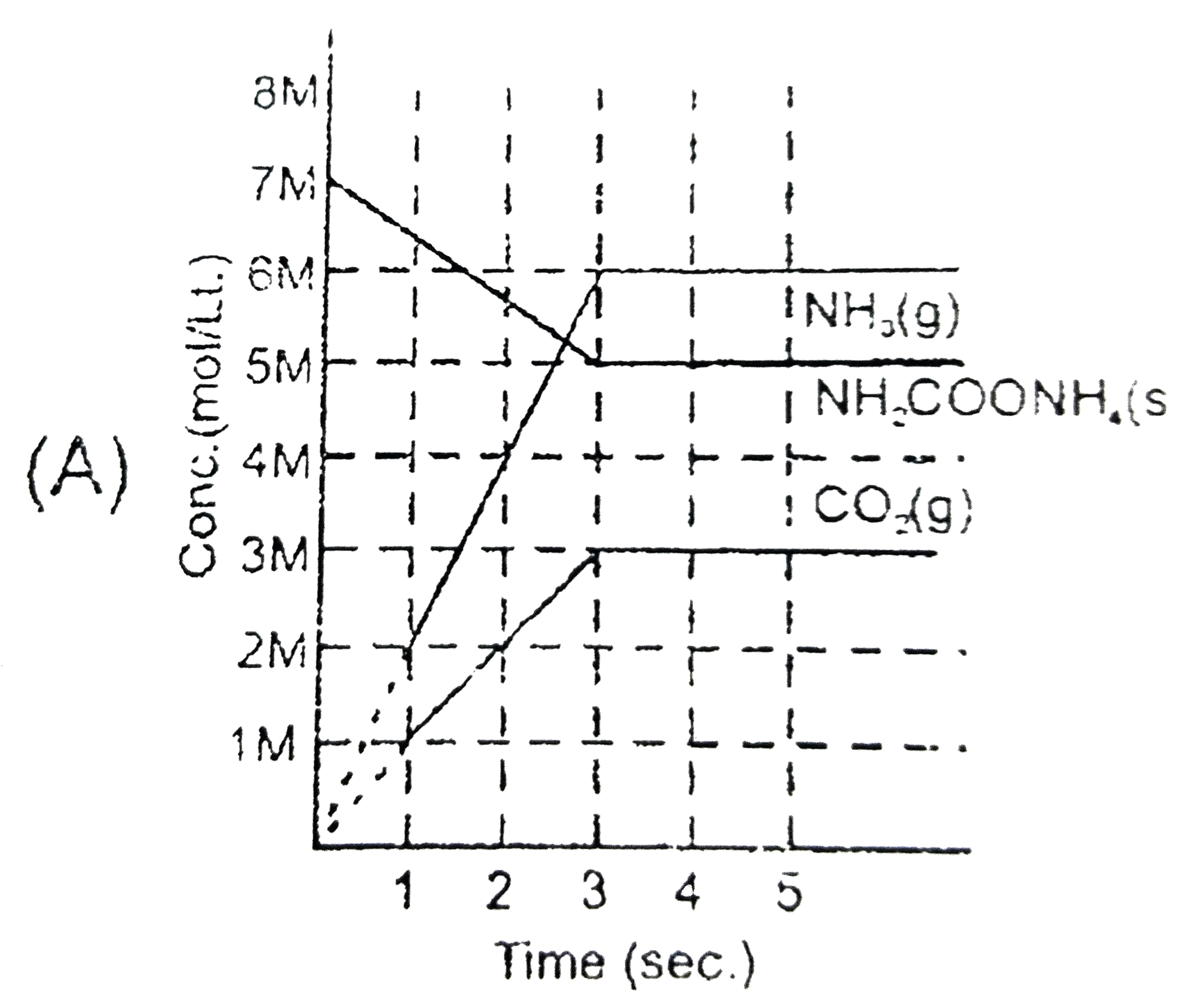
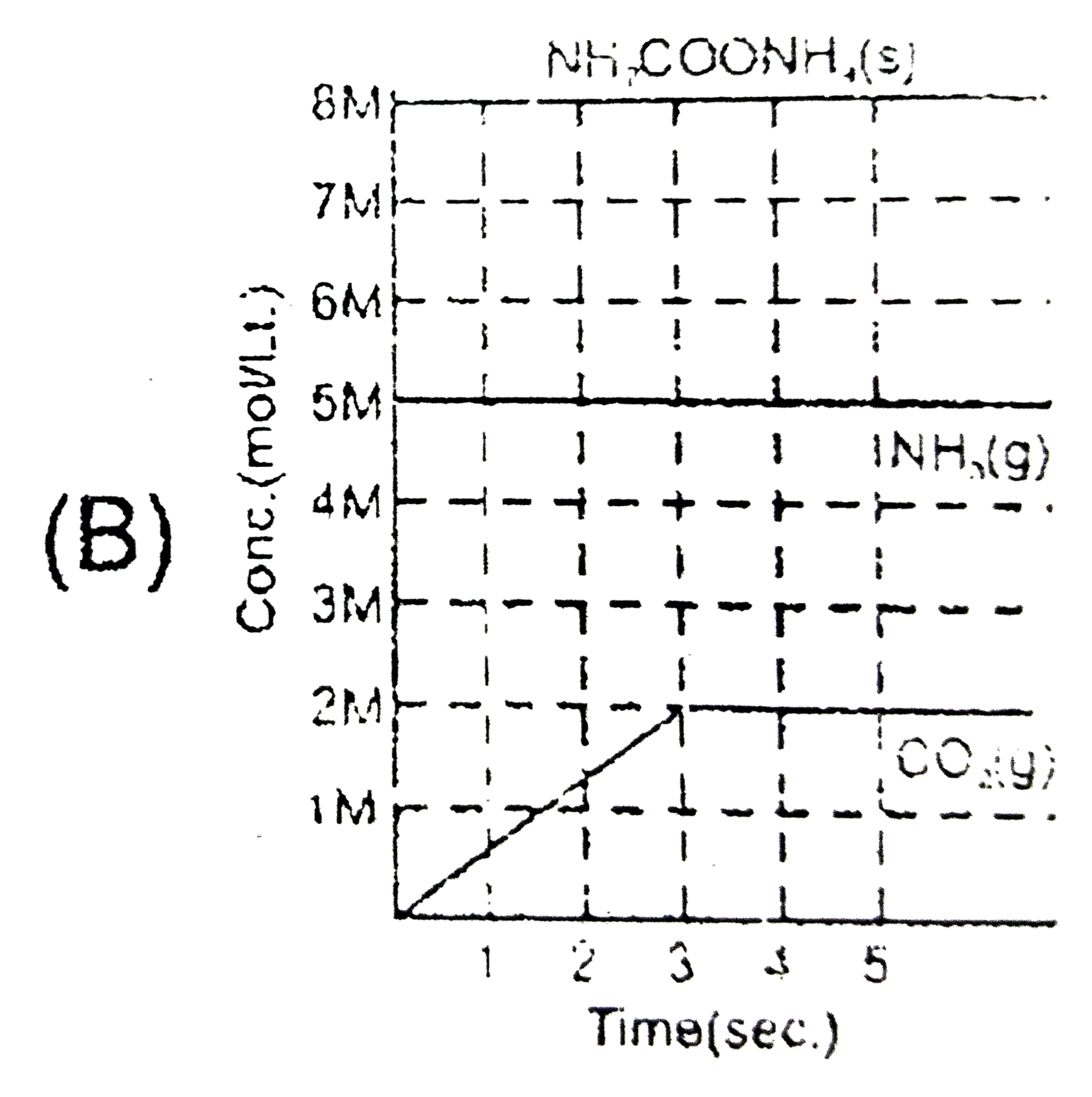
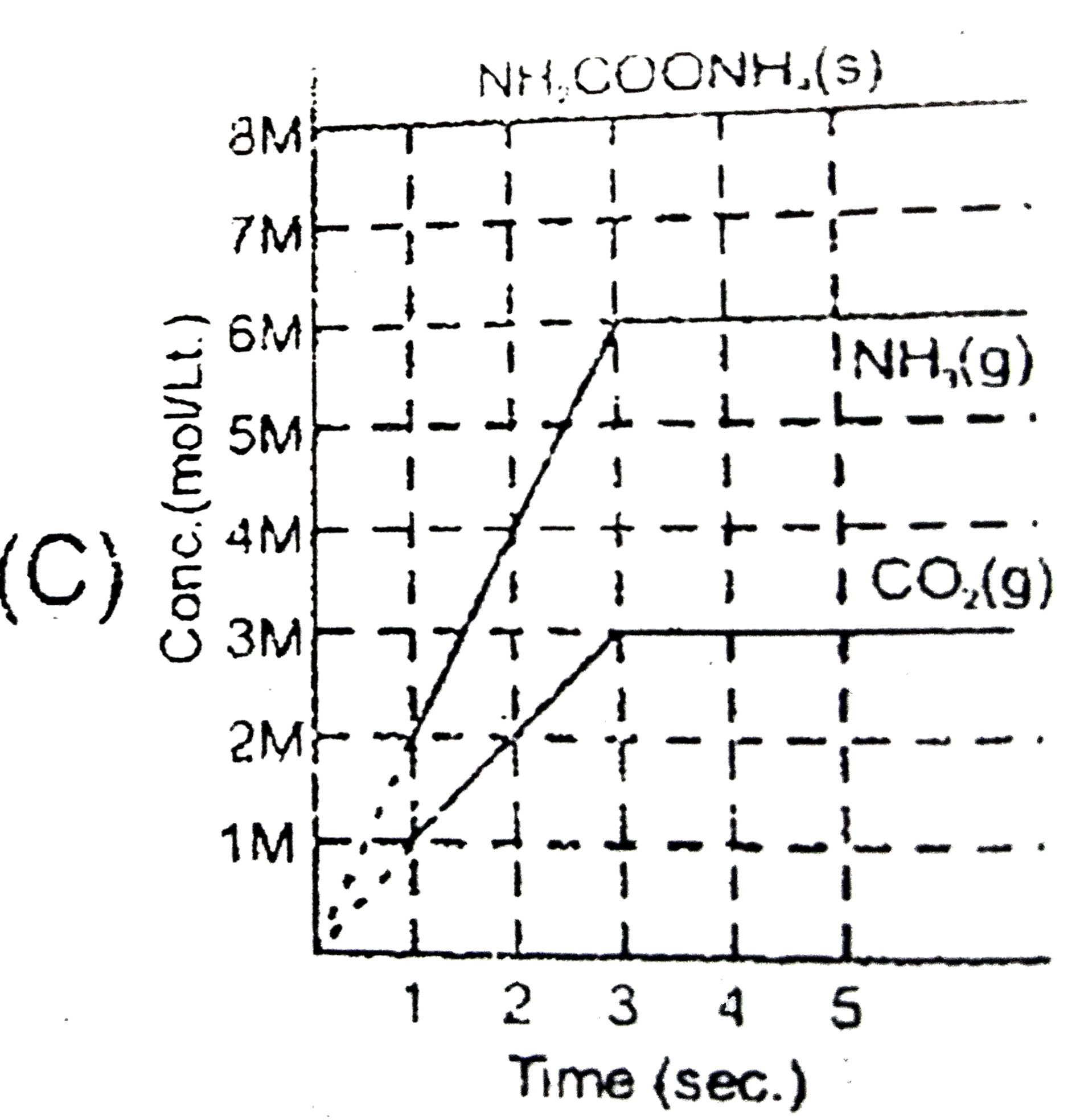
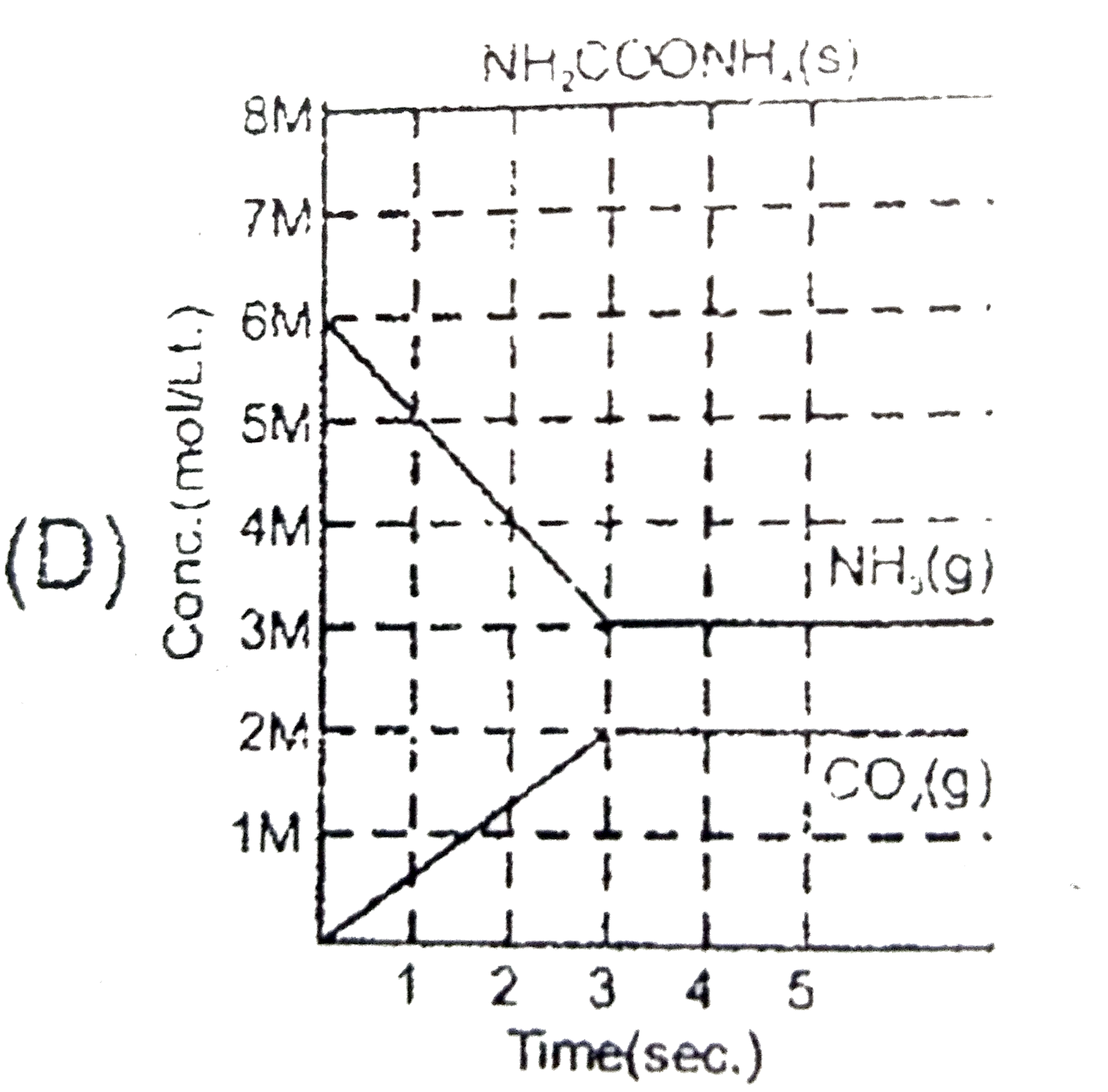
Solid ammonium carbamate dissociate to give ammonia and carbon dioxide as follows
`NH_(2)COONH_(4)(s)hArr2NH_(3)(g)+CO_(2)(g)`
which of the following graph correctly represents the equilibrium.

A

B

C

D

Text Solution

AI Generated Solution

The correct Answer is:

To solve the question regarding the dissociation of solid ammonium carbamate into ammonia and carbon dioxide, we will analyze the equilibrium process and how it can be represented graphically. ### Step-by-Step Solution: 1. **Understanding the Reaction**: The reaction given is: \[ NH_2COONH_4(s) \rightleftharpoons 2NH_3(g) + CO_2(g) \] Here, solid ammonium carbamate dissociates into gaseous ammonia and carbon dioxide. 2. **Identifying the Phases**: - Ammonium carbamate is a solid, which means its concentration does not change over time as it does not enter the equilibrium expression. - Ammonia (NH₃) and carbon dioxide (CO₂) are gases, and their concentrations will change as the reaction progresses. 3. **Graphical Representation**: - On a graph where the y-axis represents concentration and the x-axis represents time: - The concentration of solid ammonium carbamate will remain constant (a horizontal line). - The concentration of ammonia will start at zero and increase until it reaches a constant value at equilibrium. - The concentration of carbon dioxide will also start at zero and increase until it reaches a constant value at equilibrium. 4. **Drawing the Graph**: - For ammonium carbamate (solid), draw a horizontal line at a constant concentration. - For ammonia, draw a curve that starts at zero, rises steeply, and then levels off as it approaches its equilibrium concentration. - For carbon dioxide, draw a similar curve to ammonia, starting at zero, rising, and then leveling off at its equilibrium concentration. 5. **Identifying the Correct Graph**: - Among the provided options (graphs A, B, C, D), look for a graph that shows: - A constant line for the solid (ammonium carbamate). - An increasing curve for ammonia that levels off. - An increasing curve for carbon dioxide that also levels off. - Based on the description, graph C corresponds to this behavior. ### Conclusion: The correct graph that represents the equilibrium of the dissociation of solid ammonium carbamate into ammonia and carbon dioxide is **Graph C**. ---
Promotional Banner

Topper's Solved these Questions

  • CHEMICAL EQUILIBRIUM

    RESONANCE ENGLISH|Exercise Exercise-2 (Part-1)|28 Videos
  • CHEMICAL EQUILIBRIUM

    RESONANCE ENGLISH|Exercise Exercise-2 (Part-2)|22 Videos
  • CHEMICAL EQUILIBRIUM

    RESONANCE ENGLISH|Exercise Exercise-1 (Part-1)|38 Videos
  • CHEMICAL BONDING

    RESONANCE ENGLISH|Exercise ORGANIC CHEMISTRY(Fundamental Concept )|6 Videos
  • D & F-BLOCK ELEMENTS & THEIR IMPORTANT COMPOUNDS

    RESONANCE ENGLISH|Exercise Match the column|1 Videos

Similar Questions

Explore conceptually related problems

Solid ammonium carbomate, NH_4CO_2NH_2(s), dissociates into ammonia and carbon dioxide when it evaporates as shown by NH_4CO_2NH_2(s)hArr2NH_3(g)+CO_2(g) At 25^@C , the total pressure of the gases in equilibrium with the solid is 0.116 atm.If 0.1 atm of CO_2 is introduced after equilibrium is reached then :

The value of K_(P) for NH_(2)COONH_(4(s))hArr 2NH_(3(g))+CO_(2(g)) if the total pressure at equilibrium is P :-

NH_(4)COONH_(4)(s) hArr 2NH_(3)(g)+CO_(2)(g) . for the above reaction, K_(p) is 4, K_c will be

Solid Ammonium carbamate dissociates as: NH_(2)COONH_(4)(s)hArr2NH_(3)(g)+CO_(2)(g). In a closed vessel, solid ammonium carbonate is in equilibrium with its dissociation products. At equilibrium, ammonia is added such that the partial pressure of NH_(3) at new equilibrium now equals the original total pressure. Calculate the ratio of total pressure at new equilibrium to that of original total pressure. Also find the partial pressure of ammonia gas added.

Solid Ammonium carbamate dissociates as: NH_(2)COONH_(4)(s)hArr2NH_(3)(g)+CO_(2)(g). In a closed vessel, solid ammonium carbamate is in equilibrium with its dissociation products. At equilibrium, ammonia is added such that the partial pressure of NH_(3) at new equilibrium now equals the original total pressure. Calculate the ratio of total pressure at new equilibrium to that of original total pressure.

Solid ammonium carbamate dissociated according to the given reaction NH_2COONH_4(s) hArr 2NH_3(g) +CO(g) Total pressure of the gases in equilibrium is 5 atm. Hence K_p .

Solid ammonium carbamate NH_(2)COONH_(4) was taken in excess in closed container according to the following reaction NH_(2)COONH_(4)(s)hArr2NH_(3)(g)+CO_(2)(g) . If equilibrium pressure is 4 atm, it's equilibrium constnat K_(P) is ?

Solid ammonium carbamate (NH_(4)COONH__(4)) was taken in excess in closed container according to the following reaction NH_(2)COONH_(4)(s)hArr2NH_(3)(g)+CO_(2)(g). If equilibrium pressure is 4 atm, it's equilibrium constnat K_(P) is ?

The decomposition of solid ammonium carbamate, (NH_(4))(NH_(2)CO_(2)) , to gaseous ammonia and carbon dioxide is an endothermic reaction. 9NH_(4))(NH_(2)CO_(2)))(s)hArr2NH_(3)(g)+CO_(2)(g) (a) When solid (NH_(4))(NH_(2)CO_(2)) is introduced into and evacuated flask at 25^(@)C , the total pressure of gas at equilibrium is 0.3 atm. What is the value of K_(p) "at" 25^(@)C ?

NH_(4)COONH_(2)(s)hArr2NH_(3)(g)+CO_(2)(g) If equilibrium pressure is 3 atm for the above reaction, then K_(p) for the reaction is

RESONANCE ENGLISH-CHEMICAL EQUILIBRIUM-Exercise-1 (Part-2)
  1. What is the minimum mass of CaCO3(s), below which it decomposes comple...

    Text Solution

    |

  2. If 50% of CO(2) converts to CO at the following equilibrium: (1)/(2)...

    Text Solution

    |

  3. Solid ammonium carbamate dissociate to give ammonia and carbon dioxide...

    Text Solution

    |

  4. For NH(4)HS(s)hArrNH(3)(g)+H(2)S(g) reaction started only with NH(4)HS...

    Text Solution

    |

  5. Consider the decomposition of solid NH(4)HS in a flask containing NH(3...

    Text Solution

    |

  6. What is the relative humidity of air at 1 bar pressure and 313K temper...

    Text Solution

    |

  7. For the equilibrium CuSO(4)xx5H(2)O(s)hArrCuSO(4)xx3H(2)O(s) + 2H(2)O(...

    Text Solution

    |

  8. (a) CuSO(4).5H(2)O(s)hArrCuSO(4).3H(2)O(s)+2H(2)O(g) K(p)=4xx10^(-4)at...

    Text Solution

    |

  9. For the equilibrium CuSO(2).5H(2)O(s)hArrCuSO(4).3H(2)O(s)+2H(2)O(g) ...

    Text Solution

    |

  10. CuSO(4).5H(2)O(s)hArrCuSO(4). 3H(2)O(s)+2H(2)O(g), K(p)=4xx10^(-4)atm^...

    Text Solution

    |

  11. The correct relationship between free energy change in a reaction and ...

    Text Solution

    |

  12. For the reaction, H(2)(g)+I(2)(g)hArr 2HI(g), K(c)^(@)=66.9 at 350^(@)...

    Text Solution

    |

  13. The equilibrium constants for the reaction Br(2)hArr 2Br at 500 K an...

    Text Solution

    |

  14. An exothermic reaction is represented by the graph :

    Text Solution

    |

  15. An endothermic reaction is represented by the graph:

    Text Solution

    |

  16. The value of DeltaG^(@) for a reaction in aqueous phase having K(c)=1,...

    Text Solution

    |

  17. The effect of temperature on equilibrium constant is expressed as(T(2)...

    Text Solution

    |

  18. For the reaction CO(g)+H(2)O(g) hArr CO(2)(g)+H(2)(g) at a given t...

    Text Solution

    |

  19. Given the following reaction at equilibrium N(2)(g) + 3H(2)(g)hArr2NH(...

    Text Solution

    |

  20. The equilibrium SO(2)Cl(2)(g) hArr SO(2)(g)+Cl(2)(g) is attained at 25...

    Text Solution

    |
