Home
Class 11
CHEMISTRY
Which of the following compounds after c...

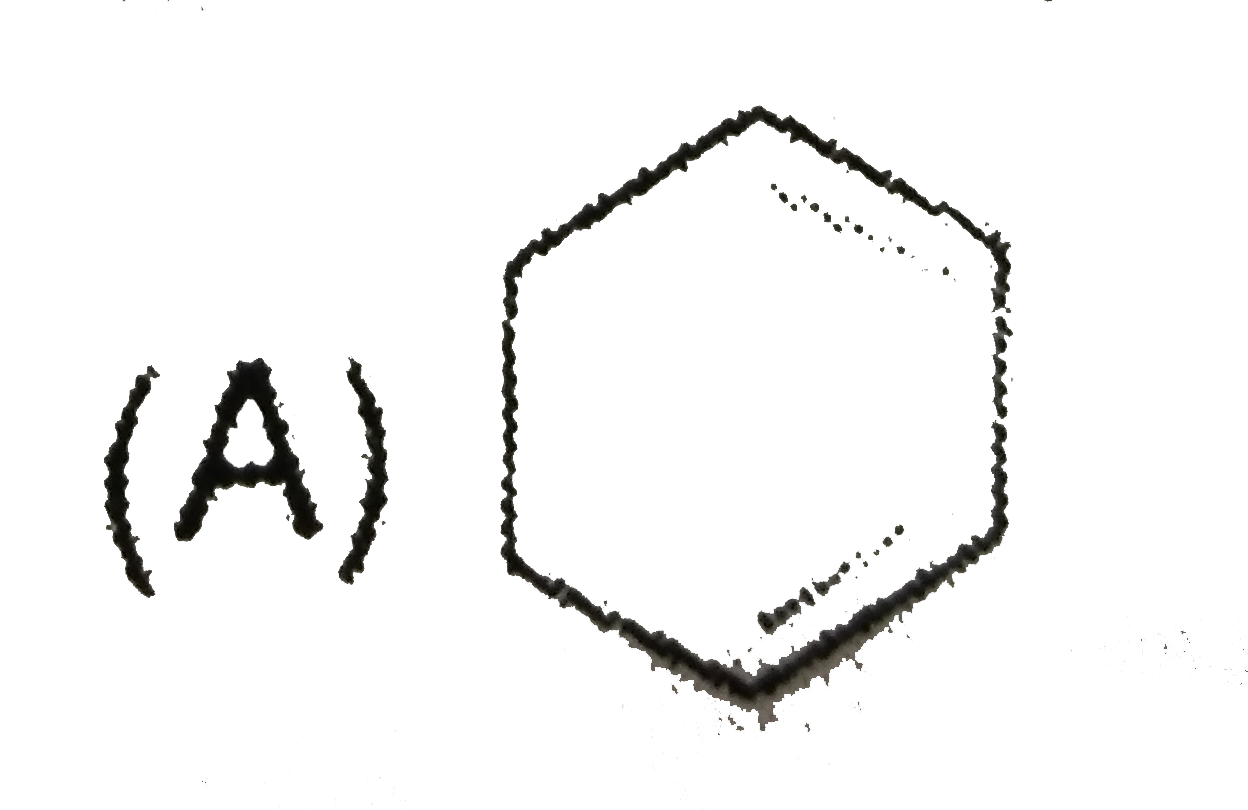
Which of the following compounds after complete hydrogenation will form three monochloro structural isomeric products ?

A

B

`{:(CH_(3)-CH-C-CH_(3)),(" |" " ||"),(" "CH_(3)" "CH_(2)):}`

C

D

`{:(" "C-=CH),(" |"),(HC-=C-CH-C-=CH):}`

Text Solution

AI Generated Solution

The correct Answer is:

To solve the question of which compound, after complete hydrogenation, will form three monochloro structural isomeric products, we can follow these steps: ### Step 1: Identify the Compounds We need to analyze the given compounds to determine their structures and how they would behave upon complete hydrogenation. The compounds are not explicitly listed in the question, but we can assume they are common organic compounds that can undergo hydrogenation. ### Step 2: Perform Complete Hydrogenation Complete hydrogenation of an unsaturated compound (like alkenes or alkynes) will convert it into a saturated compound (alkane). For example, if we have a compound like cyclohexene, hydrogenation will yield cyclohexane. ### Step 3: Analyze the Resulting Alkane Once we have the saturated alkane, we need to analyze its structure to see how many unique monochloro isomers can be formed. A monochloro isomer is formed when one hydrogen atom in the alkane is replaced by a chlorine atom. ### Step 4: Count the Unique Monochloro Isomers - If the resulting alkane has symmetrical groups, the number of unique monochloro isomers will be fewer. - If the resulting alkane has different groups or positions where chlorine can be substituted, the number of unique isomers will increase. ### Example Analysis 1. **Cyclohexane**: After hydrogenation, it remains cyclohexane. There is only one way to substitute a chlorine atom, resulting in only one monochloro isomer. 2. **2-Methylpentane**: After hydrogenation, it becomes a saturated alkane. The possible monochloro isomers would be: - Chlorination at the 2-position (2-chloro-2-methylpentane) - Chlorination at the 3-position (3-chloro-2-methylpentane) - Chlorination at the 4-position (4-chloro-2-methylpentane) This results in three unique monochloro isomers. 3. **1-Hexene**: After hydrogenation, it becomes hexane. The possible monochloro isomers would be: - Chlorination at the 2-position (2-chlorohexane) - Chlorination at the 3-position (3-chlorohexane) - Chlorination at the 4-position (4-chlorohexane) This results in three unique monochloro isomers. ### Conclusion After analyzing the compounds, the correct answer will be the compound that, after hydrogenation, yields an alkane with three unique positions for chlorination. ### Final Answer The compound that will form three monochloro structural isomeric products after complete hydrogenation is **2-Methylpentane** or **1-Hexene**.

To solve the question of which compound, after complete hydrogenation, will form three monochloro structural isomeric products, we can follow these steps: ### Step 1: Identify the Compounds We need to analyze the given compounds to determine their structures and how they would behave upon complete hydrogenation. The compounds are not explicitly listed in the question, but we can assume they are common organic compounds that can undergo hydrogenation. ### Step 2: Perform Complete Hydrogenation Complete hydrogenation of an unsaturated compound (like alkenes or alkynes) will convert it into a saturated compound (alkane). For example, if we have a compound like cyclohexene, hydrogenation will yield cyclohexane. ...
Promotional Banner

Topper's Solved these Questions

  • STRUCTURAL IDENTIFICATION & PRACTICAL ORGANIC CHEMISTRY

    RESONANCE ENGLISH|Exercise Additional theory|4 Videos
  • STRUCTURAL IDENTIFICATION & PRACTICAL ORGANIC CHEMISTRY

    RESONANCE ENGLISH|Exercise Additional Exercise|15 Videos
  • STRUCTURAL IDENTIFICATION & PRACTICAL ORGANIC CHEMISTRY

    RESONANCE ENGLISH|Exercise APSP|30 Videos
  • SOLID STATE

    RESONANCE ENGLISH|Exercise Part- IV|21 Videos
  • THERMODYNAMIC & THERMOCHEMISTRY

    RESONANCE ENGLISH|Exercise INORGANIC CHEMISTRY(P-Block Elements)|26 Videos

Similar Questions

Explore conceptually related problems

Total number of monochloro structure products

Which of the following compound show optical isomerism?

Which of the following compound show optical isomerism?

which of the following compound will show stereo isomerism?

Which of the following compounds display geomertical isomerism ?

Which of the following compounds shows geometrical isomerism ?

Which of the following compound will show optical isomerism

Which of the following compounds exhibits linkage isomerism?

RESONANCE ENGLISH-STRUCTURAL IDENTIFICATION & PRACTICAL ORGANIC CHEMISTRY-Part-III
  1. Farnesence is a compound found in the waxy coating of apples. On hydro...

    Text Solution

    |

  2. A compound P(C(5)H(6)) gives positive Bayer test and on hydrogentation...

    Text Solution

    |

  3. X' compound (C(4)H(8)O) decolorises bromine water react with I(2) & Na...

    Text Solution

    |

  4. Compounds I and II can be distinguished by using reagent. {:("(I)",,...

    Text Solution

    |

  5. Which of the following test will not be given by (Squaric acid)

    Text Solution

    |

  6. Which of the following compounds after complete hydrogenation will for...

    Text Solution

    |

  7. A organic compound having molecular formula C(3)H(4), react with sodiu...

    Text Solution

    |

  8. Compound P Liberates H(2) gas with Na metal. P gives the precipitate w...

    Text Solution

    |

  9. True statements is/are

    Text Solution

    |

  10. C(6)H(15)O(6)(P) underset(Zn, H(2)O)overset(O(3))rarrC(4)H(8)O(4)(Q) u...

    Text Solution

    |

  11. In how many reactions CO(2) gas is released out after reaction with Na...

    Text Solution

    |

  12. How many alkenes, alkynes and alkadienes can be hydrogenated to form I...

    Text Solution

    |

  13. How many acyclic structural isomeric carbonyl compound having molecula...

    Text Solution

    |

  14. Structural of Ascorbic acid is represented as follows How many of...

    Text Solution

    |

  15. Observe the following compounds

    Text Solution

    |

  16. n' number of alkenes yields 2,2,3,4,4- pentamethyl-pentane on catalyti...

    Text Solution

    |

  17. Aldehyde and ketones may be prepared by reductive cleavage of carbon-c...

    Text Solution

    |

  18. (X) overset(O(3)//Zn)underset(H(2)O)toCO(2)+CH(3)-underset(O)underset(...

    Text Solution

    |

  19. which of the following products is not formed in above reaction : prod...

    Text Solution

    |

  20. Match the column :

    Text Solution

    |
