Home
Class 12
CHEMISTRY
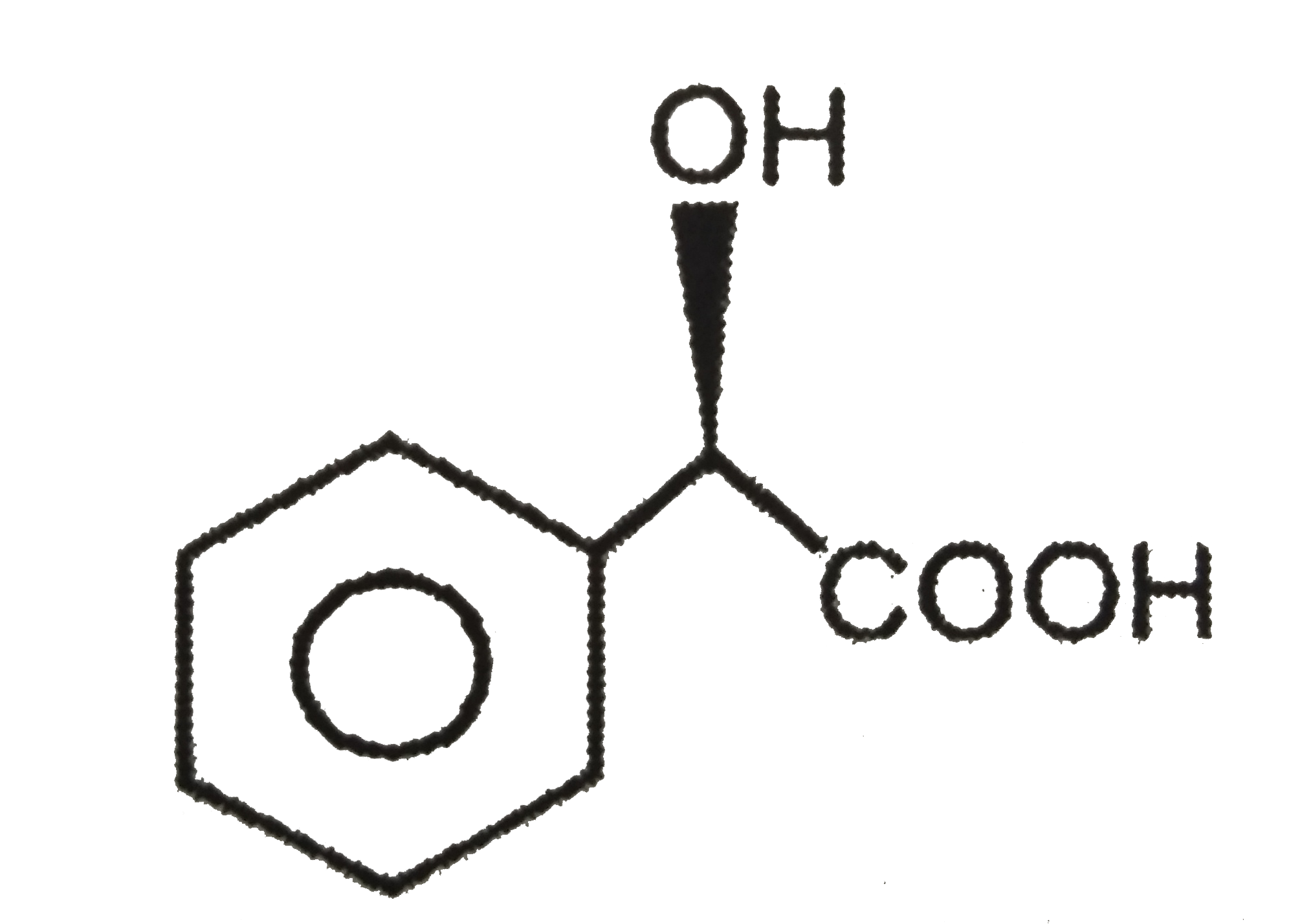
Pure (R) Mandelic acid has specific rot...

Pure (R) Mandelic acid has specific rotation of 150. If a sample contains 60% of the R and 40% of its enantiomer, the `[alpha]` of his solution is.

Text Solution

Verified by Experts

The correct Answer is:

30
Promotional Banner

Topper's Solved these Questions

  • STEREOISOMERISM

    RESONANCE ENGLISH|Exercise EXERCISE (PART III : ONE OR MORE THAN ONE OPTIONS CORRECT TYPE)|11 Videos
  • STEREOISOMERISM

    RESONANCE ENGLISH|Exercise EXERCISE (PART IV : COMPREHENSION)|5 Videos
  • STEREOISOMERISM

    RESONANCE ENGLISH|Exercise EXERCISE (PART I ONLY ONE OPTION CORRECT TYPE)|10 Videos
  • SOLUTIONS

    RESONANCE ENGLISH|Exercise Advabced Level Problems (PART-2)|35 Videos
  • STRUCTURAL IDENTIFICATION

    RESONANCE ENGLISH|Exercise Advanced level Problems (Part-III)|12 Videos

Similar Questions

Explore conceptually related problems

D (+) Glucose has melting point 146^@ C and specific rotation [alpha]_(D)^(25) is + 112^@ C. Another D(+) Glucose has melting point 150^@ C and specific rotational [alpha]_(D)^(25) is + 18.7^@ C. The two form have significantly different optical rotation but when an aqueous solution of either form is allowed to stand, it rotation changes. The specific rotation of one form decreases and rotation of other increases until both solution show the same value +52.7^@ . The change in rotation towards an equilibrium value is called mutarotation. Mutarotation is characteristic feature of:

D (+) Glucose has melting point 146^@ C and specific rotation [alpha]_(D)^(25) is + 112^@ C. Another D(+) Glucose has melting point 150^@ C and specific rotational [alpha]_(D)^(25) is + 18.7^@ C. The two form have significantly different optical rotation but when an aqueous solution of either form is allowed to stand, it rotation changes. The specific rotation of one form decreases and rotation of other increases until both solution show the same value +52.7^@ . The change in rotation towards an equilibrium value is called mutarotation. For mannose the mutarotation can be shown in brief as follow:

Let (+) tartaric acid has a specific rotation of +11.1 , Calculate the specific rotation of a mixture of 68%(+) tartaric acid and 32%(-) tartaric acid.

Cholesterol, when isolated from natural sources, is obtained as a single enantiomer. The observed rotation alpha of a 0.3 g sample of cholesterol in 5mL of chloroform solution contained in a 10 cm polarimeter tube is -0.78^(@) . Calculate the specific rotation of cholesterol. A sample of synthetic cholesterol was prepared consisting entirely of (+)-cholesterol. This synthetic (+)-cholesterol was mixed with some natural (-)-cholesterol. The mixture had a specific rotation [alpha]_(D)^(20) " of " -13^(@). What fraction of the mixture was (+)-cholesterol ?

(R)-2-methyl-1-butanol has a specific rotation of " +13.5^(@) ".The specific rotation of "2" - methyl-1-butanol containing "40%" of the (S)- enantiomer is

The acid solution has a specific gravity of 1.8, when it contains 62% by weight of the acid. The solution is diluted to such an extant this its specific gravity is lowered to 1.2. what is the % by weight of the acid new solution.

A solution of acid having 62% by mass of acid has specific gravity of 1.8 g. If the solution is to be diluted to attain a specific gravity of 1.2 then what volume of water should be added to 100 ml of this solution?

Compound which rotates the plane polarised light is known as optically active compound . On the basis of direction of rotation two forms of an optically active compounds are termed as dextro and laevo rotatory . The two are termed as enantiomers . If we have a 1 : 1 mixture of d and l isomers of a given chiral compound , optical rotation of such mixture is zero Such a mixture is optically inactive and is called a recemic modification. The net specific rotation of any mixture of the d and isomers of a given chiral compound is equal to the weighted average of the rotations due to both the isomers Mathematically if can be expressed as : [alpha]_(net) =f_(d) [alpha_(d)] + f_(1) [alpha_(l)] Where f_(a) and f_(l) are fractions of d and l isomers respectively and [alpha_(d)] , [alpha_(l)] are their specific rotations The pure d isomer of certain chiral compound has [alpha]_(d)^(25) =+ 55^(@) .A non racemic mixture of this compound has a net [alpha]_(d)^(25) =- 11^(@) . What is the fractions of this isomer in mixture ?
