Home
Class 12
CHEMISTRY
The reaction of compounf P with CH(3)MgB...

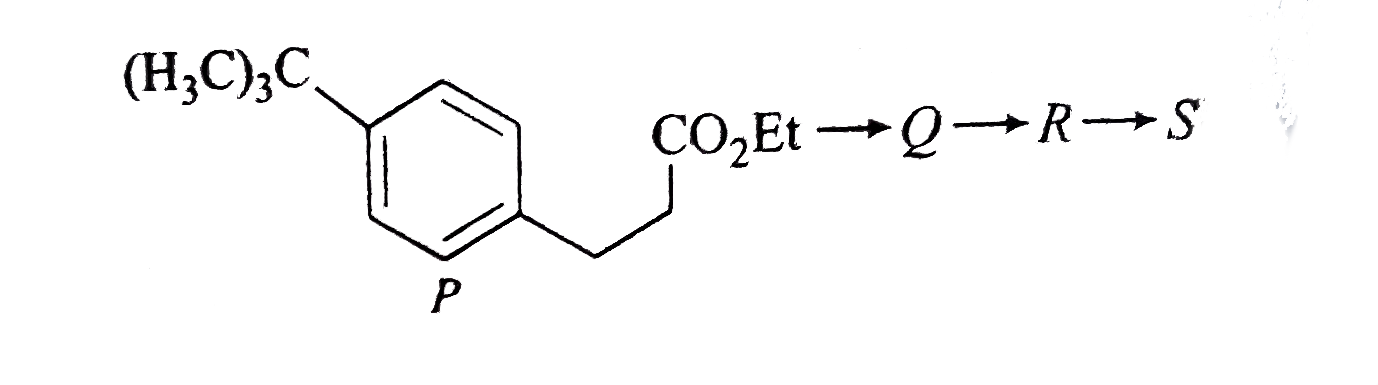
The reaction of compounf P with `CH_(3)MgBr` (excess) in `(C_(2)H_(5)_(2)O` followed by addition of `H_(2)O` give Q the compound Q on treatment with `H_(2)SO_(4)`at `0^(@)` C gives R. the reaction of R with `CH_(3) COCl` in the presence of anhydrous `AlCl_(3)"in" CH_(2)Cl_(2)` followed by treatment with `H_(2)O` produces compound S. [Et in compound P is ethyl group] The product S is

A

Aromatic sulfonation and Friedel-Crafts acylation

B

Friedel-Crafts alkylation and Friedel-Crafts acylation

C

Friedel-Crafts alkylation, dehydeation and Friedel-Crafts acylation

D

Dehydration and Friedel-Crafts acylation

Text Solution

Verified by Experts

The correct Answer is:

B
Promotional Banner

Topper's Solved these Questions

  • AROMATIC COMPOUNDS

    RESONANCE ENGLISH|Exercise Part - II JEE MAIN|20 Videos
  • AROMATIC COMPOUNDS

    RESONANCE ENGLISH|Exercise JEE MAIN (Online Problem)|15 Videos
  • AROMATIC COMPOUNDS

    RESONANCE ENGLISH|Exercise Part - IV Comprehension|13 Videos
  • ALKYL HALIDE, ALCOHOL, PHENOL, ETHER

    RESONANCE ENGLISH|Exercise ORGANIC CHEMISTRY(Alkyl Halide, Alcohol,Phenol,Ether)|56 Videos
  • BASIC CONCEPTS

    RESONANCE ENGLISH|Exercise ORGANIC CHEMISTRY(BASIC CONCEPTS)|27 Videos

Similar Questions

Explore conceptually related problems

The reaction of compounf P with CH_(3)MgBr (excess) in (C_(2)H_(5)_(2)O followed by addition of H_(2)O give Q the compound Q on treatment with H_(2)SO_(4) at 0^(@) C gives R. the reaaction of R with CH_(3) COCl in the presence of anhydrous AlCl_(3) in CH_(2)Cl_(2) followed by treatment with H_(2)O "produces compound S . [Et in compound P is ethyl group] The reaction, Q to R and R TO S, are

Treatment of benzene with "CO"//HCl in the presence of anhydrous AlCl_(3)//CuCl followed by reaction with Ac_(2)"O"//NaOAc gives a compound X. Reaction of X with H_(2)//Pd//c followed by treatment with H_(3)PO_(4) gives another compound Y. The compound Y is :

Which of the following structures correspond to the product expected, when excess of C_(6)H_(6) reacts with CH_(2)Cl_(2) in presence of anhydrous AlCl_(3) .

Phenol on treatment with CO_(2) in the presence of NaOH followed by acidification produces compound X as the major product. X on treatment with (CH_(3)CO)_(2)O in the presence of catalytic amount of H_(2)SO_(4) produces

Treatment of benzene with CO/HCl in the presence of anhydrous "AlCl"_(3)//"CuCl" followed by reaction with Ac_(2)"O"//"NaOAc" gives compound X as the major product. Compound X upon reaction with Br_(2)//Na_(2)CO_(3) , followed by heating at 473 K with moist KOH furnishes Y as the major product. Reaction of X with H_(2)//Pd-C , followed by H_(3)PO_(4) treatment gives Z as the major product. The compound Y is

Treatment of benzene with CO/HCl in the presence of anhydrous "AlCl"_(3)//"CuCl" followed by reaction with Ac_(2)"O"//"NaOAc" gives compound X as the major product. Compound X upon reaction with Br_(2)//Na_(2)CO_(3) , followed by heating at 473 K with moist KOH furnishes Y as the major product. Reaction of X with H_(2)//Pd-C , followed by H_(3)PO_(4) treatment gives Z as the major product. The compound Z is

The product of following reaction is- C_2H_5O^(-) + CH_(3)CH_(2)I to

Bromobenzene on treatment with fuming H_(2)SO_(4) gives a compound which one treatment with Cl_(2)//AlCl_(3) gives (A), (A) on distillation with dil. H_(2)SO_(4) gives (B). (B) on treatment with an eq. of Mg in dry ether gives (C ). (C ) on treatment with CH_(3)CHO followed by hydrolysis gives (D). (D) on treatment with NaOl gives (E). Identify the structures of (A) to (E).

Find the oxidation number of carbon in the following compounds: CH_(3)OH, CH_(2)O, HCOOH, C_(2)H_(2) .

RESONANCE ENGLISH-AROMATIC COMPOUNDS-Exercise-3 (Part-I) JEE Advanced
  1. Match the transformation in Column I with appropriate option in Column...

    Text Solution

    |

  2. The major product of the following reaction is :

    Text Solution

    |

  3. Amongst the compounds given, the one that would form a brilliant color...

    Text Solution

    |

  4. In the following reaction, the product (s) formed is (are)

    Text Solution

    |

  5. The major product of the following reaction contain x bromine atoms in...

    Text Solution

    |

  6. P and Q are isomers of dicarboxylic acid C(4)H(4)O(4). Both decolorize...

    Text Solution

    |

  7. The reactivity of compound Z with different halogens under appropriat...

    Text Solution

    |

  8. For the identification of beta-napthtol using dye test, it is necessar...

    Text Solution

    |

  9. Match the four material (P, Q, R, S) given in List -I with the corresp...

    Text Solution

    |

  10. Among the following, the number of reaction(s) that produce(s) benzal...

    Text Solution

    |

  11. The major product U in the following reactions is

    Text Solution

    |

  12. In the following reactions, the major product W is:

    Text Solution

    |

  13. The product (s) of the following reaction sequence is (are)

    Text Solution

    |

  14. The correct statement(s) about of the following reaction sequence is(a...

    Text Solution

    |

  15. The major product of the following reaction is:

    Text Solution

    |

  16. The reaction of compounf P with CH(3)MgBr (excess) in (C(2)H(5)(2)O fo...

    Text Solution

    |

  17. The reaction of compounf P with CH(3)MgBr (excess) in (C(2)H(5)(2)O fo...

    Text Solution

    |

  18. The reaction(s) leading to the formation of 1,35- trimehtylbenzene is ...

    Text Solution

    |

  19. Aniline reacts with mixed acid (conc. HNO(3) and conc. H(2)SO(4)) at 2...

    Text Solution

    |

  20. In the following reaction sequence, the amount of D (in g) formed from...

    Text Solution

    |
