Home
Class 12
PHYSICS
Two blocks a and B of mass m(A)=1kg and ...

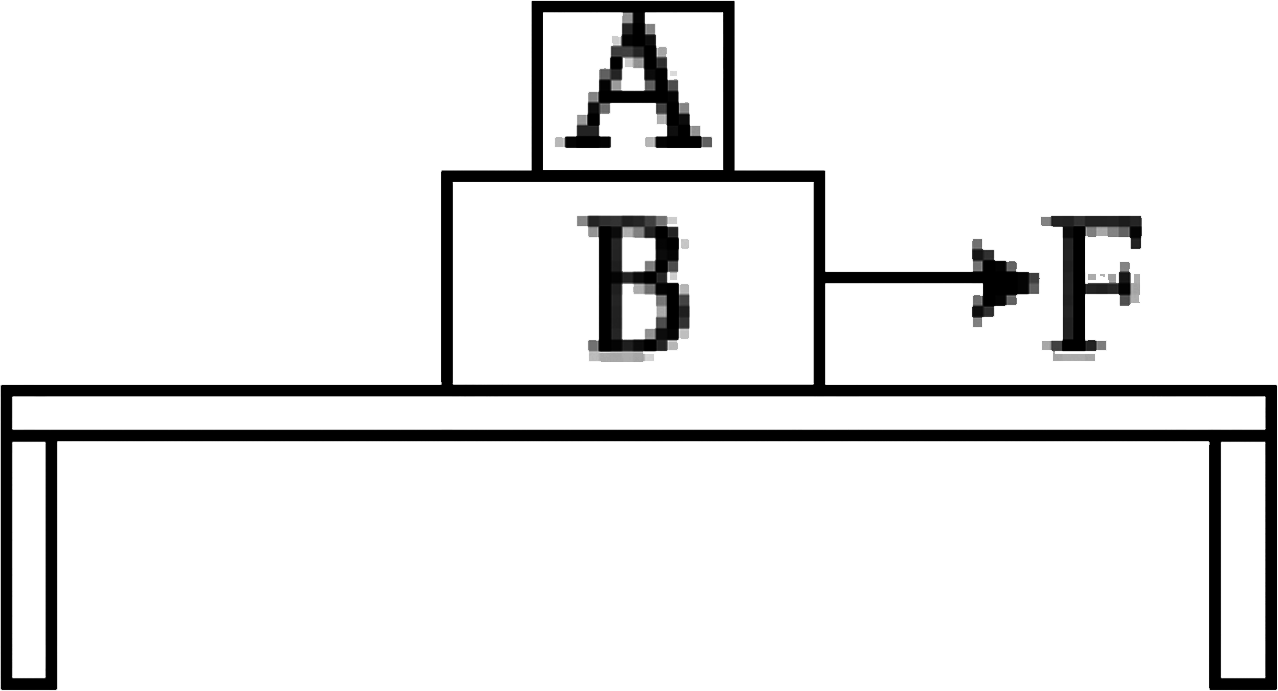
Two blocks a and B of mass `m_(A)=1kg` and `m_(B)=3kg` are kept on the table as shown in figure the coefficient of friction between A and B is 0.2 and between B and the surface of the table is also 0.2 the maximum force F that can be applied on B horizontally, so that the block A does not slide over the block B is [Take `g=10m//s^(2)`]

Text Solution

Verified by Experts

The correct Answer is:
16

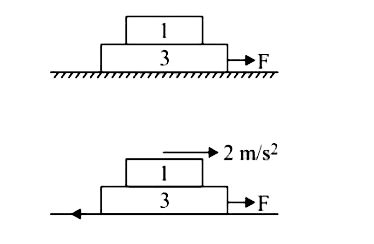
max. acceleration of 1 kg block
`= (f_("max"))/(1) = (mu xx 1 xx g)/(1) = 2m//s^(2)`
When maximum F is applied on 3 kg
`f_(k) = 0.2 xx 4 xx 10 = 8`
`F - 8 = (3 + 1) xx 2`
`F = 16N`
Promotional Banner

Topper's Solved these Questions

  • JEE MAIN REVISION TEST - 13

    VMC MODULES ENGLISH|Exercise PHYSICS (SECTION 2)|5 Videos
  • JEE MAIN REVISION TEST - 12

    VMC MODULES ENGLISH|Exercise PHYSICS|25 Videos
  • JEE MAIN REVISION TEST - 18

    VMC MODULES ENGLISH|Exercise PHYSICS - SECTION 2|5 Videos

Similar Questions

Explore conceptually related problems

Two block A and B of mass 50 kg and 300 kg respectively are placed as shown in figure. Coefficient of friction between all surface is (1)/(2) Then (take g = 10 m//s )

The coefficient of static friction between the two blocks shown in figure is mu and the table is smooth. What maximum horizontal forced F can be applied to he block of mass M so that the block move together?

The coefficient of static friction between the two blocks shown in figure is mu and the table is smooth. What maximum horizontal forced F can be applied to he block of mass M so that the block move together?

On a smooth table two blocks of masses 2.5kg and 1.5kg are placed one over the other as shown in figure. If the coefficient of static friction between two blocks is 0.2, the maximum horizontal force to be applied on the lower block so that the two blocks move together is (g = ms^(-2) )

A block of mass m is kept on horizontal turn table at x distance from the centre. If coefficient of friction between block and surface of turn table is mu , then maximum angular speed of the table so that block does not slip

Two blocks A and B are lying on the table as shown in the figure. The coefficient of friciton between block A and block B is mu . The coefficient of friction between block B and ground also mu . An external force F is applied in the direction shown. The maximum value of the force F that can be applied without moving the blocks.

A block of mass m=2kg is resting on a rough inclined plane of inclination of 30^(@) as shown in figure. The coefficient of friction between the block and the plane is mu=0.5 . What minimum force F should be applied perpendicular to the plane on the block, so that blocks does not slip on the plane? (g=10m//s^(2))

Two block A and B of masses 5 kg. and 3 kg. respectively rest on smooth horizontal surface with B over A. The coefficient of friction between A and B. 0.5 the maximum horizontal force that can be applied to A so that there will be motion of A and B without separation is :-

Block A weighing 100 kg rests on a block B and is tied with a horizontal string to the wall at C. Block B weighs 200 kg. The coefficient of friction between A and B is 0.25 and between B and the surface is 1/3. The horizontal force P necessary to move the block B should be (g=10m//s^(2))

Block A weighing 100 kg rests on a block B and is tied with a horizontal string to the wall at C. Block B weighs 200 kg. The coefficient of friction between A and B is 0.25 and between B and the surface is 1/3. The horizontal force P necessary to move the block B should be (g=10m//s^(2))

