Home
Class 12
PHYSICS
A(nonrotating) star collaps onto from an...

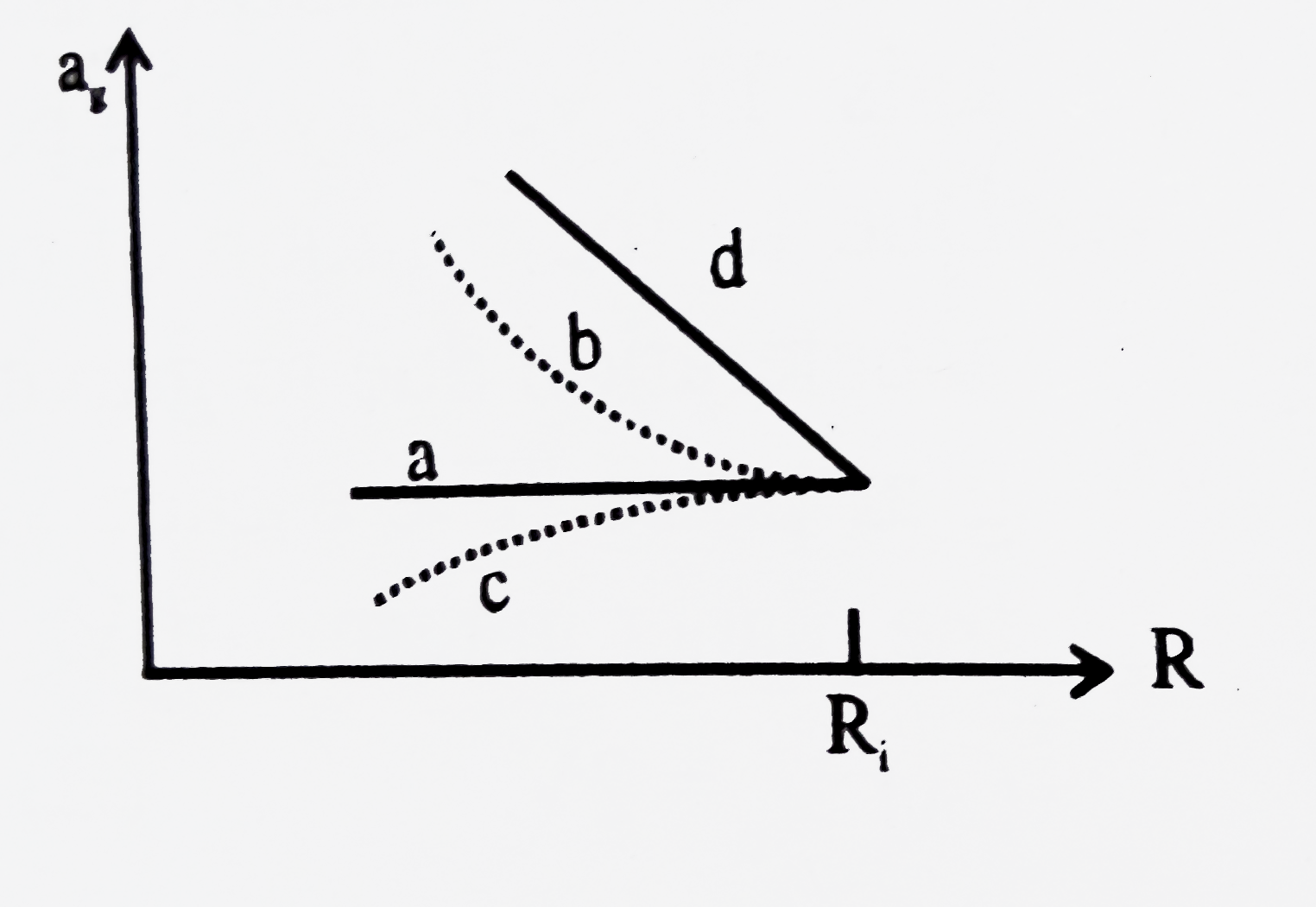
A(nonrotating) star collaps onto from an initial radius `R_(i)` with its mass remaining unchanged. Which curve in figure best gives the gravitational acceleration `a_(g)` on the surface of the star as a function of the radius of the star during the collapse?

A

a

B

b

C

c

D

d

Text Solution

Verified by Experts

The correct Answer is:
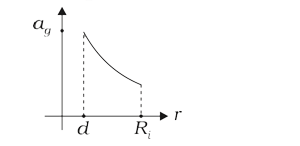
B

`a_g=(GM)/r^2`
Promotional Banner

Topper's Solved these Questions

  • GRAVITATION

    VMC MODULES ENGLISH|Exercise JEE Main (Archive)|43 Videos
  • GRAVITATION

    VMC MODULES ENGLISH|Exercise JEE Advance (Archive) SINGLE OPTION CORRECT|14 Videos
  • GRAVITATION

    VMC MODULES ENGLISH|Exercise Level-1 MCQs|60 Videos
  • GASEOUS STATE & THERMODYNAMICS

    VMC MODULES ENGLISH|Exercise JEE ADVANCED (ARCHIVE )|111 Videos
  • INTRODUCTION TO VECTORS & FORCES

    VMC MODULES ENGLISH|Exercise JEE Advanced ( ARCHIVE LEVEL-2)|12 Videos

Similar Questions

Explore conceptually related problems

A spherical hole of radius R//2 is excavated from the asteroid of mass M as shown in the figure the gravitational acceleration at a point on the surface of the asteroid just above the excavation is

If the mass of Mars is 0.107 M_(E ) and its radius is 0.53 R_(E ) , estimate the gravitational field g at the surface of Mars.

A satellite of mass m revolves around the earth of radius R at a hight x from its surface. If g is the acceleration due to gravity on the surface of the earth, the orbital speed of the satellite is

Two stars of mass M_(1) & M_(2) are in circular orbits around their centre of mass The star of mass M_(1) has an orbit of radius R_(1) the star of mass M_(2) has an orbit of radius R_(2) (assume that their centre of mass is not acceleration and distance between starts is fixed) (a) Show that the ratio of orbital radii of the two stars equals the reciprocal of the ratio of their masses, that is R_(1)//R_(2) = M_(2)//M_(1) (b) Explain why the two stars have the same orbital period and show that the period T=2pi((R_(1)+R_(2))^(3//2))/(sqrt(G(M_(1)+M_(2)))) .

Assuming the earth to be a homogeneous sphere of radius R , its density in terms of G (constant of gravitation) and g (acceleration due to gravity on the surface of the earth)

The gravitational potential energy of body of mass 'm' at the earth's surface - mgR_(e) . Its gravitational potential energy at a height R_(e) from the earth's surface will be (here R_(e) is the radius of the earth)

If g be the acceleration due to gravity of the earth's surface, the gain is the potential energy of an object of mass m raised from the surface of the earth to a height equal to the radius R of the earth is

The height from the surface of earth at which the gravitational potential energy of a ball of mass m is half of that at the centre of earth is (where R is the radius of earth)

A small body of mass m falls to the earth from infintie distance away. What will be its velocity or reaching the earth? (Radius of the earth = R, acceleration due to gravity on the surface of the earth is g) :-

An earth satellite of mass m revolves in a circular orbit at a height h from the surface of the earth. R is the radius of the earth and g is acceleration due to gravity at the surface of the earth. The velocity of the satellite in the orbit is given by

VMC MODULES ENGLISH-GRAVITATION-Level-2
  1. Gravitational force with which a body attracts the other is always equ...

    Text Solution

    |

  2. A body starts from rest from a point distant r(0) from the centre of t...

    Text Solution

    |

  3. A(nonrotating) star collaps onto from an initial radius R(i) with its ...

    Text Solution

    |

  4. If ge, gh and gd be the acceleration due to gravity at earth’s surfac...

    Text Solution

    |

  5. The acceleration due to gravity on the planet A is 9 times the acceler...

    Text Solution

    |

  6. If the earth were to spin faster, acceleration due to gravity at the p...

    Text Solution

    |

  7. Assuming the earth to be a sphere of uniform density the acceleration ...

    Text Solution

    |

  8. Three planets of same density have radii R(1),R(2) and R(3) such that ...

    Text Solution

    |

  9. Two objectes of mass m and 4m are at rest at and infinite seperation. ...

    Text Solution

    |

  10. Two uniform spherical stars made of same material have radii R and 2R....

    Text Solution

    |

  11. Two uniform spherical starts made of same material have radii R and 2...

    Text Solution

    |

  12. A body weighs 64 N on the surface of the Earth. What is the gravitatio...

    Text Solution

    |

  13. A satellite is launched into a circular orbit of radius 'R' around ear...

    Text Solution

    |

  14. A planet of small mass m moves around the sun of mass M along an ellip...

    Text Solution

    |

  15. The figure shows the variation of energy with the orbit radius of a bo...

    Text Solution

    |

  16. A satellite revolves in the geostationary orbit but in a direction eas...

    Text Solution

    |

  17. A satallite of mass m, initally at rest on the earth, is launched into...

    Text Solution

    |

  18. A satellite of mass 5M orbits the earth in a circular orbit. At one po...

    Text Solution

    |

  19. A satellite can be in a geostationary orbit around earth in an orbit o...

    Text Solution

    |

  20. When a satellite in a circular orbit around the earth enters the atmos...

    Text Solution

    |

