Home
Class 12
PHYSICS
The correct figure that shows , schemati...

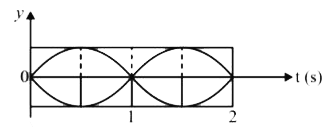
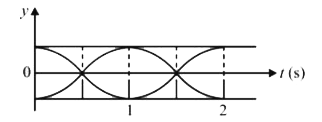
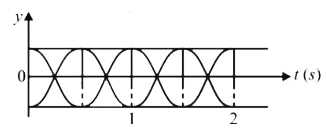
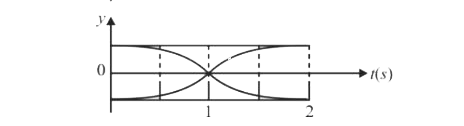
The correct figure that shows , schematically , the wave pattern produced by superposition of two waves of frequencies 9 Hz and 11 Hz, is :

A

B

C

D

Text Solution

AI Generated Solution

The correct Answer is:

To solve the problem regarding the wave pattern produced by the superposition of two waves with frequencies of 9 Hz and 11 Hz, we can follow these steps: ### Step 1: Identify the Frequencies We have two frequencies: - \( f_1 = 9 \, \text{Hz} \) - \( f_2 = 11 \, \text{Hz} \) ### Step 2: Calculate the Beat Frequency The beat frequency is calculated using the formula: \[ f_{\text{beat}} = |f_2 - f_1| \] Substituting the values: \[ f_{\text{beat}} = |11 \, \text{Hz} - 9 \, \text{Hz}| = 2 \, \text{Hz} \] ### Step 3: Determine the Time Period of the Beats The time period of the beats can be found using the formula: \[ T_{\text{beat}} = \frac{1}{f_{\text{beat}}} \] Substituting the beat frequency: \[ T_{\text{beat}} = \frac{1}{2 \, \text{Hz}} = 0.5 \, \text{seconds} \] This means that in 0.5 seconds, there will be one complete cycle of rise and fall in the intensity of the resultant wave. ### Step 4: Analyze the Wave Pattern Since the beat frequency is 2 Hz, this indicates that the wave pattern will show a rise and fall in intensity twice every second. Thus, the wave pattern will have a periodicity of 0.5 seconds. ### Step 5: Choose the Correct Figure To find the correct schematic representation of the wave pattern, we look for a graph that shows: - A complete cycle of rise and fall occurring in 0.5 seconds. - The wave pattern should reflect the superposition of two waves, showing alternating constructive and destructive interference. ### Conclusion The correct figure will be the one that depicts the wave pattern with a cycle of rise and fall every 0.5 seconds, corresponding to the calculated beat frequency of 2 Hz. ---

To solve the problem regarding the wave pattern produced by the superposition of two waves with frequencies of 9 Hz and 11 Hz, we can follow these steps: ### Step 1: Identify the Frequencies We have two frequencies: - \( f_1 = 9 \, \text{Hz} \) - \( f_2 = 11 \, \text{Hz} \) ### Step 2: Calculate the Beat Frequency ...
Promotional Banner

Topper's Solved these Questions

  • WAVE MOTION

    VMC MODULES ENGLISH|Exercise JEE ADVANCED ARCHIVE LEVEL 2|32 Videos
  • WAVE MOTION

    VMC MODULES ENGLISH|Exercise JEE ADVANCED ARCHIVE LEVEL 2 (MUTIPLE CORRECT TYPE)|20 Videos
  • WAVE MOTION

    VMC MODULES ENGLISH|Exercise LEVEL-2|41 Videos
  • UNITS, MEASUREMENTS & ERRORS

    VMC MODULES ENGLISH|Exercise IN - CHAPTER EXERCISE - B|10 Videos
  • WORK ENERGY AND POWER

    VMC MODULES ENGLISH|Exercise IMPECCABLE|54 Videos

Similar Questions

Explore conceptually related problems

What is the beat frequency, when two waves of frequency 450 Hz and 456 Hz are superposed?

During superposition of two waves of nearly equal frequencies , beat frequency is defined as the

Find the wavelength of electromagnetic waves of frequency 9× 10^19 Hz in free space.

Find the wavelength of electromagnetic waves of frequency 5× 10^19 Hz in free space.

Find the wavelength of electromagnetic waves of frequency 7× 10^19 Hz in free space.

Find the wavelength of electromagnetic waves of frequency 8× 10^19 Hz in free space.

Find the wavelength of electromagnetic waves of frequency 4× 10^19 Hz in free space.

Figure shows the shape of part of a long string in which transverse waves are produced by attaching one end of the string to tuning fork of frequency 250 Hz. What is the velocity of the waves?

One of the components of frequency of amplitude modulated wave (AM) formed by the superposition of message signal of frequency omega_1 on a carrier wave of frequency omega_2 is

To which part of the electromagnetic spectrum does a wave of frequency 5xx10^(19) Hz belong ?

VMC MODULES ENGLISH-WAVE MOTION-JEE MAIN ARCHIVE LEVEL 1
  1. A closed organ pipe has a fundamental frequency of 1.5 kHz. The number...

    Text Solution

    |

  2. A string of length 1 m and mass 5 g is fixed at both ends. The tension...

    Text Solution

    |

  3. A train moves towards a stationary observer with speed 34 m/s. The tra...

    Text Solution

    |

  4. Equation of travelling wave on a stertched string of linear density 5 ...

    Text Solution

    |

  5. A resonance tube is old and has jagged end. It is still used in the la...

    Text Solution

    |

  6. A tavelling harmonic wave is represented by the equation y(x,t)=10...

    Text Solution

    |

  7. A person standing on an open ground hears the sound of a jet aeroplan...

    Text Solution

    |

  8. A wire of length 2L, is made by joining two wires A and B of same leng...

    Text Solution

    |

  9. A string is clamped at both the ends and it is vibrating in its 4^(th)...

    Text Solution

    |

  10. The pressure wave, P = 0.01 sin[1000t-3x]Nm^(-2), corresponds to the s...

    Text Solution

    |

  11. The correct figure that shows , schematically , the wave pattern produ...

    Text Solution

    |

  12. A string of length 2m is fixed at two ends. It is in resonance with a ...

    Text Solution

    |

  13. Two cars A and B are moving away from each other in opposite direction...

    Text Solution

    |

  14. A source of sound S is moving with a velocity of 50m//s towards a stat...

    Text Solution

    |

  15. A stationary source of sound is emitting sound of frequency 500Hz. Two...

    Text Solution

    |

  16. Two sources of sound S(1) and S(2) produce sound waves of same frequen...

    Text Solution

    |

  17. A small speaker delivers 2 W of audio will one detect 120 dB intensit...

    Text Solution

    |

  18. A tuning fork of frequency 480 Hz is used in an experiment for measuri...

    Text Solution

    |

  19. A progressive wave travelling along the positive x-direction is repres...

    Text Solution

    |

  20. A submarine (A) travelling at 18km//hr is being chased along the line ...

    Text Solution

    |
