Home
Class 12
PHYSICS
A car accelerates from rest at a constan...

A car accelerates from rest at a constant rate `alpha` for some time, after which it decelerates at a constant rate `beta,` to come to rest. If the total time elapsed is t seconds. Then evalute the maximum velocity aquired by the car is

A

` (alpha beta )/( alpha + beta ) t`

B

` ( alpha + beta )/( alpha beta ) t`

C

` ( alpha ^(2) + beta ^(2))/( beta alpha ) `

D

` (alpha + beta^(2))/( beta alpha ) `

Text Solution

Verified by Experts

The correct Answer is:
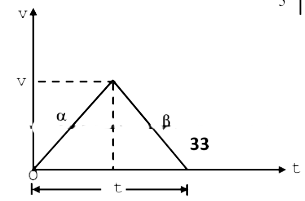
A

` t= (v)/(alpha ) +(v)/(beta) `
` rArr v= ( alpha beta t)/( alpha +beta ) `
Promotional Banner

Topper's Solved these Questions

  • KINEMATICS OF A PARTICLE

    VMC MODULES ENGLISH|Exercise LEVEL 2|65 Videos
  • KINEMATICS OF A PARTICLE

    VMC MODULES ENGLISH|Exercise JEE MAIN (archive)|19 Videos
  • KINEMATICS OF A PARTICLE

    VMC MODULES ENGLISH|Exercise JEE Advanced (archive)|14 Videos
  • JEE MAIN REVISON TEST-23

    VMC MODULES ENGLISH|Exercise PHYSICS (SECTION 2)|1 Videos
  • LAWS OF MOTION

    VMC MODULES ENGLISH|Exercise IMPECCABLE|53 Videos

Similar Questions

Explore conceptually related problems

A car accelerates from rest at a constant rate alpha for some time, after which it decelerates at a constant rate beta, to come to rest. If the total time elapsed is t seconds. Then evalute (a) the maximum velocity reached and (b) the total distance travelled.

A car accelerates from rest at a constant rate alpha for some time, after which it decelerates at a constant rate beta, to come to rest. If the total time elapsed is t seconds. Then evalute (a) the maximum velocity reached and (b) the total distance travelled.

A car accelerates from rest at a constant rate alpha for some time, after which it decelerates at a constant rate beta, to come to rest. If the total time elapsed is t seconds. Then evalute (a) the maximum velocity reached and (b) the total distance travelled.

A bus accelerates from rest at a constant rate alpha for some time, after which it decelerates at a constant rate beta to come to rest. If the total time elapsed is t seconds then, evaluate. (a)the maximum velocity achieved and (b)the total distance travelled graphically.

A car accelerates from rest at a constant rate 'alpha' for some time after which it decelerates at a constant rate beta to come to rest. If the total time elapsed is t, the maximum velocity acquired by the car is given by :

A train accelerates from rest at a constant rate alpha for some time and then it retards to rest at the constant rate beta . If the total distance covered by the train is s, then the velocity of the train is

A car accelerates from rest at a constant rate of 2 m s^(-2) for some time. The it retatds at a constant rate of 4 m s^(-2) and comes to rest. It remains in motion for 6 s .

A train accelerates from rest at a constant rate a for time t_(1) and then it retards at the constant rate b for time t_(2) then comes to rest. Find the ratio t_(1) / t_(2) .

A car acceleration from rest at a constant rate 2m//s^(2) for some time. Then, it retards at a constant rate of 4 m//s^(2) and comes to rest. If it remains motion for 3 second, then the maximum speed attained by the car is:-

A car accelerates from rest at constant rate of 2ms^(-2) for some time. Immediately after this, it retards at a constant rate of 4ms^(-2) and comes to rest. The total time for which it remains in motion is 3 s. Taking the moment of start of motion as t = 0, answer the following questions. If the time of acceleration is t_(1) , then the speed of the car at t=t_(1) is

VMC MODULES ENGLISH-KINEMATICS OF A PARTICLE -LEVEL 1
  1. The displacement of a body is given to be proportional to the cube of ...

    Text Solution

    |

  2. The v-x graph for a car in a race on a straight road is given. Identif...

    Text Solution

    |

  3. A car accelerates from rest at a constant rate alpha for some time, af...

    Text Solution

    |

  4. A car, starting from rest, has a constant acceleration for a time in...

    Text Solution

    |

  5. A train starts from rest and moves with a constant accelerationof 2.0m...

    Text Solution

    |

  6. A particle moves along X-axis as x=4(t-2)+at(t-2)^(2) Which of the...

    Text Solution

    |

  7. The displacement x of a particle moving in one dimension under the act...

    Text Solution

    |

  8. If the velocity of a particle is given by v=(180-16x)^((1)/(2))(m)/(s)...

    Text Solution

    |

  9. A particle moves along a straight line. Its position at any instant is...

    Text Solution

    |

  10. The acceleration of a particle is increasing linerly with time t as bt...

    Text Solution

    |

  11. A particle moving in a straight line has velocity-displacement equatio...

    Text Solution

    |

  12. Statement-1: When velocity of a particle is zero then acceleration of ...

    Text Solution

    |

  13. A body starts moving with a velocity v0 = 10 ms^-1. It experiences a r...

    Text Solution

    |

  14. A body of mass 10 kg is being acted upon by a force 3t^2 and an opposi...

    Text Solution

    |

  15. The displacement of a particle moving in a straight line is described ...

    Text Solution

    |

  16. A body starts from the origin and moves along the X-axis such that the...

    Text Solution

    |

  17. A particle is projected with velocity v(0) along x - axis. The deceler...

    Text Solution

    |

  18. Which of the following represents uniformly accelerated motion ?

    Text Solution

    |

  19. The position-time relation of a particle moving along the x-axis is gi...

    Text Solution

    |

  20. If the velocity v of a particle moving along a straight line decreases...

    Text Solution

    |

