Home
Class 12
PHYSICS
Two stones are through up simultaneously...

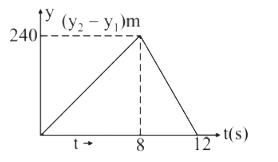
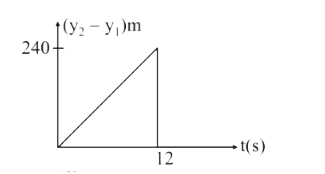
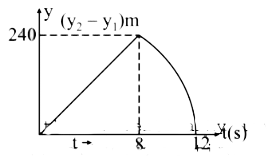
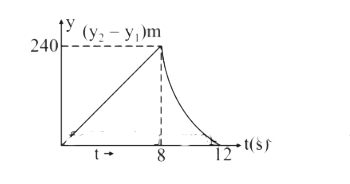
Two stones are through up simultaneously from the edge of a cliff 240 m high with initial speed of 10 m/s and 40 m/s respectively. Which of the following graphs best represents the time variation of relative position of the second stone with respect to the first? Assume stones do not rebound after hitting the ground and neglect air resistance, take . ` g= 10 m//s^(2) ` (The figures are schematic and not drawn to scale)

A

B

C

D

Text Solution

AI Generated Solution

The correct Answer is:

To solve the problem step by step, we need to analyze the motion of both stones and their relative positions over time. ### Step 1: Understand the Initial Conditions - **Height of the cliff**: 240 m - **Initial speed of Stone 1 (S1)**: 10 m/s (upwards) - **Initial speed of Stone 2 (S2)**: 40 m/s (upwards) - **Acceleration due to gravity (g)**: 10 m/s² (downwards) ### Step 2: Determine the Time of Flight for Each Stone To find out how long each stone takes to hit the ground, we can use the kinematic equation: \[ h = v_i t + \frac{1}{2} a t^2 \] Where: - \( h \) = height (240 m) - \( v_i \) = initial velocity - \( a \) = acceleration (which is -g because it acts downwards) For **Stone 1 (S1)**: \[ 240 = 10t - \frac{1}{2}(10)t^2 \] \[ 240 = 10t - 5t^2 \] \[ 5t^2 - 10t + 240 = 0 \] Using the quadratic formula \( t = \frac{-b \pm \sqrt{b^2 - 4ac}}{2a} \): Here, \( a = 5, b = -10, c = 240 \): \[ t = \frac{10 \pm \sqrt{(-10)^2 - 4 \cdot 5 \cdot 240}}{2 \cdot 5} \] \[ t = \frac{10 \pm \sqrt{100 - 4800}}{10} \] Since the discriminant is negative, Stone 1 will hit the ground before reaching the maximum height. For **Stone 2 (S2)**: \[ 240 = 40t - \frac{1}{2}(10)t^2 \] \[ 240 = 40t - 5t^2 \] \[ 5t^2 - 40t + 240 = 0 \] Using the quadratic formula again: Here, \( a = 5, b = -40, c = 240 \): \[ t = \frac{40 \pm \sqrt{(-40)^2 - 4 \cdot 5 \cdot 240}}{2 \cdot 5} \] \[ t = \frac{40 \pm \sqrt{1600 - 4800}}{10} \] Again, the discriminant is negative, indicating that Stone 2 will also hit the ground. ### Step 3: Analyze Relative Motion The relative velocity between the two stones is: \[ v_{rel} = v_{S2} - v_{S1} = 40 - 10 = 30 \text{ m/s} \] This means that Stone 2 is moving away from Stone 1 at a constant rate of 30 m/s until one of them hits the ground. ### Step 4: Determine the Position Function The position of each stone can be described by: - For Stone 1: \[ y_1(t) = 240 + 10t - 5t^2 \] - For Stone 2: \[ y_2(t) = 240 + 40t - 5t^2 \] ### Step 5: Find the Relative Position The relative position of Stone 2 with respect to Stone 1 is given by: \[ y_{rel}(t) = y_2(t) - y_1(t) \] \[ y_{rel}(t) = (240 + 40t - 5t^2) - (240 + 10t - 5t^2) \] \[ y_{rel}(t) = 30t \] ### Step 6: Determine the Graph Behavior - For the time before both stones hit the ground, the relative position increases linearly with a slope of 30. - After Stone 1 hits the ground, it stops moving, and Stone 2 continues to fall under gravity, which means the relative position will start to decrease as Stone 2 falls. ### Conclusion The graph of the relative position of Stone 2 with respect to Stone 1 will show a linear increase until Stone 1 hits the ground, followed by a curve that decreases as Stone 2 falls.

To solve the problem step by step, we need to analyze the motion of both stones and their relative positions over time. ### Step 1: Understand the Initial Conditions - **Height of the cliff**: 240 m - **Initial speed of Stone 1 (S1)**: 10 m/s (upwards) - **Initial speed of Stone 2 (S2)**: 40 m/s (upwards) - **Acceleration due to gravity (g)**: 10 m/s² (downwards) ...
Promotional Banner

Topper's Solved these Questions

  • KINEMATICS OF A PARTICLE

    VMC MODULES ENGLISH|Exercise JEE Advanced (archive)|14 Videos
  • KINEMATICS OF A PARTICLE

    VMC MODULES ENGLISH|Exercise LEVEL 2|65 Videos
  • JEE MAIN REVISON TEST-23

    VMC MODULES ENGLISH|Exercise PHYSICS (SECTION 2)|1 Videos
  • LAWS OF MOTION

    VMC MODULES ENGLISH|Exercise IMPECCABLE|53 Videos

Similar Questions

Explore conceptually related problems

Two stones are thrown up simultaneously from the edge of a cliff 200 m high with initial speeds of 15 m s^(-1) and 30 m s^(-1) respectively. The time variation of the relative position of the second stone with respect to the first is shown in the figure. The equation of the linear part is

Two stones are thrown up simultaneously from the edge of a cliff with initial speed v and 2 v . The relative position of the second stone with respect to first varies with time till both the stones strike the ground as.

One stone is projected horizontally from a 20 m high cliff with an initial speed of 10 ms^(-1) . A second stone is simultaneously dropped from that cliff. Which of the following is true?

Two stones are thrown vertically upwards simultaneously from the same point on the ground with initial speed u_(1) = 30 m//sec and u_(2) = 50 m//sec . Which of the curve represent correct variation (for the time interval in which both reach the ground) of (x_(2) - x_(1)) = the relative position of second stone with respect to first with time (t) (v_(2) - v_(1)) = the relative velocity of second stone with respect to first with time (t). Assuming that stones do not rebound after hitting.

A projectile is fired form the top of a 40 m high cliff with an initial speed of 50 m/s at an unknown angle. Find its speed when it hits the ground.

Two stones A and B are projected simultaneously from the top of a 100 - m high tower. Stone B is projected horizontally with speed 10 ms^-1 , and stone A is droppd from the tower. Find out the following : (a) Time of flight of the two stone (b) Distance between two stones after 3 s (c ) Angle of strike with ground (d) Horizontal range of particle B .

A man standing on the edge of a cliff throws a stone straight up with initial speed (u) and then throws another stone straight down with same initial speed and from the same position. Find the ratio of the speeds. The stones would have attained when they hit ground at the base of the cliff.

A stone released with zero velocity from the top of a tower, reaches the ground in 4s. The height of the tower is (g = 10 m//s^(2))

A ball is thrown upwards from the top of a tower 40 m high with a velocity of 10 m//s. Find the time when it strikes the ground. Take g=10 m//s^2 .

A ball is thrown upwards from the top of a tower 40 m high with a velocity of 10 m//s. Find the time when it strikes the ground. Take g=10 m//s^2 .

VMC MODULES ENGLISH-KINEMATICS OF A PARTICLE -JEE MAIN (archive)
  1. Two balls A and B of same masses are thrown from the top of the buildi...

    Text Solution

    |

  2. Speeds of two identical cars are u and 4u at at specific instant. The ...

    Text Solution

    |

  3. A bullet fired into a fixed target loses half of its velocity after pe...

    Text Solution

    |

  4. A car moving with a speed of 50 km h^(-1) can be stopped by brakes aft...

    Text Solution

    |

  5. A particle moves in a straight line with retardation proportional to i...

    Text Solution

    |

  6. A ball is released from the top of a tower of height h metre. It takes...

    Text Solution

    |

  7. An automobile travelling with a speed 60 km//h , can brake to stop wi...

    Text Solution

    |

  8. A car, starting from rest, accelerates at the rate (f) through a dista...

    Text Solution

    |

  9. The relation between time t and distance x is t = ax^(2)+ bx where a a...

    Text Solution

    |

  10. A parachutist, after bailing out, falls 50 m without friction, When th...

    Text Solution

    |

  11. A particle located at x = 0 at time t = 0, starts moving along the pos...

    Text Solution

    |

  12. The velocity of particle is v=v(0)+"gt"+ft^(2). If its position is x=0...

    Text Solution

    |

  13. A body is at rest at x = 0. At t = 0, it starts moving in the positive...

    Text Solution

    |

  14. Consider a rubber ball freely falling from a height h = 4.9 m onto a h...

    Text Solution

    |

  15. An object , moving with a speed of 6.25 m//s , is decelerated at a ra...

    Text Solution

    |

  16. From a tower of height H, a particle is thrown vertically upwards with...

    Text Solution

    |

  17. Two stones are through up simultaneously from the edge of a cliff 240 ...

    Text Solution

    |

  18. A ball is thrown vertically upward and it returns back. Which of the f...

    Text Solution

    |

  19. All the graphs below are intended to represent the same motion. One of...

    Text Solution

    |
