Home
Class 12
PHYSICS
A particle falls from rest under gravity...

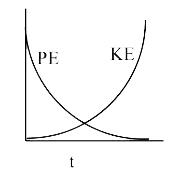
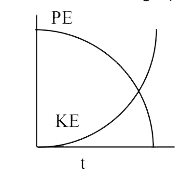
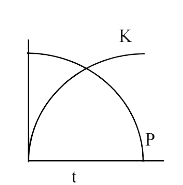
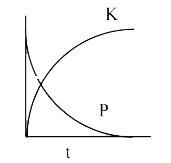
A particle falls from rest under gravity. Its potential energy with respect to the ground (PE) and its kinetic energy (KE) are plotted against time (t). Choose the correct graph.

A

B

C

D

Text Solution

AI Generated Solution

The correct Answer is:

To solve the problem of a particle falling from rest under gravity and to analyze its potential energy (PE) and kinetic energy (KE) with respect to time (t), we can follow these steps: ### Step 1: Understand the Initial Conditions The particle starts from rest at a height \( h \). Therefore, at \( t = 0 \): - Potential Energy (PE) = \( mgh \) (maximum) - Kinetic Energy (KE) = 0 (minimum) ### Step 2: Analyze the Motion of the Particle As the particle falls under the influence of gravity: - The potential energy decreases as the height decreases. - The kinetic energy increases as the particle gains speed. ### Step 3: Write the Equations for PE and KE 1. **Potential Energy (PE)**: The potential energy at any height \( h \) is given by: \[ PE = mgh \] As the particle falls, the height \( h \) decreases. The height at time \( t \) can be expressed using the equation of motion: \[ h(t) = h - \frac{1}{2}gt^2 \] Therefore, the potential energy as a function of time becomes: \[ PE(t) = mg\left(h - \frac{1}{2}gt^2\right) = mgh - \frac{1}{2}mgt^2 \] 2. **Kinetic Energy (KE)**: The velocity \( v \) of the particle at time \( t \) is given by: \[ v(t) = gt \] The kinetic energy can be expressed as: \[ KE = \frac{1}{2}mv^2 = \frac{1}{2}m(gt)^2 = \frac{1}{2}mg^2t^2 \] ### Step 4: Determine the Nature of the Graphs - **Potential Energy (PE)**: The equation \( PE(t) = mgh - \frac{1}{2}mgt^2 \) is a downward-facing parabola because the coefficient of \( t^2 \) is negative. It starts at a maximum value \( mgh \) when \( t = 0 \) and decreases to 0 as the particle reaches the ground. - **Kinetic Energy (KE)**: The equation \( KE(t) = \frac{1}{2}mg^2t^2 \) is an upward-facing parabola because the coefficient of \( t^2 \) is positive. It starts at 0 when \( t = 0 \) and increases as the particle falls. ### Step 5: Choose the Correct Graph Based on the analysis: - The graph of potential energy (PE) will be a downward-facing parabola starting from \( mgh \) at \( t = 0 \) and approaching 0 as \( t \) increases. - The graph of kinetic energy (KE) will be an upward-facing parabola starting from 0 at \( t = 0 \) and increasing indefinitely as time progresses. Thus, the correct graph will show: - PE as a downward parabola starting from \( mgh \). - KE as an upward parabola starting from 0. ### Conclusion The correct option is the one that shows the potential energy decreasing from \( mgh \) to 0 and the kinetic energy increasing from 0 to a maximum value as time progresses. ---

To solve the problem of a particle falling from rest under gravity and to analyze its potential energy (PE) and kinetic energy (KE) with respect to time (t), we can follow these steps: ### Step 1: Understand the Initial Conditions The particle starts from rest at a height \( h \). Therefore, at \( t = 0 \): - Potential Energy (PE) = \( mgh \) (maximum) - Kinetic Energy (KE) = 0 (minimum) ### Step 2: Analyze the Motion of the Particle ...
Promotional Banner

Topper's Solved these Questions

  • ENERGY & MOMENTUM

    VMC MODULES ENGLISH|Exercise Level - 1 PARAGRAPH QUESTIONS|3 Videos
  • ENERGY & MOMENTUM

    VMC MODULES ENGLISH|Exercise LEVEL - 2|48 Videos
  • ENERGY & MOMENTUM

    VMC MODULES ENGLISH|Exercise LEVEL - 0 - LONG ANSWER TYPE|5 Videos
  • ELECTROSTATICS

    VMC MODULES ENGLISH|Exercise JEE Advanced (Archive)|89 Videos
  • GASEOUS STATE & THERMODYNAMICS

    VMC MODULES ENGLISH|Exercise JEE ADVANCED (ARCHIVE )|111 Videos

Similar Questions

Explore conceptually related problems

Potential energy (PE_(n)) and kinetic energy (KE_(n)) of electron in nth orbit are related as

A body performs S.H.M. Its kinetic energy K varies with time t as indicated by graph

When an apple falls from a tree what happens to its gravitational potential energy just as it reaches the ground? After it strikes the ground?

A freely falling object eventually stops on reaching the ground. What happens to its kinetic energy ?

An alpha particle is accelerated from rest through a potential difference of 100 volt. Its final kinetic energy is

A particle starts moving from the origin & moves along positive x-direction. Its rate of change of kinetic energy with time shown on y-axis varies with time t as shown in the graph. If position, velocity acceleration & kinetic energy of the particle at any time t are x,v a & k respectively then which of the option (s) may be correct ?

For a simple pendulum, a graph is plotted between itskinetic energy (KE) and potential energy (PE) against its displacement d . Which one of the following represents these correctly? (graph are schematic and not drawn to scale)

A particle is released from height H . At certain height from the ground its kinetic energy is twice its gravitational potential energy. Find the height and speed of particle at that height.

A particle starts moving from rest the origin & moves along positive x- direction . Its rate of change of kinetic energy with time shown on y- axis veries with time t as shown in the graph. If position, velocity , acceleration & kinetic energy of the particle at any time t are x,v,a,& k respectively then which of the option (s) may be correct ?

The potential energy of a projectile at its maximum height is equal to its kinetic energy there. Its range for velocity of projection u is

VMC MODULES ENGLISH-ENERGY & MOMENTUM-Level - 1
  1. For a block of mass m to slide without friction up the rise of height ...

    Text Solution

    |

  2. A rectangular block is mobing along a frictionless path, when it encou...

    Text Solution

    |

  3. A particle falls from rest under gravity. Its potential energy with re...

    Text Solution

    |

  4. A particle of mass m is released from height h on smooth quarter circu...

    Text Solution

    |

  5. A block is released from the top of two inclined rough surfaces of hei...

    Text Solution

    |

  6. A particle is given an initial speed u inside a smooth spherical shell...

    Text Solution

    |

  7. A small object of mass m, on the end of a light cord, is held horizont...

    Text Solution

    |

  8. A particle is rotated in vertical circle by connecting it to string f...

    Text Solution

    |

  9. A heavy particle of weight w, attached to a fixed point by a light ine...

    Text Solution

    |

  10. Two springs A and B(kA=2kB) are stretched by applying forces of equal ...

    Text Solution

    |

  11. A block of mass m is initially moving to the right on a horizontal fri...

    Text Solution

    |

  12. A horizontal 50 N force acts on a 2 kg crate which is at rest on a smo...

    Text Solution

    |

  13. The speed v reached by a car of mass m in travelling a distance x, dri...

    Text Solution

    |

  14. The first graph shows the potential energy U(x) for a particle moving...

    Text Solution

    |

  15. Potential energy of a particle is related to x coordinate by equation ...

    Text Solution

    |

  16. A particle of mass 15 kg has an initial velocity vecv(i) = hati - 2 ha...

    Text Solution

    |

  17. A U-shaped wire has a semicircular bending between A and B as shown in...

    Text Solution

    |

  18. Two carts (A and B), having spring bumpers, collide as shown. Cart A h...

    Text Solution

    |

  19. An open water tight railway wagon of mass 5xx10^(3) kg coasts at initi...

    Text Solution

    |

  20. A 64-kg woman stands on frictionless ice. She kicks a 0.10-kg stone ba...

    Text Solution

    |
