Home
Class 12
PHYSICS
A small block of mass 1kg is released fr...

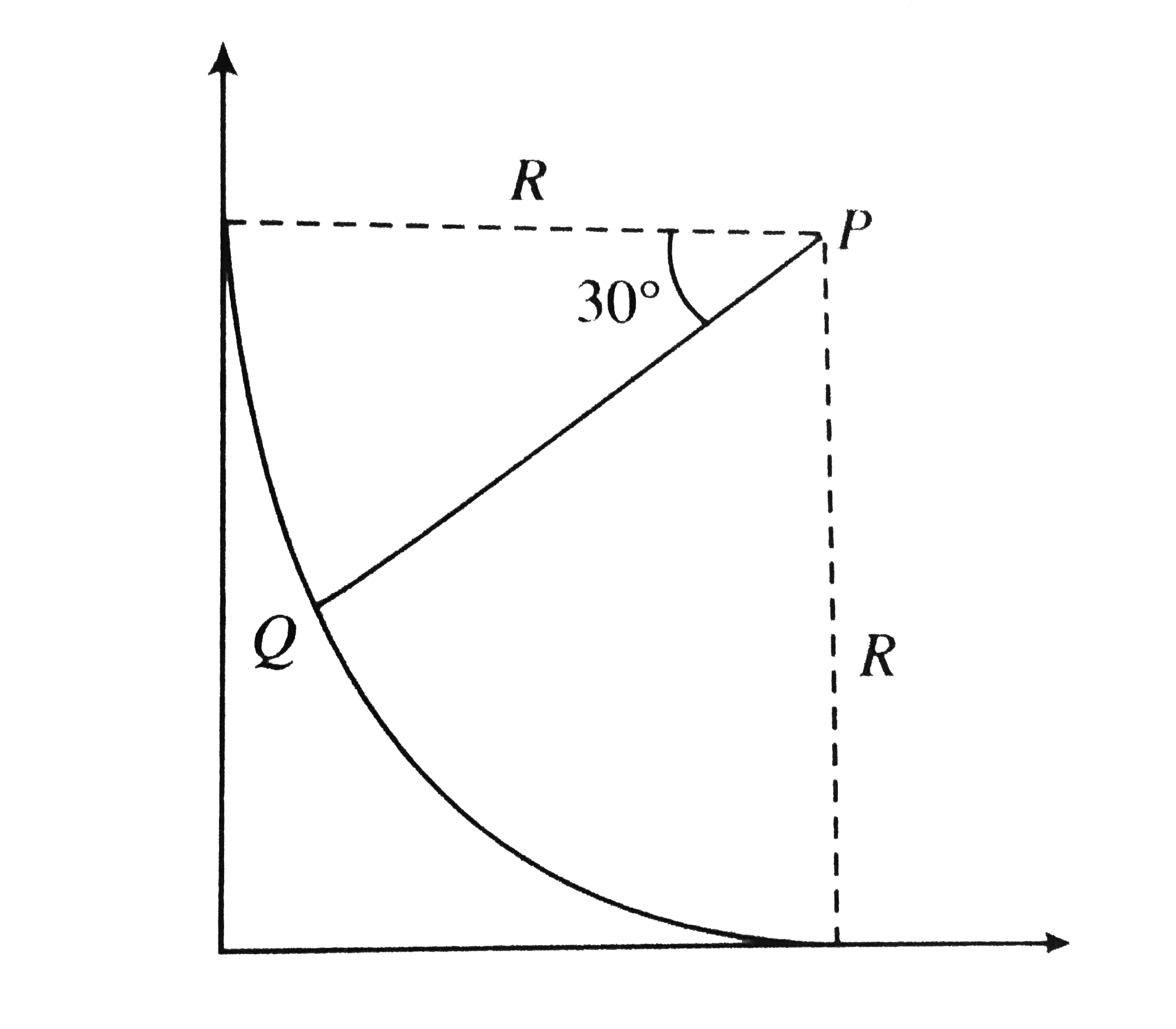
A small block of mass `1kg` is released from rest at the top of a rough track. The track is circular arc of radius `40m`. The block slides along the track without toppling and a frictional force acts on it in the direction opposite to the instantaneous velocity. The work done in overcoming the friction up to the point Q, as shown in figure. is `150J`. (Take the acceleration due to gravity, `g=10ms^-2`)

The speed of the block when it reaches the point Q is

A

`5 ms^(-1)`

B

`10 ms^(-1)`

C

`10sqrt(3) ms^(-1)`

D

`20 ms^(-1)`

Text Solution

Verified by Experts

The correct Answer is:

B

Using work energy theorem
`mg R sin 30^@ = W_f = 1/2 mv^2 , " "200 - 150 = (v^2)/2 =< v = 10 ms^(-1)` .
Promotional Banner

Topper's Solved these Questions

  • ENERGY & MOMENTUM

    VMC MODULES ENGLISH|Exercise JEE ADVANCE (ARCHIVE) - ASSERTION & REASON TYPE|1 Videos
  • ENERGY & MOMENTUM

    VMC MODULES ENGLISH|Exercise JEE ADVANCE (ARCHIVE) - MATCH MATRIX TYPE|1 Videos
  • ENERGY & MOMENTUM

    VMC MODULES ENGLISH|Exercise JEE ADVANCE (ARCHIVE)|80 Videos
  • ELECTROSTATICS

    VMC MODULES ENGLISH|Exercise JEE Advanced (Archive)|89 Videos
  • GASEOUS STATE & THERMODYNAMICS

    VMC MODULES ENGLISH|Exercise JEE ADVANCED (ARCHIVE )|111 Videos

Similar Questions

Explore conceptually related problems

A small block of mass 1 kg is a circular are of ratius 40 m . The block sides along the track without topping and a frictionnal force acts on it in the direction opposite in the instrmens velocity . The work done in evercoming the friction up to the point Q as shown is the figure below is 150 J (Take the acceleration due to gravity g = 10 ms^(-2)) The speed of the block when it reaches the point Q is

A small block of mass 1 kg is a circular are of ratius 40 m . The block sides along the track without topping and a frictionnal force acts on it in the direction opposite in the instrmens velocity . The work done in evercoming the friction up to the point Q as shown is the figure below is 150 J (Take the acceleration due to gravity g = 10 ms^(-2)) The magnitude of the normal reaction that acts on the block at the point Q is

A block of mass 4kg is released from the top of a rough inclines plane of height 10 m . If velocity of the block is 10 m//s at the bottom of the inclined then work done by the friction force on the block will be

A small blockofmass 'm' is released from rest at the top of a rough inclined plane as shown The coefficient of friction between the block and inclined plane is 'mu' Using work-energy theorem, find the speed of block as it passes the lowest point.

A block is released from rest at the top of an inclined plane which later curves into a circular track of radius r as shown in figure. Find the minimum height h from where it should be released so that it is able to complete the circle.

A block f mas 1 kg is placed at the point A of a rough track shown in figure. If slightly pushed towards right, it stos at the point B of the track. Calculate the work done by the frictional force on the block during its transit from A to B.

A block of mass 1 kg slides down a vertical curved track that is one quadrant of a circle of radius 1m. Its speed ast the the bottom si 2 m//s . The work done by frictional force is :

Figure shows a smooth vertical circular track AB of radius R. A block slides along the surface AB when it is given a velocity equal to sqrt(6gR) at point A. The ratio of the force exerted by the track on the block at point A to that at point B is

A bead of mass m is released from rest at A to move along the fixed smooth circular track as shown in figure. The ratio of magnitudes of centripetal force and normal reaction by the track on the bead at any point P_0 described by the angle theta(!=0) would

A small of mass m starts from rest at the position shown and slides along the frictionless loop the loop track of radius R. What is the smallest value of y such that the object will slide without losing contact with the track?
