Home
Class 12
CHEMISTRY
The combustion of 0.2 mol of liquid carb...

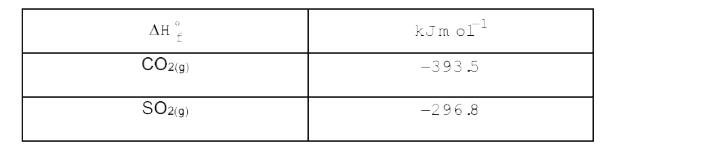
The combustion of 0.2 mol of liquid carbon disulphide `CS_2` to give `CO_2(g) and SO_2(g)` releases 215 kJ of heat. What is `Delta H_(f)^(@) "for" CS_(2(l)) "in" kJmol^(-1)` :

A

772.1

B

87.9

C

-385

D

-475

Text Solution

Verified by Experts

The correct Answer is:

B

`CS_2 + 3O_(2) rarr CO_(2) + 2SO_(2)`
0.2 mole of `CS_2 = 215 kJ` of heat
1 mole of `CS_(2) = (215)/(0.2) = 1075 kJ` of heat
`Delta H_("comb") = 2 Delta H_(f)(SO_2) + Delta H_(f)(CO_2) - DeltaH_(f)(CS_2)`
`1075 = 2(-28=96.8) + (-393.5) - Delta H_(f)(CS_2)`
`1075 = 2(-296.8) + (-393.5) - Delta H_(f)(CS_2)`
`DeltaH_(f) (CS_2) = 2(-296.8) + (-393.5)-1075 = 87.9 kJ//mol`.
Promotional Banner

Topper's Solved these Questions

  • THERMOCHEMISTRY

    VMC MODULES ENGLISH|Exercise JEE MAIN (ARCHIVE)|20 Videos
  • THERMOCHEMISTRY

    VMC MODULES ENGLISH|Exercise JEE ADVANCED (ARCHIVE)|31 Videos
  • THERMOCHEMISTRY

    VMC MODULES ENGLISH|Exercise LEVEL-1|75 Videos
  • THEORY OF SOLUTIONS

    VMC MODULES ENGLISH|Exercise JEE Advanced (Archive)|31 Videos
  • THERMODYNAMICS

    VMC MODULES ENGLISH|Exercise JEE ADVANCED (ARCHIVE)|44 Videos

Similar Questions

Explore conceptually related problems

The enthalpy change for the combustion of N_(2)H_(4)(l) (Hydrazine) is -622.2 kJ mol^(-1) . The products are N_(2)(g) and H_(2)O(l) . If Delta_(f)H^(Theta) for H_(2)O(l) is -285.8 kJ mol^(-1) . The Delta_(f)H^(Theta) for hydrazine is

Calculate the boiling point of a solution containing 0.61 g of benzoic acid in 50 g of carbon disulphide assuming 84% dimerization of the acid. The boiling point and K_(b) of CS_(2) are 46.2^(@)C and 2.3 kg mol^(-1) .

The combustion of 1 mol of benzene takes place at 298 K and 1 atm . After combustion, CO_(2)(g) and H_(2)O(l) are produced and 3267.0 kJ of heat is librated. Calculate the standard entalpy of formation, Delta_(f)H^(Θ) of benzene Given: Delta_(f)H^(Θ)CO_(2)(g) = -393.5 kJ mol^(-1) Delta_(f)H^(Θ)H_(2)O(l) = -285.83 kJ mol^(-1) .

When 12.0g of carbon (graphite)reacted with oxygen to form CO and CO_(2) at 25^(@)C and constant pressure, 252 kJ of heat was released and no carbon remained. If Delta H_(f)^(0)(CO,g)= -110.5 kJ mol^(-1) and Delta H_(f)^(0)(CO_(2),g)= -393.5 kJ mol^(-1) ,calculate the mass of oxygen consumed.

Calculate the standard heat of formation of C_2H_5OH(l) from the following data: (a) C_2H_5OH (l) + 2O_2(g) to 2CO_2(g) + 3H_2O (l) , DeltaH^@ = - 1366.5 kJ (b) Delta_f H^@ [ CO_2] = -393.5 kJ mol^(-1), Delta_f H^@ [ H_2O(l)] = -285.5 kJ mol^(-1) .

The heat librerated on complete combustion of 1 mole of CH_(4) gas to CO_(2)(g) and H_(2)O(l) is 890 kJ. Calculate the heat evolved by 2.4 L of CH_(4) on complete combustion. ( 1 mol of CH4 at 298K and 1 atm= 24L)

The combustion of benzene (l) gives CO_(2)(g) and H_(2)O(l) . Given that heat of combustion of benzene at constant volume is –3263.9 kJ mol^(–1) at 25^(@)C , heat of combustion (in kJ mol^(–1) ) of benzene at constant pressure will be (R = 8.314 JK–1 mol–1)

The combustion of benzene(/) gives CO_2(g) and H_2O(l) Given that heat of combustion of benzene at constant volume is -3263.9 kJ mol^(-1) at 25^@C , heat of combustion (in kJ mol^(-1) ) of benzene at constant pressure will be (R = 8.314 JK^(-1) mol^(-1))

CH_4(g) + 2O_2(g) to CO_2(g) + 2H_2O(g), Delta H = -809 kJ The calorific value of 1 kg of CH_4(g) is ………… kJ/kg.

Calculate the heat of combustion of eithene CH_(2) = CH_(2)(g) + 3O_(2)(g) rarr 2CO_(2)(g) + 2H_(2)O(I) The bond energy data are given below C = C = 619 kJ mol^(-1) C - H = 414 kJ mol^(-1) O = O = 499 kJ mol^(-1) C = O = 724 kJ mol^(-1) O - H = 460 kJ mol^(-1)

VMC MODULES ENGLISH-THERMOCHEMISTRY-LEVEL-2
  1. From given following equations and DeltaH^(@) values, determine the en...

    Text Solution

    |

  2. NH(3)(g) + 3Cl(2)(g) rarr NCl(3)(g) + 3HCl(g), " "DeltaH(1) N(...

    Text Solution

    |

  3. The combustion of 0.2 mol of liquid carbon disulphide CS2 to give CO2(...

    Text Solution

    |

  4. Estimate the average S -F bond energy in SF(6). The values of standard...

    Text Solution

    |

  5. Heat of atomisation of NH(3) and N(2)H(4) are "x kcal mol"^(-1) and "...

    Text Solution

    |

  6. 2Fe+(3)/(2)O(2)rarr Fe(2)O(3)" "xkJ//mol e 2Fe+O(2) rarr 2FeO" ...

    Text Solution

    |

  7. The heat of reaction for N(2)+3H(2) rarr 2NH(3) at 27^(@)C is -91.94kJ...

    Text Solution

    |

  8. The heat evolved in the combustion of benzene is given by C(6)H(6) (...

    Text Solution

    |

  9. If x(1) , x(2) and x(3) are enthalpies of H-H , O=O and O-H bonds resp...

    Text Solution

    |

  10. Calculate the resonance enegry of N(2)O form the following data Delt...

    Text Solution

    |

  11. When a certain amount of ethylene was combusted, 6226 kJ heat was evol...

    Text Solution

    |

  12. For which one of the following equations DeltaH(r)^(@) equal to DeltaH...

    Text Solution

    |

  13. The enthalpy of hydrogenation for 1-pentene is +126 kJ/mol. The enthal...

    Text Solution

    |

  14. 1.0litre sample of a mixture of CH(4) and O(2) measured at 25^(@)C and...

    Text Solution

    |

  15. The commercial production of water gas utilizes the reaction under sta...

    Text Solution

    |

  16. Calculate the heat of neutralisation from the following data: 200mL ...

    Text Solution

    |

  17. A cylinder of gas is assumed to contain 11.6 kg of butane (C4H10). If ...

    Text Solution

    |

  18. The heat of combusion of glycogen is about 476 kJ mol^(-1) of carbon. ...

    Text Solution

    |

  19. Given the equilibrium system NH(4)Cl(s)hArr NH(4)^(+)(aq)+Cl^(-)(aq)...

    Text Solution

    |

  20. Difference between the heats of reaction at constant pressure and a co...

    Text Solution

    |
