Home
Class 12
CHEMISTRY
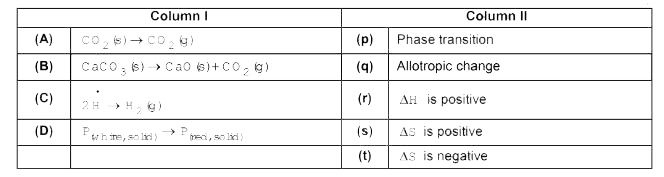
Match the transformation in Column I wit...

Match the transformation in Column I with appropriate option in Column II.

Text Solution

Verified by Experts

`[A to p,r,s] [B to r,s] [C to t][D to p,q,t]`
(A) `CO_(2)(s) to CO_(2)(g)`
It is just a phase transition (sublimation) as no chemical change has occurred. Sublimation is always endothermic. Products is gas, more disordered, hence `DeltaS` is positive
(B) `CaCO_(3)(g) to CaO(s) + CO_(2)(g)`
It is a chemical decomposition, not a phase change. Thermal decomposition occur at the expense of energy, hence endothermic. Product contain a gaseous species, hence, `DeltaS gt 0`
(C ) `2H to H_(2)(g)`
A new H-H covalent bond is being formed, hence, `DeltaH lt 0`. Also, product is less disordered than reactant, `DeltaS lt 0` .
(D) Allotropes are considered as different phase, hence `P_("white, solid") to P_("red, solid")` is a phase transitions as well as allotropic change.
Also, red phophorus is more ordered than while phosphorus, `S lt 0`
Promotional Banner

Topper's Solved these Questions

  • THERMODYNAMICS

    VMC MODULES ENGLISH|Exercise JEE (MAIN ARCHIVE)|32 Videos
  • THERMOCHEMISTRY

    VMC MODULES ENGLISH|Exercise JEE ADVANCED (ARCHIVE)|31 Videos
  • THERMODYNAMICS & THERMOCHEMISTRY

    VMC MODULES ENGLISH|Exercise Impeccable|48 Videos

Similar Questions

Explore conceptually related problems

Match the reactions in Column I with appropriate options in Column II.

Match the statement in Column I to the appropriate statement(s) from Column II.

Match the given compounds in Column-I with their appropriate descriptions given in Column II.

Match the items of column -I with the appropriate items of column -II

Match the column I with Column II and mark the appropriate choice

Match the column I with Column II and mark the appropriate choice.

Match the column I with Column II and mark the appropriate choice.

Match the column I with Column II and mark the appropriate choice.

Match the column I with Column II and mark the appropriate choice.

Match the column I with Column II and mark the appropriate choice.

VMC MODULES ENGLISH-THERMODYNAMICS-JEE ADVANCED (ARCHIVE)
  1. Among the following the state function(s) is (are):

    Text Solution

    |

  2. One mole of an ideal gas is taken from a to b along two paths denoted ...

    Text Solution

    |

  3. To an evacuated vessel with movable piston under external pressure of ...

    Text Solution

    |

  4. Match the transformation in Column I with appropriate option in Column...

    Text Solution

    |

  5. Match the thermodynamic processes given under column I with the expres...

    Text Solution

    |

  6. For an ideal gas, consider only P-V work in going from an initial stat...

    Text Solution

    |

  7. The reversible expansion of an ideal gas under adiabatic and isotherma...

    Text Solution

    |

  8. A fixed mass ‘m’ of a gas is subjected to transformation of states fro...

    Text Solution

    |

  9. The pair of isochoric among the transformation of state is :

    Text Solution

    |

  10. An ideal gas in a thermally insulated vessel at internal pressure =P(1...

    Text Solution

    |

  11. For the process, H(2)O(l) to H(2)O(g)

    Text Solution

    |

  12. Thermal decomposition of gaseous X(2) to gaseous X at 298K takes place...

    Text Solution

    |

  13. Thermal decomposition of gaseous X(2) to gaseous X at 298 K takes plac...

    Text Solution

    |

  14. The standard state Gibbs free energies of formation of ) C(graphite an...

    Text Solution

    |

  15. For a reaction taking place in a container in equilibrium with its sur...

    Text Solution

    |

  16. A thermo-dynamical system is changed from state (P(1),V(1)) to (P(2),...

    Text Solution

    |

  17. Which of the following lines correctly show the temperature dependence...

    Text Solution

    |

  18. An ideal gas undergoes a cyclic process as shown in figure .

    Text Solution

    |

  19. A reversible cyclic process for an ideal gas is shown below. Here, P, ...

    Text Solution

    |

  20. For a reaction A to P, the plots of [A] and [P] with time at temperatu...

    Text Solution

    |
