Home
Class 12
CHEMISTRY
A thermo-dynamical system is changed fro...

A thermo-dynamical system is changed from state `(P_(1),V_(1))` to `(P_(2),V_(2))` by two different process. The quantity which will remain same will be

A

The work done on the gas is maximum when it is compressed irreversibly from `(p_(2),V_(2))` to `(p_(1),V_(1))` against constant pressure `p_(1)`.

B

The change in internal energy of the gas is (i) zero, if it explained reversibly with `T_(1) = T_(2)`, and (ii) positive, if it is expanded reversibly under adiabatic conditions with `T_(1) ne T_(2)`.

C

If the expansion is carried out freely, it is simultaneously both isothermal as well as adiabatic

D

The work done by the gas is less when it is expanded reversibly from `V_(1)` to `V_(2)` under adiabatic conditions as compared to that when expanded reversibly from `V_(1)` to `V_(2)` under isothermal conditions.

Text Solution

Verified by Experts

The correct Answer is:
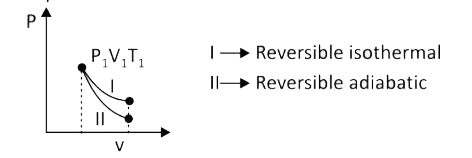
acd

`underset(p_(1),V_(1),T_(1))("statement-1") overset("Expansion") to underset(P_(2),V_(2),T_(2))("statement-2")`
`rArr` Work done in reversible compression process is smaller than the work done in irreversible compression process.
`rArr DeltaU =0` for reversible isothermal expression.
`DeltaU lt 0` for reversible adiabatic expansion.
`rArr` For free expansion q=0, w=0 and `DeltaU=0`, hence it is simultaneously both isothermal `(DeltaU=0)` as well as adiabatic (q=0)
`rArr` Work done in reversible adiabatic expansion is less than the work done in reversible isothermal expansion as shown in figure.
Promotional Banner

Topper's Solved these Questions

  • THERMODYNAMICS

    VMC MODULES ENGLISH|Exercise JEE (MAIN ARCHIVE)|32 Videos
  • THERMOCHEMISTRY

    VMC MODULES ENGLISH|Exercise JEE ADVANCED (ARCHIVE)|31 Videos
  • THERMODYNAMICS & THERMOCHEMISTRY

    VMC MODULES ENGLISH|Exercise Impeccable|48 Videos

Similar Questions

Explore conceptually related problems

Directions: The following question has four choices out of which ONLY ONE is correct. A thermodynamical system is changed from state ( P^1, V^1 ) to ( P^², V^² ) by two different processes, the quantity which will remain same is:

A system changes from the state (P_(1),V_(1)) to (P_(2),V_(2)) as shown in the diagram. The work done by the system is

A thermodynamic system goes from states (i) P_(1),V to 2P_(1),V (ii) P,V_(1) to P2 ,V_(1) . Then work done in the two cases is

An ideal gas is expand from (p_(1),V_(1),T_(1)) to (p_(2),V_(2),T_(2)) under different conditions. The correct statement(s) among the following is (are):

A system can be taken from the initial state p_(1),V_(1) to the final state p_(2,V_(2) by two different methods, let DeltaQ and DeltaW represent the heat given to the system and the work done by the system. Which of the following must be the same in both the method?

Assertion: When ideal gas expand from P_(1), V_(1), T_(1), to P_(2), V_(2), T_(2) two steps, and work done is high in which number of steps are high Reason: Work is path function

A gas with (c_(p))/(c_(V))=gamma goes from an intial state (p_(1), V_(1), T_(1)) to a final state (p_(2), V_(2), T_(2)) through an adiabatic process. The work done by the gas is

One mole of hydrogen, assumed to be ideal, is adiabatically expanded from its initial state (P_(1), V_(1), T_(1)) to the final state (P_(2), V_(2), T_(2)) . The decrease in the internal energy of the gas during this process will be given by

The state of a mole of an ideal gas changed from state A at pressure 2P and volume V follows four different processes and finally returns to initial state A reversibly as shown below in the graph. By interpreting the graph, answer the following questions. Which is the kind of process followed from state A to state, B ?

The state of a mole of an ideal gas changed from state A at pressure 2P and volume V follows four different processes and finally returns to initial state A reversibly as shown below in the graph. By interpreting the graph, answer the following questions. Which is the kind of process followed from state A to state, B ?

VMC MODULES ENGLISH-THERMODYNAMICS-JEE ADVANCED (ARCHIVE)
  1. Among the following the state function(s) is (are):

    Text Solution

    |

  2. One mole of an ideal gas is taken from a to b along two paths denoted ...

    Text Solution

    |

  3. To an evacuated vessel with movable piston under external pressure of ...

    Text Solution

    |

  4. Match the transformation in Column I with appropriate option in Column...

    Text Solution

    |

  5. Match the thermodynamic processes given under column I with the expres...

    Text Solution

    |

  6. For an ideal gas, consider only P-V work in going from an initial stat...

    Text Solution

    |

  7. The reversible expansion of an ideal gas under adiabatic and isotherma...

    Text Solution

    |

  8. A fixed mass ‘m’ of a gas is subjected to transformation of states fro...

    Text Solution

    |

  9. The pair of isochoric among the transformation of state is :

    Text Solution

    |

  10. An ideal gas in a thermally insulated vessel at internal pressure =P(1...

    Text Solution

    |

  11. For the process, H(2)O(l) to H(2)O(g)

    Text Solution

    |

  12. Thermal decomposition of gaseous X(2) to gaseous X at 298K takes place...

    Text Solution

    |

  13. Thermal decomposition of gaseous X(2) to gaseous X at 298 K takes plac...

    Text Solution

    |

  14. The standard state Gibbs free energies of formation of ) C(graphite an...

    Text Solution

    |

  15. For a reaction taking place in a container in equilibrium with its sur...

    Text Solution

    |

  16. A thermo-dynamical system is changed from state (P(1),V(1)) to (P(2),...

    Text Solution

    |

  17. Which of the following lines correctly show the temperature dependence...

    Text Solution

    |

  18. An ideal gas undergoes a cyclic process as shown in figure .

    Text Solution

    |

  19. A reversible cyclic process for an ideal gas is shown below. Here, P, ...

    Text Solution

    |

  20. For a reaction A to P, the plots of [A] and [P] with time at temperatu...

    Text Solution

    |

