Home
Class 12
CHEMISTRY
Which is not the graphical representatio...

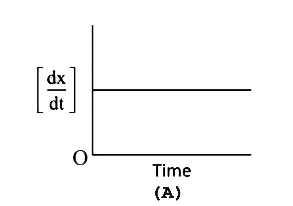
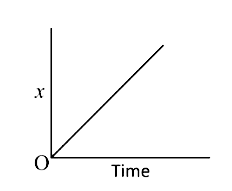
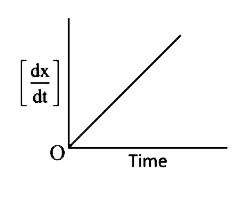
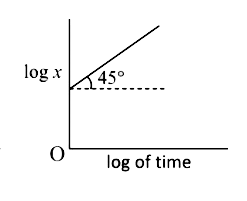
Which is not the graphical representation for the zeroth order reaction ?

A

B

C

D

Text Solution

AI Generated Solution

The correct Answer is:

To determine which graphical representation is not appropriate for a zero-order reaction, we need to understand the characteristics of zero-order kinetics. ### Step-by-step Solution: 1. **Understanding Zero-order Reactions**: - In a zero-order reaction, the rate of reaction (R) is constant and does not depend on the concentration of the reactants. This can be expressed mathematically as: \[ R = k \] where \( k \) is the rate constant. 2. **Graphical Representations**: - **Rate vs. Concentration**: Since the rate is constant and does not depend on concentration, plotting the rate (dx/dt) against concentration will yield a horizontal line (a straight line parallel to the x-axis). - **Rate vs. Time**: The rate remains constant over time, so this plot will also be a horizontal line. - **Concentration vs. Time**: For a zero-order reaction, the concentration of the reactant decreases linearly over time. This will yield a straight line with a negative slope. - **Log(Concentration) vs. Time**: This plot will not yield a straight line for a zero-order reaction. Instead, it will be a curve since the logarithm of a linear function does not produce a linear graph. 3. **Identifying the Incorrect Representation**: - Based on the analysis: - **Option 1**: Rate vs. Concentration - Correct representation (horizontal line). - **Option 2**: Rate vs. Time - Correct representation (horizontal line). - **Option 3**: Rate vs. Time - Incorrect representation (this is the same as option 1). - **Option 4**: Log(Concentration) vs. Time - Incorrect representation (not a straight line). 4. **Conclusion**: - The graphical representation that is not appropriate for a zero-order reaction is the one that plots Log(Concentration) vs. Time. Therefore, the answer is **Option 3**.

To determine which graphical representation is not appropriate for a zero-order reaction, we need to understand the characteristics of zero-order kinetics. ### Step-by-step Solution: 1. **Understanding Zero-order Reactions**: - In a zero-order reaction, the rate of reaction (R) is constant and does not depend on the concentration of the reactants. This can be expressed mathematically as: \[ R = k ...
Promotional Banner

Topper's Solved these Questions

  • CHEMICAL KINETICS

    VMC MODULES ENGLISH|Exercise Level-2|50 Videos
  • CHEMICAL KINETICS

    VMC MODULES ENGLISH|Exercise Level-2 ( Numerical Value Type for JEE Main )|15 Videos
  • CHEMICAL KINETICS

    VMC MODULES ENGLISH|Exercise Level-0 (Long Answer Type )|6 Videos
  • CHEMICAL EQUILIBRIUM

    VMC MODULES ENGLISH|Exercise IN-CHAPTER EXERCISE - G|10 Videos
  • CHEMICAL THERMODYNAMICS

    VMC MODULES ENGLISH|Exercise IN - CHAPTER EXERCISE - L|10 Videos

Similar Questions

Explore conceptually related problems

Which is the true graphical representation of V vs 1/P

When HCl (aq) is titrated with NaOH(aq) conductometrically then the graphical representation of the titration will be

Give a graphical representation of the C_(4) cycle.

Which of the following graph is correct for a zero order reaction ?

Give a graphic representation of the C_3 cycle.

Which of the following is the correct cell representation for the given cell reaction ? Zn+H_2SO_4 to ZnSO_4 + H_2

In the following graphical representation for the reaction A rarr B , there are two types of regions:

Which is the correct graphical representation based on photoelectric effect ?

Symbolic representation of a chemical reaction.

Which of the following graph is correct for zero order reaction?

VMC MODULES ENGLISH-CHEMICAL KINETICS -Level-1
  1. Resistance increases with increases in temperature for

    Text Solution

    |

  2. the disintegration rate of a certain radioactive sample at any int...

    Text Solution

    |

  3. Which is not the graphical representation for the zeroth order reactio...

    Text Solution

    |

  4. The half-life of 2 sample are 0.1 and 0.4 seconds. Their respctive con...

    Text Solution

    |

  5. The activation energy for most of the reaction is approximately 50 kJ ...

    Text Solution

    |

  6. For the reaction : 2A + B rarr C + D, measurement of the rate of the r...

    Text Solution

    |

  7. A substance undergoes first order decomposition. The decomposition fol...

    Text Solution

    |

  8. For reaction aA rarr xP, when [A] = 2.2 mM, the rate was found to be 2...

    Text Solution

    |

  9. A chemical reaction involves two reacting species. The rate of reactio...

    Text Solution

    |

  10. The rate of reaction between two reactants A and B decreases by facto...

    Text Solution

    |

  11. For a first-order reaction A rarr B the reaction rate at reactant conc...

    Text Solution

    |

  12. The rate constant for a chemical reaction has unit litre mol^(-1) sec^...

    Text Solution

    |

  13. Which of the following reaction ends in finite time ?

    Text Solution

    |

  14. A+ 2B rarr C+D." If "-(d[A])/(dt)=5xx10^(-4)" mol L"^(-1) s^(-1)," the...

    Text Solution

    |

  15. In a reaction A rarr products , when start is made from 8.0 xx 10^(-2...

    Text Solution

    |

  16. 2N(2)O(5)to4NO(2)+O(2). The rate of reaction in terms of N(2)O(5) will...

    Text Solution

    |

  17. For the reaction , Cl(2)+2I^(-) rarr I(2)+2Cl^(-), the initial concent...

    Text Solution

    |

  18. In the reaction 3Ararr2B, rate of reaction +(d[B])/(dt) is equal to :

    Text Solution

    |

  19. For the reaction N2+3H2rarr2NH3 , the rate of change of concentration ...

    Text Solution

    |

  20. The reaction, 2SO(2(g)) + O(2(g))hArr2SO(3(g)) is carried out in a 1 d...

    Text Solution

    |
