Home
Class 12
PHYSICS
Four charges q(1)=q(2)=-q(3)=-q(4)=q a...

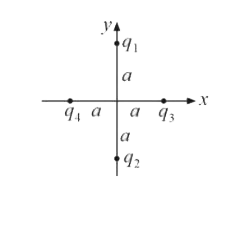
Four charges `q_(1)=q_(2)=-q_(3)=-q_(4)=q` are arranged in the y-plane forming an elastic quadrupole. Bringing these charges from infinity, what is the needed work to compose such an arrangement?

A

`k(q)/(a)(1-2sqrt(2))`

B

`k(q^(2))/(a) (2sqrt(2))`

C

`k(q^(2))/(2a)(1-2sqrt(2))`

D

`k(q^(2))/(a) (1-2sqrt(2))`

Text Solution

Verified by Experts

The correct Answer is:

D

The electrostatic energy required to compose such a system is given as follows
`U=(k)/(2) sum_(i ne j) (q_(i)q_(j))/(r_(ij))`
Where `r_(ij)=|r_(i)-r_(j)|`
Inserting data from the figure to equation (i), we get,
`U=((q_(1)q_(2))/(r_(12))+(q_(1)q_(3))/(r_(13))+(q_(1)q_(4))/(r_(14))+(q_(2)q_(4))/(24)+(q_(2)q_(3))/(r_(23))+(q_(3)q_(4))/(r_(34)))k`
`=k(q^(2))/(a)((1)/(2)-(1)/(sqrt(2))-(1)/(sqrt(2))-(1)/(sqrt(2))-(1)/(sqrt(2))+(1)/(sqrt(2)))=k(q^(2))/(a)(1-2sqrt(2))`
Promotional Banner

Topper's Solved these Questions

  • MOCK TEST 8

    VMC MODULES ENGLISH|Exercise PHYSICS (SECTION 2)|5 Videos
  • MOCK TEST 7

    VMC MODULES ENGLISH|Exercise PHYSICS (SECTION 2)|5 Videos
  • MOCK TEST 9

    VMC MODULES ENGLISH|Exercise PHYSICS (SECTION 2)|5 Videos

Similar Questions

Explore conceptually related problems

Four charges q_(1) = 1 muC,q_(2)=2 muC,q_(3)=-3 muC and q_(4)=4 muC are kept on the vertices of a square of side 1 m . Find the electric potential energy of this system of charges.

Four equal charges Q are placed at the four corners of a square of each side is 'a'. Work done in removing a charge -Q from its centre to infinity is

Four positive charges (2sqrt2-1)Q are arranged at the four corners of a square. Another charge q is placed at the centre of the square. Resulting force acting on each corner charge is zero if q is

Three charges -q,+2q, and -q are arranged on a line as shown in fig. Calculate the field at a distance rgtgta on the line.

Suppose that three point charges q_(a), q_(b) and q_(c) are arranged at the vertices of a right -angled triangle as shown . What is the absolute electric potential at the position of the third charge if q_(a)=- 6.0 mu C , q_(b)=+4.0muC , q_(c)=+2.0 mu C , a= 4.0 m and b=3.0 m ? Suppose that the third charge which is initially at rest is repelled to infinity by the combined electric field of the other two charges which are held fixed . What is the final final kinetic energy of the third charge ?

Four charges Q_(1), Q_(2), Q_(3) and Q_(4) of same magnitude are fixed along the x axis at x=-2a, -a, +a and +2a , respectively. A positive charge q is placed on the positive y axis at a distance b gt 0 . Four options of the signs of these charges are given in List I. The direction of the forces on the charge q is given in List II. Match List I with List II and select the correct answer using the code given below the lists. {:(,"List-I",,,"List-II"),((P),Q_(1)","Q_(2)","Q_(3)","Q_(4) "all positive",,(1),+x),((Q),Q_(1)","Q_(2) " positive, "Q_(3)","Q_(4)" negative",,(2),-x),((R),Q_(1)","Q_(4)" positive ,"Q_(2)","Q_(3)" negative",,(3),+y),((S),Q_(1)","Q_(3)" positive , "Q_(2)","Q_(4)" negative",,(4),-y):}

Two electric charges q_(1) = q and q_(2) = -2q are placed at a distance l = 6a apart. Find the locus of points in the plane of the charges where the field potential is zero

Three charges -q_(1), +q_(2) and -q_(3) are placed as shown in the figure. The x -component of the force on -q_(1) is proportional to

Four point charges q_(A) = 2 mu C , q_(B) = -5 mu C, q_(C) = 2 mu C and q_(D) = -5 mu C are located at the corners of a square ABCD of side 10 cm. What is the force on a charge of 1 mu C placed at the center of the square ?

Four charges of +q, +q +q and +q are placed at the corners A, B, C and D of s square. The resultant force on the charge at D
