Home
Class 12
MATHS
Let alpha, beta be the roots of equat...

Let ` alpha, beta ` be the roots of equation ` x ^ 2 - x + 1 = 0 ` and the matrix ` A = (1 ) /(sqrt3 ) |{:(1,,1,,1),(1,,alpha,,alpha ^2),(1,,beta,,-beta^ 2):}| ` , the value of det ` (A. A^T)` is

A

`1/3`

B

`1`

C

`-1`

D

`3`

Text Solution

Verified by Experts

The correct Answer is:
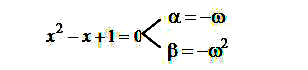
C

`because`
`A=1/sqrt3[(1,1,1),(1,-omega,-omega^2),(1,-omega^2,-omega^4)], det(A.A^T)=|A|^2`
`=1/3|(1,-1,-1),(1,omega,omega^2),(1,omega^2,omega)| , because omega^3=1 , 1+omega+omega^2=0`
`=1/3(omega^2-omega^4+omega-omega^2+omega-omega^2)^2`
`=1/3(omega-omega^2)^2 = 1/3(omega^2+omega^4-2omega^3)`
`=1/3(-1-2)=-1`
det `(A.A^T)`=-1
Promotional Banner

Topper's Solved these Questions

  • MOCK TEST 10

    VMC MODULES ENGLISH|Exercise MATHEMATICS (SECTION 2)|5 Videos
  • MOCK TEST 1

    VMC MODULES ENGLISH|Exercise PART III : MATHEMATICS (SECTION-2)|10 Videos
  • MOCK TEST 11

    VMC MODULES ENGLISH|Exercise MATHEMATICS (Section-2)|5 Videos

Similar Questions

Explore conceptually related problems

Let alpha, and beta are the roots of the equation x^(2)+x +1 =0 then

Let alpha be a root of the equation x ^(2) + x + 1 = 0 and the matrix A = ( 1 ) /(sqrt3) [{:( 1,,1,,1),( 1,, alpha ,, alpha ^(2)), ( 1 ,, alpha ^(2),, alpha ^(4)):}] then the matrix A ^( 31 ) is equal to :

Let alpha, beta are the roots of the equation x^(2)+x+1=0 , then alpha^3-beta^3

If alpha, beta are roots of the equation x^(2) + x + 1 = 0 , then the equation whose roots are (alpha)/(beta) and (beta)/(alpha) , is

If alpha,beta are the roots of the equation x^(2)+x+1=0 , find the value of alpha^(3)-beta^(3) .

alpha and beta are the roots of the equation x^(2) - 3x + 5 = 0 , the equation whose roots are (1)/(alpha) and (1)/(beta) is:

If alpha, beta are the roots of x^2 - sqrt(3)x + 1 = 0 then alpha^(21) + beta^(21) is:

Let alpha and beta be the roots of the equation x^(2) + x + 1 = 0 . Then, for y ne 0 in R. [{:(y+1, alpha,beta), (alpha, y+beta, 1),(beta, 1, y+alpha):}] is

Let alpha and beta , be the roots of the equation x^2+x+1=0 . The equation whose roots are alpha^19 and beta^7 are:

If alpha, beta are the roots of 2x^(2) + 5x + 2 = 0 , then the equation with roots (1)/(alpha+1), (1)/(beta+1) is

