Home
Class 12
BIOLOGY
Answer any two of the following : (i) ...

Answer any two of the following :
(i) Draw a longitudinal section of the pistil of an angiosperm showing the growth of pollen tube up to the micropyle of ovule, Label (a) stigma, (b) embryo sac, (c) pollen tube, (d) micropyle,
(ii) Explain the events that occurs, up to fertilisation, when the compatible pollen grain lands on the stigma.

Text Solution

Verified by Experts
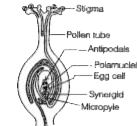
(i)
(ii) The sequence of events that occur when a compatible pollen grain lands on stigma are as follows:
(a) Pollen-pistil interactions Once the compatible pollen grain lands on stigma which is receptive, it recognises and accepts the pollen with the aid of chemical components, interacting with pollen.
(b) Germination of pollen grain Once the pollen is recognised, it germinates on the stigma. of flower. The tube cell of pollen grain protrudes out through germ pores to form a .pollen tube. The generative cell divides to form two male gametes and are released into the tube.
(c) Growth of pollen tube The pollen tube grows down through the tissues of stigma and style and enters ovule, usually through micropyle end of ovule. Inside ovule, the filiform apparatus guides the pollen tube, carrying gametes to the egg.
(d) Double fertilisation After releasing the two male gametes into the synergids, one of them fuses with egg to form a diPloid zygote (syngamy) and other male gamete fuses with diploid polar nuclei to form triploid primary endosperm cell (triple fusion). Because of occurrence of these two types of fusions, this event is called double fertilisation.
Promotional Banner

Topper's Solved these Questions

  • VERY SIMILAR TEST 4

    ARIHANT PRAKASHAN|Exercise SECTION B (ZOOLOGY) (GROUP A)|10 Videos
  • VERY SIMILAR TEST 4

    ARIHANT PRAKASHAN|Exercise SECTION B (ZOOLOGY) (GROUP B)|9 Videos
  • VERY SIMILAR TEST 4

    ARIHANT PRAKASHAN|Exercise SECTION A (BOTANY) (GROUP B)|9 Videos
  • VERY SIMILAR TEST 2

    ARIHANT PRAKASHAN|Exercise Section - B (Zoology)|26 Videos
  • VERY SIMILAR TEST 5

    ARIHANT PRAKASHAN|Exercise SECTION B (ZOOLOGY) GROUP C|7 Videos

Similar Questions

Explore conceptually related problems

Consider the following statements. (i) Polyspermy may bring about fertilisation of egg by more than one male nucleus or the supernumerary sperms may fertilise other components of embryo sac much as synergids or antipodals. (ii) In angiosperms, pollen tube is normally an unbranched structure which ususally persists after fertilisation. (iii) Intine is the inner, pectocellulosic layer of pollen grain wall which is destroyed during acetolysis. (iv) Exine layer of pollen grain comprises of an outer non-sculptured layer sexine and an inner sculptured layer tectum. Which of the following combinations of above given statements is correct ?

Given below are four statements (A-D) each with one or two blanks. Select option which correctly fills up the blanks in any two statements. (A) Multiple ovulation ul(i) transfer teachnology is for ul(ii) improvement. (B) In it a cow is administered ul(i) to induce follicular maturation and ul(ii) ovulation. (C) Instead of one egg per cycle, ul(i) eggs are produced through it. (D) The fertilised ul(i) at ul(ii) celled stages are recovered non-surgically and transferred to surrogate mothers.

In the tropical rainforest, the majority of trees have showy animal-pollinated flowers. In temperate forests the majority of trees are wind pollinated. Which factors best explain these contrasting patterns ? (i) Wind is rare in tropical forests. (ii) Because of high species diversity in the tropics, individuals of trees species are often widely separated making wind an inefficient means of pollen dispersal. (iii) More opportunities for coevolved mutualisms exist in tropical forests because of the high diversity of animal species. (iv) Trees in tropical forests are mostly evergreen and year-round leaf canopies impede pollen dispersal by wind. (v) Flowering in tropical forests occurs over a short period of time when wind is absent. (a) (i) , (ii) and (v) (b) (i),(iii) and (v) (c) (ii), (iii) and (iv) (d) (ii) and (iv)

