Home
Class 12
MATHS
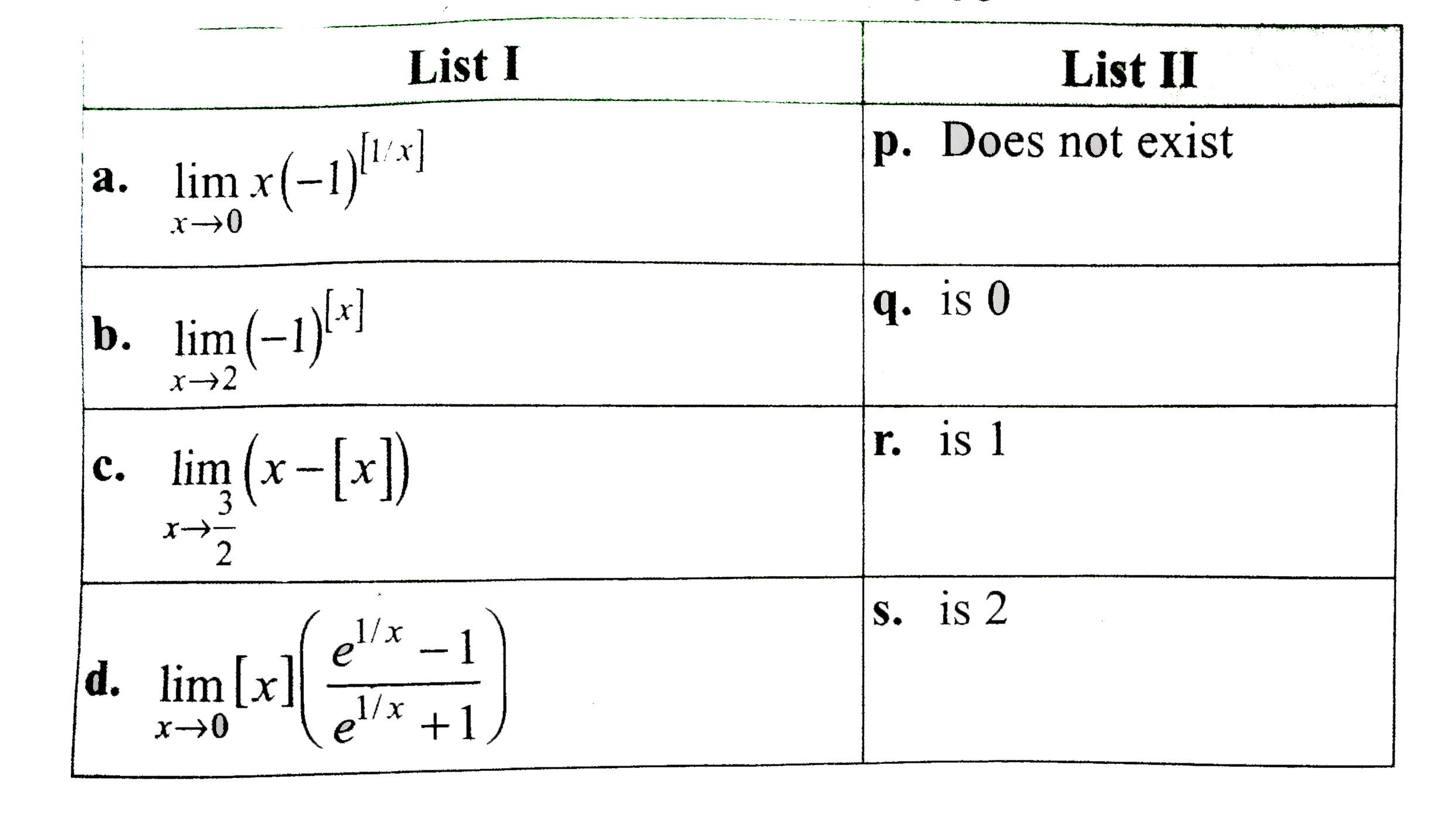
Match the following lists (where [x] rep...

Match the following lists (where `[x]` represents the greatest integer function) and then choose the correct code.

Codes :
`{:(,"a b c d"),((1),"s r q p"),((2),"q p s p"),((3), "s r p q"),((4),"p p q r"):}`

Text Solution

Verified by Experts

The correct Answer is:

`(2)`

a. `underset(xto0)lims(-1)^([1//x])`
`L.H.L.=underset(hto0)lim(0-h)(-1)^([(1)/(0-h)])=0`
`R.H.L.=underset(hto0)lim(0+h)(-1)^([(1)/(0+h)])=0`
b. `underset(xto2)lim(-1)^([x])`
`L.H.L.=underset(hto0)lim(-1)^([2-h])=(-1)^(1)=-1`
`R.H.L.=underset(hto0)lim(-1)^([2+h])=(-1)^(2)=1`
So limit does not exist.
c.`underset(xto(3)/(2))lim(x-[x])`
`L.H.L.=underset(hto0)lim(3)/(2)-h-[(3)/(2)-h]=underset(hto0)lim(3)/(2)-h-1=(1)/(2)`
`R.H.L.=underset(hto0)lim(3)/(2)+h-[(3)/(2)+h]=underset(hto0)lim(3)/(2)+h-1=(1)/(2)`
`L.H.L.=R.H.L.=(1)/(2)`
`underset(xto0)lim[x]((e^(1//x)-1)/(e^(1//x)+1))`
`L.H.L.=underset(hto0)lim[0-h](((1)/(e^(0-h)-1))/((1)/(e^(0-h)+1)))`
`=underset(hto0)lim[-h]((e^(-(1)/(h))-1)/((1)/(e^(0-h)+1)))=(-1)xx(-1)=1`
R.H.L.`=underset(hto0)lim[0+h]((e^((1)/(h))-1)/(e^((1)/(h)+1)))=0`
Limit does not exist
Promotional Banner

Topper's Solved these Questions

  • LIMITS

    CENGAGE|Exercise Exercise (Numerical)|23 Videos
  • LIMITS

    CENGAGE|Exercise JEE Main Previous Year|8 Videos
  • LIMITS

    CENGAGE|Exercise Exercise (Comprehension)|20 Videos
  • JEE 2019

    CENGAGE|Exercise Chapter 10|9 Videos
  • LINEAR COMBINATION OF VECTORS, DEPENDENT AND INDEPENDENT VECTORS

    CENGAGE|Exercise DPP 1.2|10 Videos

Similar Questions

Explore conceptually related problems

Consider a DeltaABC in which sides AB and AC are perpendicular to x-y-4=0 and 2x-y-5=0, repectively. Vertex A is (-2, 3) and the circumcenter of DeltaABC is (3/2, 5/2). The equation of the line in List I is of the form ax+by+c=0, where a,b,c in I. Match it with the corresponding value of c in list II and then choose the correct code. Codes : {:(a, b, c, d),(r, s, p, q),(s, r, q, p),(q, p, s, r),(r, p, s, q):}

Consider int(x^(3)+3x^(2)+2x+1)/(sqrt(x^(2)+x+1))dx =(ax^(2)+bx+c)sqrt(x^(2)+x+1)+lambda int(dx)/(sqrt(x^(2)+x+1)) Now, match the following lists and then choose the correct code. Codes: {:(,a,b,c,d),((1),q,p,s,r),((2),s,p,q,r),((3),r,q,p,s),((4),q,s,p,r):}

Verify whether the following compound propositions are tautologies or contradictions or contingency ((p to q) vv (q to r)) to (p to r)

Refer to the given figure and identify the parts labelled P,Q,R and S.

If the p^(th) term if an A.P. is q and the q^(th) term of an A.P is p then the r^(th) term is

If p+q+r=0=a+b+c =0, then the value of the determnalnt |p a q b r c q c r a p b r b p c q a|i s a 0 b. p a+q b+r c c. 1 d. none of these

Construct the truth table for the followings statements : (a) (p^^q) to ~ p " " (b) (p^^q) to (pvvq) (c) (p^^q) to r " " (d) [p^^(~r)] to (qvvr)

If the inverse of implication p to q is defined as ~ p to ~q , then the inverse of the proposition ( p ^^ ~ q) to r is
