Home
Class 11
PHYSICS
A particle of mass 2 kg moves on a circu...

A particle of mass 2 kg moves on a circular path with constant speed 10 m`//` s . Find change in speed and magnitude of change in velocity. Whan particle completes half revolution.

Text Solution

Verified by Experts
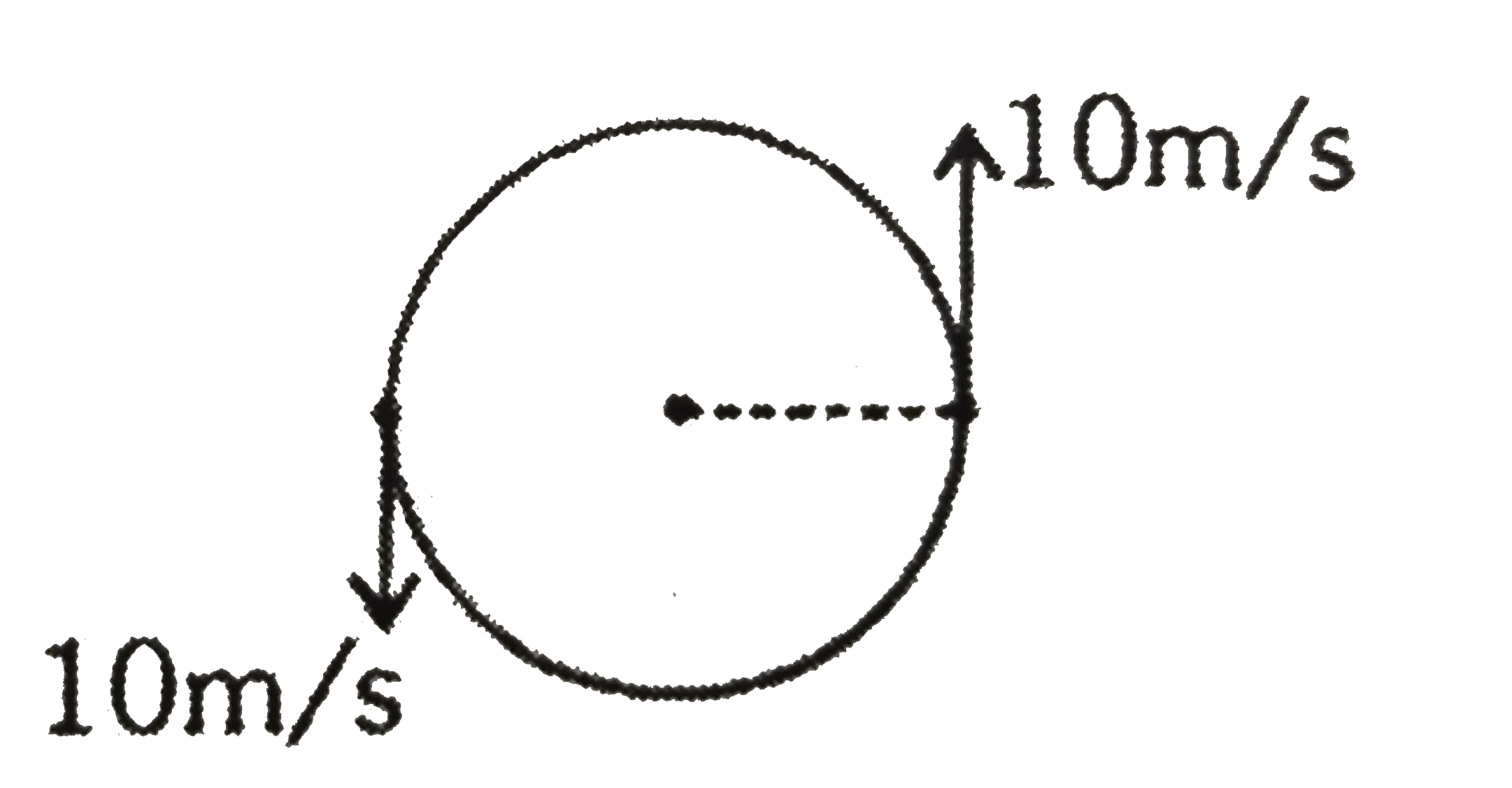
Change in speed
` Delta v = 10 - 10 =0`
Change in velocity
`Deltavecv= vecv_l - vecv_i`
`= 10 hatj - (-10hatj) = 20 hatj`
Magnitude `|Delta vecv| = 20 m//s`
Promotional Banner

Topper's Solved these Questions

  • KINEMATICS (MOTION ALONG A STRAIGHT LINE AND MOTION IN A PLANE)

    ALLEN |Exercise BEGINNER S BOX-3|2 Videos
  • KINEMATICS (MOTION ALONG A STRAIGHT LINE AND MOTION IN A PLANE)

    ALLEN |Exercise BEGINNER S BOX-4|6 Videos
  • KINEMATICS (MOTION ALONG A STRAIGHT LINE AND MOTION IN A PLANE)

    ALLEN |Exercise BEGINNER S BOX-1|6 Videos
  • KINEMATICS

    ALLEN |Exercise EXERCISE-2|89 Videos
  • MISCELLANEOUS

    ALLEN |Exercise Question|1 Videos

Similar Questions

Explore conceptually related problems

An alpha particle of mass m moves on a circular path of radius r in a plane inside and normal to uniform magnetic field B. The time taken by this particle to complete one revolution is ________

A particle is moving in a circle of radius r with speed v as shown in the figure. The magnitude of change in velocity in moving from P to Q is

The circular motion of a particle with constant speed is……….

A particle is moving along a circular along a circular path of radius 5 m with a uniform speed 5ms^(-1) . What will be the average acceleration when the particle completes half revolution?

For particle moving on circular path with constant speed angle between instantaneous velocity and instantaneous acceleration will be …... .

Electric charge Q having mass M moves on a circular path of radius R with velocity vecv , perpendicular to uniform magnetic field B. When a particle completes one revolution, work done by the field is _______

A particle of mass 1 kg moves in a circular path of radius 1 m such that its speed varies with time as per equation v=3t^(2)m//s where time t is in seconds. The power delivered by the force acting on the paritcle at t=1s , is :-

A particle moves with constant speed v along a regular hexagon ABCDEF in the same order. Then the magnitude of the avergae velocity for its motion form A to

A particle is moving with constant speed v along the line y = a in positive x -direction. Find magnitude of its angular velocity about orgine when its position makes an angle theta with x-axis.

