Home
Class 11
PHYSICS
A particle goes from point A to point B,...

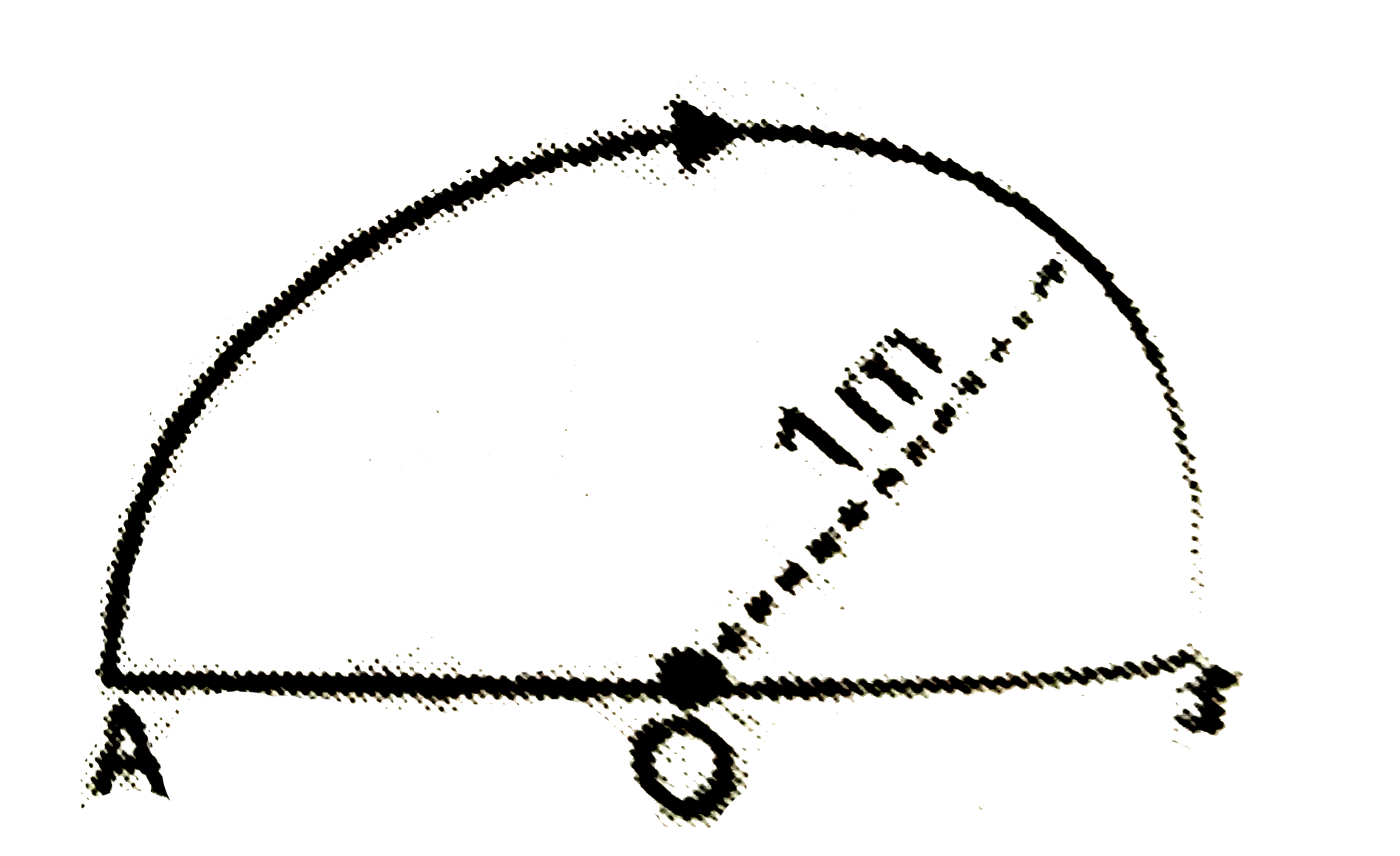
A particle goes from point A to point B, moving in a semicircle of radius 1 m in 1 second. Find the magnitude of its average velocity.

Text Solution

Verified by Experts

Average velocity
`" "= ("Net displacement")/("total time")= (AO + OB)/(time)`
`" "=(1+1)/(1) = 2m//s`
Promotional Banner

Topper's Solved these Questions

  • KINEMATICS (MOTION ALONG A STRAIGHT LINE AND MOTION IN A PLANE)

    ALLEN |Exercise BEGINNER S BOX-3|2 Videos
  • KINEMATICS (MOTION ALONG A STRAIGHT LINE AND MOTION IN A PLANE)

    ALLEN |Exercise BEGINNER S BOX-4|6 Videos
  • KINEMATICS (MOTION ALONG A STRAIGHT LINE AND MOTION IN A PLANE)

    ALLEN |Exercise BEGINNER S BOX-1|6 Videos
  • KINEMATICS

    ALLEN |Exercise EXERCISE-2|89 Videos
  • MISCELLANEOUS

    ALLEN |Exercise Question|1 Videos

Similar Questions

Explore conceptually related problems

In 1.0 s , a particle goes from point A to point B , moving in a semicircle of radius 1.0 m (see figure ). The magnitude of the average velocity

In one second, a particle goes from point A to point B moving in a semicircle (Fig). Find the magnitude of the average velocity.

A particle goes along a quadrant of a circle of radius 10m from A to B as shown in fig. Find the magnitude of displacement and distance along the path AB, and angle between displacement vector and x-axis ?

A particle is moving in a circle of radius r with speed v as shown in the figure. The magnitude of change in velocity in moving from P to Q is

A particle is moving with constant speed v along the line y = a in positive x -direction. Find magnitude of its angular velocity about orgine when its position makes an angle theta with x-axis.

The fig. shows the displacement time graph of a particle moving on a straight line path. What is the magnitude of average velocity of the particle over 10 seconds?

Assertion: Average speed of a particle in a given time interval is never less than the magnitude of the average velocity. Reason: The magnitude of the velocity (instantaneous velocity) of a particle is equal to its speed.

A particle moves in a straight line with a uniform acceleration a. Initial velocity of the particle is zero. Find the average velocity of the particle in first 's' distance.

A particle is performing circular motion of radius 1 m. Its speed is v=(2t^(2)) m//s . What will be magnitude of its acceleration at t=1s .

A particle of mass 2 kg moves on a circular path with constant speed 10 m // s . Find change in speed and magnitude of change in velocity. Whan particle completes half revolution.
