Home
Class 12
MATHS
Suppose that two circles C(1) and C(2) i...

Suppose that two circles `C_(1)` and `C_(2)` in a plane have no points in common. Then

A

there is no line tangent to both `C_(1)` and `C_(2)`

B

there are exactly four lines tangent to both `C_(1)` and `C_(2)`

C

there are no lines tangent to both `C_(1)` and `C_(2)` or there are exactly two lines tangent to both `C_(1)` and `C_(2)`

D

there are no lines tangent to both `C_(1)` and `C_(2)` or there are exactly four lines tangent to both `C_(1)` and `C_(2)`

Text Solution

Verified by Experts

The correct Answer is:
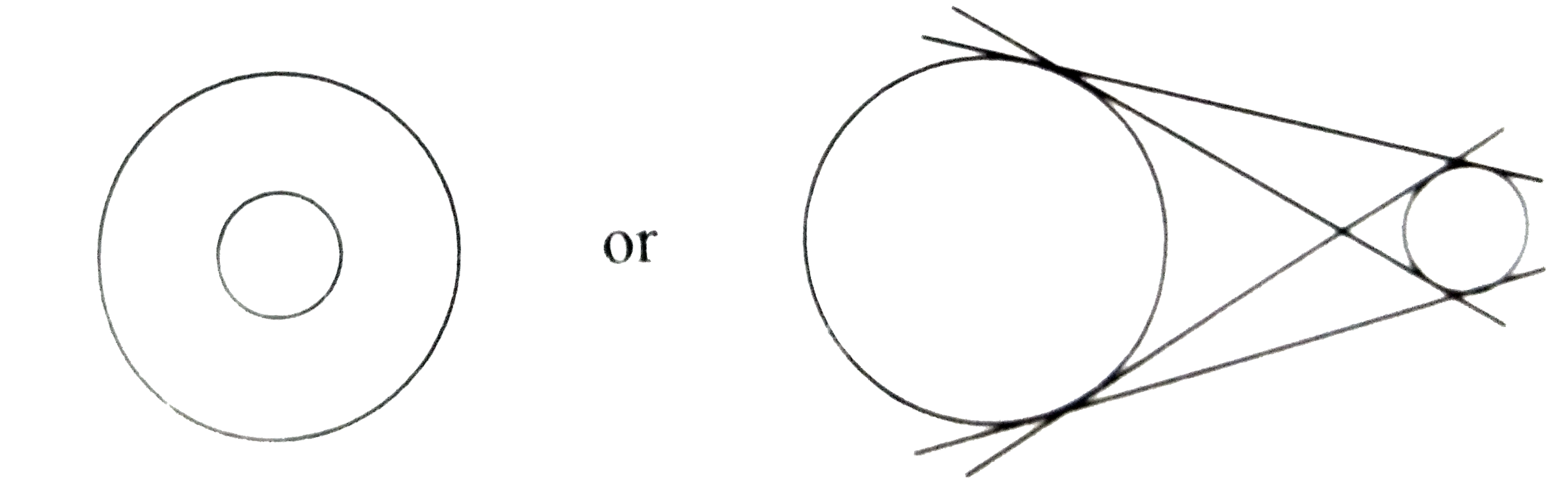
D

Since `C_(1)` and `C_(2)` in a plane have no points in common, either one circle is completely lying inside other without touching it or two circles are external without intersection or touching as shown in the following figure.
Promotional Banner

Topper's Solved these Questions

  • CIRCLES

    CENGAGE PUBLICATION|Exercise Multiple Correct Answers Type|9 Videos
  • CIRCLES

    CENGAGE PUBLICATION|Exercise Comprehension Type|8 Videos
  • CIRCLE

    CENGAGE PUBLICATION|Exercise For problems 3 and 4|2 Videos
  • COMPLEX NUMBERS

    CENGAGE PUBLICATION|Exercise MULTIPLE CORRECT ANSWER TYPE|6 Videos

Similar Questions

Explore conceptually related problems

The planes have infinite points common among them if ___

Let C_1 be the circle with center O_1(0,0) and radius 1 and C_2 be the circle with center O_2(t ,t^2+1),(t in R), and radius 2. Statement 1 : Circles C_1a n dC_2 always have at least one common tangent for any value of t Statement 2 : For the two circles O_1O_2geq|r_1-r_2|, where r_1a n dr_2 are their radii for any value of tdot (a) Statement 1 and Statement 2 are correct. Statement 2 is the correct explanation for the Statement 1 (b) Statement 1 and Statement 2 are correct. Statement 2 is not the correct explanation for the Statement 1 (c) Statement 1 is true but Statement 2 is false (d) Statement 2 is true but Statement 1 is false

C_1 and C_2 are circle of unit radius with centers at (0, 0) and (1, 0), respectively, C_3 is a circle of unit radius. It passes through the centers of the circles C_1a n dC_2 and has its center above the x-axis. Find the equation of the common tangent to C_1a n dC_3 which does not pass through C_2dot

Transverse common tangents are drawn from O to the two circles C_1,C_2 with 4, 2 respectively. Then the ratio of the areas of triangles formed by the tangents drawn from O to the circles C_1 and C_2 and chord of contacts of O w.r.t the circles C_1 and C_2 respectively is

The circle C1 : x^2 + y^2 = 3 , with center at O, intersects the parabola x^2 = 2y at the point P in the first quadrant. Let the tangent to the circle C1 at P touches other two circles C2 and C3 at R2 and R3, respectively. Suppose C2 and C3 have equal radii 2sqrt(3) and centers Q2 and Q3, respectively.If Q_2 and Q_3 lies on the y-axis, then find Q_(2)Q_(3)=12 and R_(2)R_(3)=4sqrt(6)

Two circles touch each other externally at the point C. AB is a common tangent to both the circels and touches the circle at the points A and B. Then the value of angle ABC is [GP-X]

Two circles C_1 and C_2 intersect at two distinct points P and Q in a line passing through P meets circles C_1 and C_2 at A and B , respectively. Let Y be the midpoint of A B and Q Y meets circles C_1 and C_2 at X a n d Z respectively. Then prove that Y is the midpoint of X Z

The centre of two circle are P and Q they intersect at the points A and B. The straight line parallel to the line segment PQ through the point A intersects the two circles at the point C and D Prove that CD = 2PQ

Consider the points O(0,0), A(0,1) , and B(1,1) in the x-y plane. Suppose that points C(x,1) and D(1,y) are chosen such that 0ltxlt1 . And such that O,C, and D are collinear. Let the sum of the area of triangles OAC and BCD be denoted by S. Then which of the following is/are correct?.

